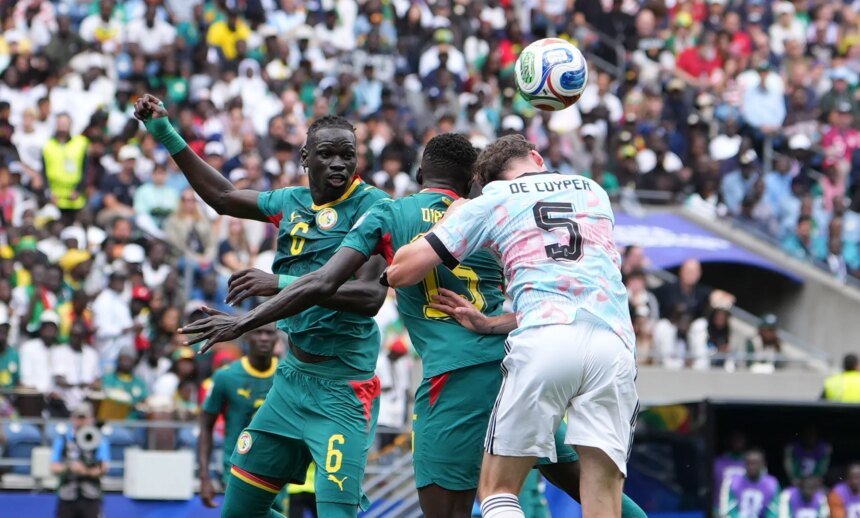
Senegal had to hold out for only a few minutes, while holding on to the two goals they had beaten Belgium, in order to write a new page in their football history, but that did not happen. Belgium player Romelu Lukaku scored the goal to reduce the difference in the 86th minute, then Youri Tielemans equalized after only three minutes, before the match was decided with a penalty kick in the final moments of extra time, causing Senegal to lose the match after being on the verge of passing to the round of 16.
Several hours before this football surprise, the Democratic Republic of Congo experienced another version of the same problem, as it took the lead over England in the seventh minute, and held on for a long time, and for a period of the match seemed as if it was on its way to one of the biggest surprises of the World Cup, but Harry Kane equalized the score in the 75th minute, then scored the winning goal four minutes before the end, so the match ended 2-1 in favor of England.
Read also
list of 2 itemsend of list
Here we are faced with two defeats that are different in detail, similar in context. A team approaches something big, then retreats, and at that moment things get mixed up. There are certainly factors related to skill, experience, technical quality, fitness, the bench, coaches’ substitutions, referees’ decisions, details of spaces, and even luck itself (in the Senegal match, the penalty kick played this role, for example), but it is not the only thing. There is an important psychological aspect that teaches us a lot about “last-minute goals,” and what happens inside the player’s mind when victory becomes so close.

The final minutes are not a normal stretch of the game
If you are a beginner in following football matches, its loyal fans, those who have watched thousands of matches, will tell you: “The match does not end before the referee’s whistle.” They have learned this in easy and difficult ways. In fact, a study published in 2025 by American scientists, which analyzed more than 3,400 matches in 21 leagues and championships, fully confirms their words.
The study found that goal scoring is not evenly distributed over the minutes of the match. As it progresses, the goal rate tends to rise, while fewer goals appear than expected in the first minutes of each half. This means that the match does not remain “the same match” in time, and what happens in the last quarter-hour is not merely a continuation of what happened in the quarter-hour that preceded it, but rather enters into a different context in which several factors change, such as the energy of the players, the size of the risk, the form of the tactic, and the mental state of the players.
The study did not only look at the timing of the first goal or each goal separately, but rather examined the time intervals between one goal and another. The research team found that goals tend to be close together in time, meaning that the goal does not always come as a completely separate event, but rather is part of a short wave within the match.
“The team that scores a goal may become more likely to score again after a short period.”
In this context, the team that scores may become more likely to score again after a short period. This enters into what the researchers call in their study “impulsive dynamics.” When a late goal enters the goal of an advanced team, it may open a new stage psychologically and tactically, where the returning team becomes more emboldened, and the team that was in the lead retreats or becomes nervous, thus generating minutes in which the probability of the next goal is higher than what reading the score alone suggests.
This is very important to understand what happened in the match between Senegal and Belgium, for example. Belgium’s first goal was a psychological event that completely redefined the match, because before the 86th minute, Senegal was in the position of managing a victory, and after that it was in the position of trying to prevent a collapse, and between the two cases there is a huge difference in attention, the decisions of the coach and the players, and even in things such as breathing rates, body movements, and the entire psychological state.
The study does not say that the reason is only psychological, as it is ultimately a temporal analysis of goals and not a psychological experiment, but it indicates that this pattern may reflect an interplay between several factors, including physical fatigue at the end of the match, tactical changes, increased risk on the part of the late team, and perhaps psychological momentum, as the team that just scored becomes more courageous, and the team that was waiting for victory becomes more fearful.
Psychological momentum
From this standpoint, when Belgium scored its first goal against Senegal, it created momentum, and psychological momentum is a concept studied by sports psychology as a change in the players’ perception of the course of the match after a decisive event, whatever the form of this event. For example, in a study on the impact of a late equalizer in a knockout match, published in the journal Science & Medicine in Football, researchers conducted an experiment on 86 players at competitive levels of soccer. They were asked to imagine a scenario in which they were playing in an important final match.
The experiments went as follows: some of them imagined that their team was trailing by a goal (the score is 1-0 for the other team) and then scored a draw, and some of them imagined that their team was ahead (the score was 1-0 for their team) and then received a draw. In both cases, the tie occurred either in the 61st minute or in the 92nd minute. After that, the researchers measured the players’ sense of psychological momentum through various questions about which team was closer to winning, which team was the most confident, which was the most frustrated, which was the most enthusiastic, and which was in control of the match.
The result was the same in all scenarios (1-1), but the feeling of the players was never the same. If the player’s team was the one who scored a tie, his sense of psychological momentum increased, but if the opponent was the one who scored, this feeling decreased, as recorded by the psychological questionnaires of the study.
“The team that scores late seems to have suddenly improved, while the capabilities of the team that conceded the goal have declined.”
More importantly, the timing of the goal doubled the effect. When the player’s team scored the equalizer in the 92nd minute, the psychological momentum was much higher than if it scored in the 61st minute, and when his team scored the equalizer in the 92nd minute, the psychological momentum was much worse than if it scored in the 61st minute. Calculating the numbers, the average momentum when the same team scored the equalizer in the 92nd minute was 6.00 compared to 4.47 when scoring in the 61st minute, while it fell to 2.53 when the opponent scored the equalizer in The 92nd minute, compared to 3.50 when he scored in the 61st minute.
This explains why the team that scores late seems as if it has suddenly developed, with its players running more, demanding the ball more, and entering tackles with more confidence. In contrast, the team that conceded the goal looks as if its capabilities have declined, not necessarily because it has lost its fitness, but because it has lost some of its interpretation of the match, as it used to tell itself that it was succeeding, and getting close, and then it began to say: “Maybe what we feared will happen.”

Approach mentality and avoidance mentality
This last sentence may be the beginning of the collapse, as the matter is more complicated than we might imagine at first glance. In sports psychology, there is a fundamental difference between the approach mindset and the avoidance mindset. The player in the approach mindset asks himself how to create an opportunity, how to receive, how to get out with the ball, and how to kill the opposing team’s dreams of a third goal. As for the player in the avoidance mindset, he asks himself questions such as: What if I make a mistake? What if I was the reason my team was eliminated from the World Cup? What if everything is lost now and we lose?
This type of message from the player to himself affects everything, and this idea appears clearly in studies of penalty kicks. In a famous study by Geir Jordt, from the Norwegian School of Mathematical Sciences, and Esther Hartmann from the University of Groningen in the Netherlands, the two researchers analyzed 36 penalty shootout series at the World Cup, European Nations Cup, and Champions League, with a total of 359 kicks, and studied the relationship between situational pressure, avoidance behavior, and performance.
“Players scored higher when the kick gave their team victory, but performance decreased when the kick was to avoid elimination.”
Not only did Geir and Esther say that some players get nervous during penalty kicks, they tried to measure the type of stress that precedes each kick. The main result was that players scored higher when the kick gave their team a chance to win, but performance clearly decreased when the kick was needed only to keep the team alive, that is, to avoid elimination. Of course, we are talking here about statistical mathematical averages. Not every player is like the other, and not every team is like the other, but researchers are usually interested in monitoring and interpreting any statistical tendency in the results.
These results show that the message inside the player’s head may vary, affecting the outcome. When a sentence says: “I will decide to win,” the pressure is directed towards getting closer to a reward. But when the message becomes: “If you lose, we will get out,” the pressure turns into fear of disaster, and this increases the chances of suffocation under pressure.
In the final minutes of knockout matches, the entire match may become like an extended penalty shootout. Every wrong pass may be a headline in the news pages tomorrow morning, and every defensive error may remain in the national memory for years. Here, the player is not only facing the opponent, but rather facing a terrifying possibility, which is that he may be the one who lost the dream, especially if it was a dream that was awaited for years. This exacerbates the pressure, and the player may lose his spontaneity.
The professional player performs most of his skills automatically. He does not think about the movement of every muscle as he passes the ball to his teammate, nor at what angle he will transfer the ball to while receiving it. His skills – with long years of training – have turned into something almost automatic, but there is only one thing that can disrupt all of this, which is the intense pressure that can return the player to “conscious observation”, where he begins to think about his foot, the position of his body, the audience, the clock, and everything.
This is what sports psychology calls “choking under pressure.” And scientific studies In this field, she refers to two main models that may cause disaster. The first is the “distraction model,” where anxiety consumes part of the player’s attention and working memory, in any sport, not just football. The second is the “self-focus model,” where the player monitors his movements with excessive awareness and confuses a skill he was performing smoothly.
The team that came close
In this tense psychological context, another dimension appears, which is not supposed to have a significant impact on the players, but it may be influential enough in critical minutes to cause a problem, which is the long repetition of certain results, or in clearer terms: experiences of repeated failure in a specific context, such as confrontations with a specific team, or a specific role in a tournament.
“The player does not enter the decisive match with a completely blank memory. Previous defeats have images in his mind.”
In the end, the player or team does not enter the decisive match with a completely blank memory. Previous defeats have images in his mind, and missed kicks are still present, but in the background of his thoughts, and all of this may turn over time into an “expected pattern,” and here the athlete may see the new situation as a return to an old scene whose end he previously experienced. Sometimes the matter may develop into something more than that, according to a study published in 2000 in the journal Research Quarterly for Sports and Sports.
The study tested the role of repeated failure and a sense of lack of control in a motor and cognitive task similar to athletic performance. The experiments were designed so that participants experience a situation in which performance is actually related to what they are doing (in half the cases), or the outcome seems uncontrollable (in the other half). The results concluded that the combination of failure and the feeling that effort does not change the outcome can produce patterns of performance deficits.
“When any team suffers consecutive defeats from a regular opponent, it is more difficult to come back in the following confrontations.”
The seriousness of this effect increases when the player or team interprets failure as a fixed characteristic rather than a correctable error. If the team is once again approaching an unprecedented achievement, the past may rear its head, turning the player to a philosophy of avoidance. He may actually avoid a bold pass, or distract unnecessarily, or the midfield may retreat too much, so the entire team plays to avoid losing instead of continuing on its path to victory.
We notice this in all types of matches, not just the World Cup. When any team suffers successive defeats from a regular opponent, the comeback is more difficult in the following confrontations. It is still possible to happen, no doubt, but it requires the compatibility of more factors than usual. In addition to training and planning factors, there is a psychological barrier that players must break in order to continue performing their tasks as they should.
Only one player
This barrier is not inevitable, and can be overcome with precise training scenarios that simulate the final minutes against a strong team, and for the team to practice receiving a late goal without collapsing, and for the players to have a clear and organized routine that was trained on after each goal, so they know who takes the ball, who passes, and how the plan works, which is what many teams already do. Scientific studies on dealing with suffocation under pressure indicate that training actually succeeds in reducing distraction and controlling attention, and that developing pre-performance routines and training in pressure conditions similar to competition improves performance in the most difficult circumstances.
This type of training is very important, because it prevents the player, especially those who are less experienced on the field, from starting to frustrate himself, so the fear of losing the win turns into pressure, which leads to tension, which in turn leads to an imbalance in decision-making, which actually causes the loss of the win, in crucial moments.
Note that football is ultimately a team game, and the decline in the performance of one player in the last minutes, for any of the previous reasons, may affect the entire line in which he plays and perhaps the entire team, so the opponents become closer to the goal, for example, if there are many bad passes in danger areas, or an attacker does not press enough.
Here, small decisions may turn into a major wave of influence, and if this happens while playing against big teams and big players, even if these teams experience a major decline during the match, they are able to seize a very narrow window of error, to turn it into a “return to the match,” and then into a major victory.
Finally, we cannot easily determine the main reason for a team’s decline in the final minutes of the match, as this is a very complex matter, but what scientists do is build general probabilities that may help teams develop, and improve our understanding of human behavior under pressure. The reason may be related to fitness, or to the coach’s plan, or perhaps to the skills of the substitutes from the two teams. The reason may be psychologically related to pressure and its impact on the coach or players, and small fragments of all of the above reasons may accumulate, and with them even natural luck.
But what is important in this context is that each team tries to deal with previous defeats, no matter how severe they were, or no matter how frequently they were repeated, as laboratories for study, for future development, and not as an inevitable reality that will continue to be repeated over time.