


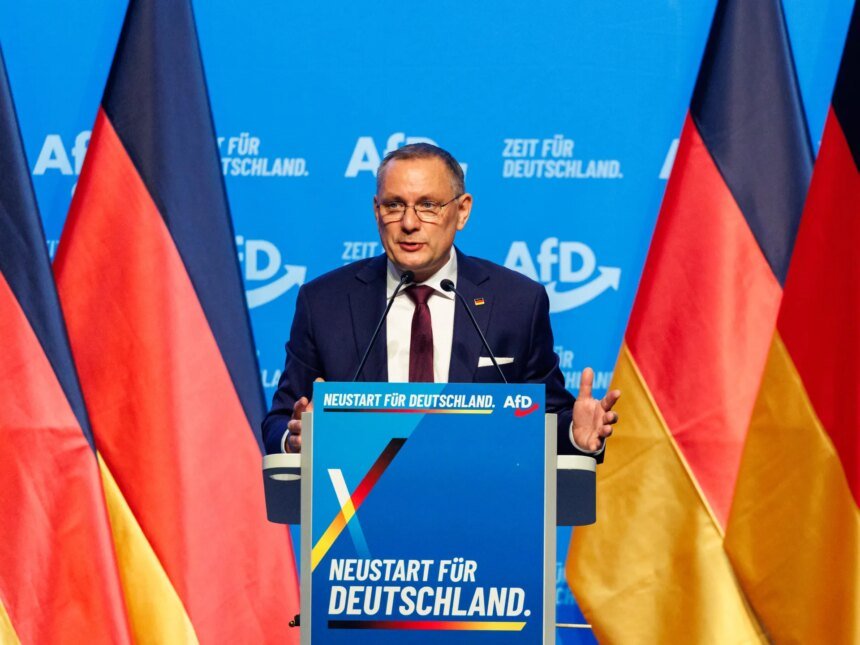
There is justification for the fear of Germans today about the deviation of the path of democracy built on the ruins of the disastrous Nazi experience of rule in Germany and the world, with the rise of the “Alternative for Germany” party against the current government coalition and the rest of the parties.
Although tens of thousands of union members, left-wing parties and civil society participated on Saturday in marches against the Alternative for Germany party, in parallel with its federal conference in the city of Erfurt in the east of the country, protesting in the streets alone may not be enough to hinder the party from continuing to jump in the opinion polls.
With the re-election of its leaders Alice Weidel and Tino Kruppala, who oversaw its rise and made it a national force, the Alternative Party hopes to continue expanding its follower base across Germany and maintain its superiority over the Christian Union party led by Chancellor Friedrich Merz, with the hope of reaching power within a few years.

About a decade ago, the Alternative for Germany party was founded, using a combination of nationalist rhetoric, calling for stricter immigration policies, and appealing to voters frustrated with successive governments and years of economic stagnation.
In a few years, the party quickly succeeded in establishing its footing in several states, especially the states in the east of the country that are most protesting against the policies of the federal government, where the leaders of the Alternative Party accuse the government coalition of pushing Germany into a dark tunnel and causing the country’s national and cultural identity to disappear with immigration flows that deplete public spending and tax payments.
The party raises public concern that is not only linked to its political progress and its real chances of voting intentions that will nominate it to win if elections are held soon, but also to fears of spreading a climate of “fascism” ninety years after its rise through the same mechanisms, that is, on the ladder of democracy as well.
advertisement
A party that brings together contradictions
The “Erfurt” conference comes before the elections in the eastern states of Saxony-Anhalt and Mecklenburg-Vorpommern, which the AfD hopes will pave the way for its success at the national level, a prospect that confuses its political opponents in the government coalition.
There are two main reasons behind this concern:
- The regional elections in eastern Germany are seen as a measure of the general political mood ahead of the federal elections.
- The Alternative Party enjoys a high percentage of support in the eastern states, and its victory in the elections will be reflected in the formation of governments.
“We want to make it clear that we will not tolerate this, and that fascism is on the rise here in Germany,” says Georg Becker, spokesman for the “Resistance,” an anti-AfD group that was the most prominent faction participating in the Erfurt conference protests.
In general, the Front opposing the AfD accuses the party of promoting racist policies and positions that are not compatible with German democratic values, and says that they threaten the country’s constitutional system. The major parties have ruled out any cooperation with him, as part of a so-called “firewall” strategy designed to isolate the party and distance it from coalition governments.

On the other hand, the leaders of the Alternative for Germany party deny any opposition on their part to the democratic foundations in Germany, stressing their commitment to the constitution, and earlier this year they obtained a court order obliging the domestic intelligence service to suspend the previous classification of the party as “extremist.”
However, the party around it paints a contradictory picture. It is not content with provoking a state of polarization among right-wing trends or neo-Nazis, but rather it has begun to gain new lands among Germans of immigrant origins.
At the national level, support for the alternative currently stands at 29%, while it does not exceed 19% in the capital, Berlin. But behind these general statistics, we can notice a steady increase in support among Germans with immigrant backgrounds, from 3% in 2015 to 19% in 2025.
The German newspaper “Tagesspiegel” says in a video report on the YouTube platform, that although this turnout has not yet received much attention, experts in Berlin are warning ahead of the state elections that this growing category of voters may greatly affect its results.
Conversations conducted by the newspaper with individuals from various immigrant communities show a complex picture of disillusionment, social decline, and political reorientation that makes continuing to bet on democracy fraught with danger.
What is the reason for fears of the alternative?
The German Institute for Human Rights, in a report issued earlier this year, believes that the far-right Alternative Party represents a return in time to the National Socialism that became popular with the Nazis in the 1930s.
According to the institute, “socialist nationalism” resonates strongly today with controversial statements issued by several leaders of the AfD, most notably Björn Höcke, the party’s leader in Thuringia, who is an important and polarizing figure throughout Germany.
advertisement
The institute warns in its report that the party’s theses contradict Article 1 of the Constitution because it withdraws the principle of equality between Germans and sets its own standards for who should be considered German, who has the right to remain in Germany even if they hold German passports, and who represent a threat to “German culture.”
The report draws attention to what it considers to be the greatest danger in the AfD’s quest to gain power and bring about radical and dangerous change in Germany.
The Institute puts at the forefront what it considers to be the party’s weapons in disseminating its theses, which are:
- Focus on using social media platforms such as TikTok to reach the largest base of German voters, especially new generations.
- Appearing as a defender of Germany’s interests and the aspirations of the masses.
- Focus on criticizing opposition politicians and those at the forefront of the official institutions of government.
The German Institute for Human Rights sounds what it sees as a danger to democracy, in a historical restoration that cannot be overlooked, in reference to the context that accompanied the rise of “National Socialism” through the ballot boxes ninety years ago.
The institute says in its report, “Although it (the Alternative) entered parliament through democratic elections, this does not make it a democracy. On the contrary, the party seeks to undermine our democracy. The success of the party is likely to increase as the number of voters for it increases. In some regions of Germany, the party is already the strongest. The Alternative for Germany party has become a serious threat to our democracy.”
Among the dangers that the report issued by the German Institute for Human Rights warns of are:
- Gradually undermining the democratic system and restricting the right to vote.
- Confiscating individual freedoms and persecuting the opposition and those with opinions critical of party policies.
- Targeting immigrants and those the party does not consider “German enough.”
- Threatening the rule of law and peaceful coexistence in Germany.
Threats at the European level
But the warnings indicate that the dangers may not stop at Germany. Extremist right-wing theses are echoing throughout Europe today, with more than one extreme right-wing party succeeding in reaching power or at the forefront of political tension and public debate, in several countries, including Italy, France, the Netherlands, Austria, Slovakia, Poland, and Hungary.
More than 180 representatives within the European Parliament are now pushing to verify the legal foundations of the “Europe of Sovereign Nations” party, which brings together several far-right parties, including the Alternative Party, on the grounds that it does not adhere to European values, which include respect for human dignity, freedom, democracy, equality, the rule of law, and human rights, including the rights of minorities.
According to the Euronews network, the evidence file, which was prepared by the “European Political Parties and Institutions Authority” and consists of 294 pages, includes judicial rulings, statements and social media posts issued by members of the party, which were considered possible indicators of a violation of the values of the European Union.
According to the regulations, once Parliament takes effect, the authority’s observations will be transmitted to the party, which will be able to submit its responses or take corrective measures. After that, the authority decides whether to cancel its registration as a European political party, with the European Parliament and the Council retaining the right to nullify the decision after its issuance.