

Tunisian retiree Haider Amer published a blog post in which he said that he receives a pension not exceeding 300 dinars ($100) after 29 years of working in the Ministry of Agriculture (Agriculture), while in reality he only receives 290 dinars ($98) after deductions that he said he does not know the reasons for.
Amer added that he asked about the recent wage increase, which the authorities said included retirees, but he was informed that he was not concerned with it because his pension was less than the guaranteed minimum wage. Al Jazeera Net contacted him, but he was satisfied with what he published in his blog.

Daily difficulties for retirees
Amer’s story does not appear to be an isolated case, but rather reflects – according to the testimonies of retirees who spoke to Al Jazeera Net – daily difficulties faced by large groups after the end of their professional path.
Read also
list of 4 itemsend of list
Youssef Al-Rabhi, a retiree, told Al Jazeera Net that there are those who receive a pension that does not exceed 240 dinars (about 82 dollars), considering that such amounts are no longer able to cover basic needs in light of the high costs of living.
He adds that a large number of retirees find themselves facing financial difficulties despite long years of work, questioning the ability of these pensions to guarantee a decent life for those who have spent decades serving the state and the economy.
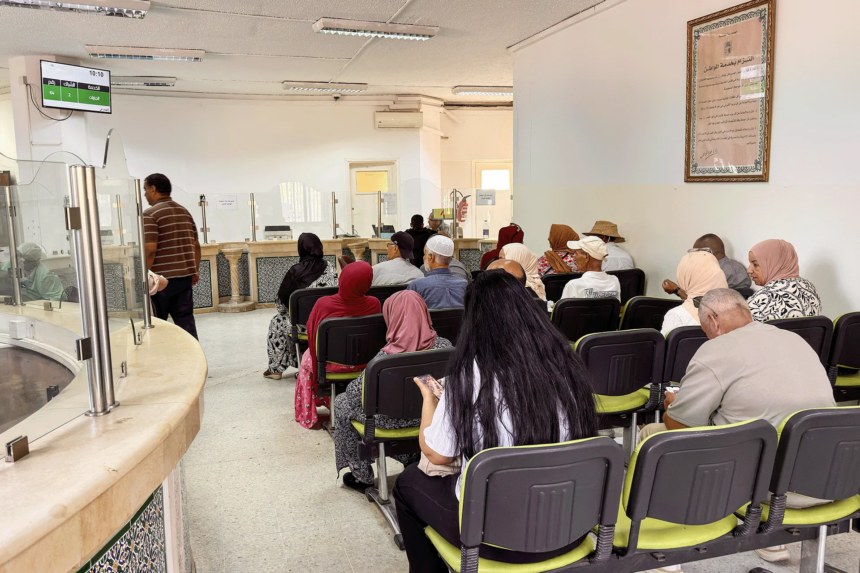
These difficulties frequently appear in front of post offices at the beginning of each month, as a number of elderly people spend long hours in line to receive their pensions.
As for the retiree, Mustafa bin Rajab, he says that he received the last increase, but he believes that it was not within the limits of the announced percentage. He explained to Al Jazeera Net that the increase he received did not exceed – according to his estimate – about 4%, adding that he received only about 50 dinars ($17), while his wife received an increase in the range of 30 dinars ($10).
Bin Rajab questions the continued deduction of taxes from some retirees, saying that they spent years working and paid their contributions before reaching retirement.

Social security system
Data from the social security system in Tunisia reveal that the number of retirees is approximately 1.278 million people, distributed between the National Social Security Fund and the National Retirement and Social Security Fund.
The National Social Security Fund accounts for the largest percentage of pension holders, at 65.1%, or approximately 832,000 retirees, compared to approximately 446,000 retirees within the National Retirement and Social Security Fund.
This comes in light of rapid demographic transformations and the increase in the number of beneficiaries of retirement pensions, which increases pressure on the financial balances of social funds, and raises questions related to the sustainability of the retirement system and its financing in the coming years.
The crisis of retirees in Tunisia does not seem to be related only to the recent limited increase, as the Secretary-General of the General University of Retirees, Abdul Qader Nasri, previously spoke about a difficult situation experienced by a large segment of pensioners.
Nasri said that more than half of retirees receive an income less than the guaranteed minimum wage, noting that about 600,000 private sector retirees and 20,000 public service retirees receive an income that in some cases does not exceed 350 dinars ($120).

Refuse to increase
In this context, the General University of Retirees affiliated with the Tunisian General Labor Union, in turn, expressed its rejection of the announced 5% increase in income for retirees of the National Social Security Fund.
The university, which represents the interests of retirees, considered that the increase was supposed to be progressive, so that those with low incomes would benefit in greater proportions, thereby reducing the differences between retirees.
She said that the current increase is not commensurate with the decline in purchasing power of a large number of retirees, warning also of the deterioration of public health services and the difficulty for some elderly people to obtain medicines and necessary services.

Controversy of categories not included
For his part, economic expert Reda Shakandali told Al Jazeera Net that he was surprised that some groups that earn less than the minimum wage guaranteed by the increase were not included.
Shkendali considered that this group is the most in need of support, calling for reviewing this trend and raising their incomes at least to the level of the guaranteed minimum wage, considering that the government may have special arrangements for these segments.
As for the expert in social funds, Hadi Dahman, he explained to Al Jazeera Net that the problem relates to the interpretation of the procedures for applying the increase, noting that there are 3 segments that were considered temporarily not included, which are some of those earning the guaranteed minimum wage, Tunisian workers abroad, and those who have been referred for retirement starting in January 2026.
Dahman added that these categories represent an important segment, and are even among the segments most in need of an increase, stressing that a review of the procedures is on the table and that it is expected that their status will be examined.
The Ministry of Social Affairs has not yet issued a final clarification regarding this problem.
The fund numbers and testimonies of pensioners reveal the depth of the crisis that retirees in Tunisia are experiencing, which goes beyond just a limited increase in their incomes that did not reach some retirees.
The question remains: How can someone who has spent all his years working find himself after retirement facing the difficulty of securing his basic needs?
It is clear that the battle is no longer just about improving pensions, but rather about the ability of the social protection system to maintain its basic meaning: providing a more secure life for those who have contributed for decades to building it.