

Published On 9/7/2026
|
Last update: 13:03 (Mecca time)
The 2026 World Cup was not without refereeing controversy, and with only a few matches remaining before the curtain came down on the tournament, the competitions, from the group stage until the quarter-finals, witnessed many controversial cases that sparked debate among fans and experts.
The Spanish newspaper “Marca” reviewed the most prominent arbitration decisions that have sparked controversy in the tournament so far, and the Arabs are clearly present in these most controversial decisions.
Read also
list of 2 itemsend of list
Mexico and South Africa… 3 red cards
The opening match between Mexico and South Africa witnessed the record for the largest number of expulsions in an opening match in World Cup history, after the referee issued three red cards.
But the most controversial decision was the expulsion of South African player Zwane after a tackle off the ball, which many considered undeserving of a red card, making the shot one of the most controversial refereeing decisions in the tournament.
Ignoring Messi’s expulsion against Algeria
In the confrontation between Argentina and Algeria, while Argentina was ahead by one goal without a response, Lionel Messi committed a tackle from behind on defender Issa Mandi.
Despite the protests of the Algerian players, the referee did not even show a yellow card to the Argentine captain, who continued the match and scored two more goals, which sparked widespread dissatisfaction within Algeria, which saw that the intervention deserved punishment.
A penalty kick was not awarded to Mbappe against Senegal
France demanded a penalty kick during the match against Senegal, after Kylian Mbappé collapsed inside the penalty area following contact with a defender in the 57th minute.
But the referee refused to call the violation, and the video referee (VAR) did not intervene, so the incident turned into one of the most controversial moments.

Vinicius’ goal against Scotland was cancelled
Vinicius Junior had a great game against Scotland, and was close to scoring a hat-trick.
The Brazilian star scored a third goal after recovering the ball from the last defender, but the video technology summoned the referee to review the presence of very slight contact during the possession of the ball, so he decided to cancel the goal amid widespread objections.

Application of “Vinicius Law”
The Paraguay-Turkey match witnessed the first application of what the newspaper called the “Vinicius Law.”
Miguel Almiron was expelled after he spoke to a Turkish player while putting his hand over his mouth, after reviewing the footage via video technology.
The decision sparked great anger in Paraguay, before the same law was later applied in the Ecuador-Mexico match, which saw Piero Hincapie sent off.

Ignoring the violence of Uruguay and Paraguay
The newspaper “Marca” described the confrontation between Uruguay and Spain as one of the most brutal matches of the tournament.
The newspaper saw that the referee allowed a large number of violent interventions by Uruguayan players without issuing sufficient violations, which angered the Spanish players, despite their success in achieving victory and despite a late expulsion received by Uruguayan player Agustín Canobio.

The France-Paraguay match was also a sign of violence in the tournament, and ended without the Uzbek referee Ilgiz Tantashev showing any card (neither yellow nor red) in the face of the Paraguayan players, despite the many mistakes and violent interventions, which caused sharp criticism from the French press, and Swedish star Zlatan Ibrahimovic described it as a match that “if he had played it, he would have been sent off 4 times.”
Croatia’s goal against Portugal was cancelled
Portugal succeeded in avoiding extra time against Croatia after video technology canceled out the equalizer scored by Mario Pasalic in stoppage time.
The review indicated that the ball touched a Croatian player before it reached the goalkeeper, putting him in an offside position with a very small margin, which was not clearly shown in television replays, while the ball sensors confirmed the correctness of the decision.
Balogun’s expulsion canceled after Trump intervened
The newspaper described the case of American striker Folarin Balogun as “the biggest controversy the tournament has witnessed.”
The player had been sent off against Bosnia and Herzegovina, which would have prevented him from facing Belgium, before the intervention of US President Donald Trump and a decision by FIFA led to the postponement of the implementation of the penalty, so that the player could participate in the match, which sparked a widespread wave of criticism.
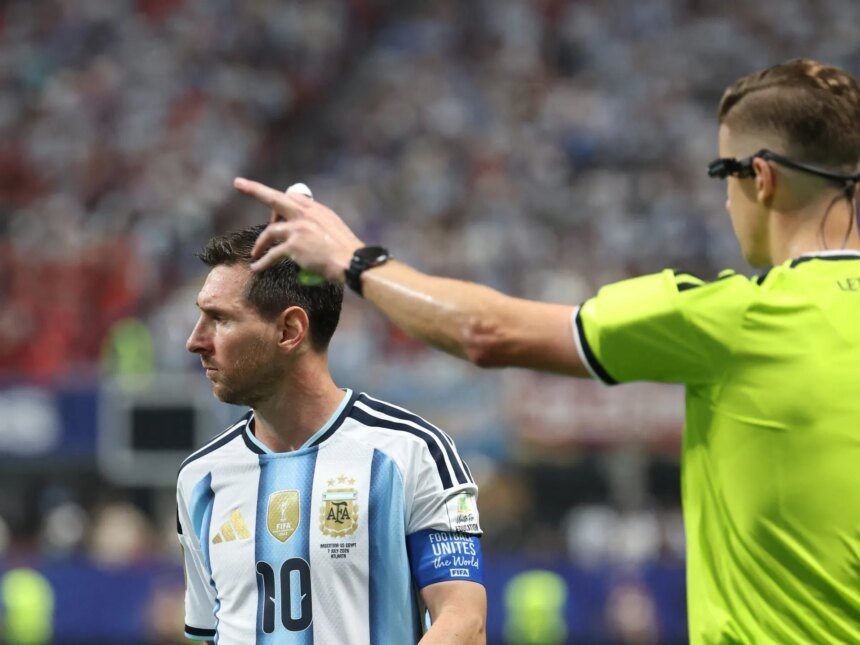
Canceling Egypt’s goal against Argentina
The Egypt-Argentina match witnessed one of the most controversial moments in the tournament.
After a quick counterattack, ended by Mustafa Zico with a wonderful goal that gave Egypt a two-goal lead, the video referee intervened before play resumed, and asked the referee to review a previous violation against Lisandro Martinez at the beginning of the attack.
The referee decided to cancel the goal due to an intervention that was considered a violation near the corner flag, a decision that sparked widespread protests within the Egyptian camp, whether due to the nature of the contact or the length of time that preceded the shot being reviewed.
Two Egyptian claims for two penalty kicks against Argentina
In addition to the disallowed goal, the Egyptian team demanded two penalty kicks during the match against Argentina.
The first came after contact between Julián Alvarez and Mohamed Salah, while the second was the result of an intervention by Alexis McAllister inside the penalty area.