

President Donald Trump said that Tehran is seeking to conclude a settlement deal, after announcing the end of the agreement after the United States launched – at midnight on Thursday – new raids on Iran.
Trump explained that he received a call after yesterday’s strikes and that Iran strongly desires to conclude a settlement, but he said that he doubts how serious Iran is in concluding an agreement and does not trust that it will adhere to any deal in the future.
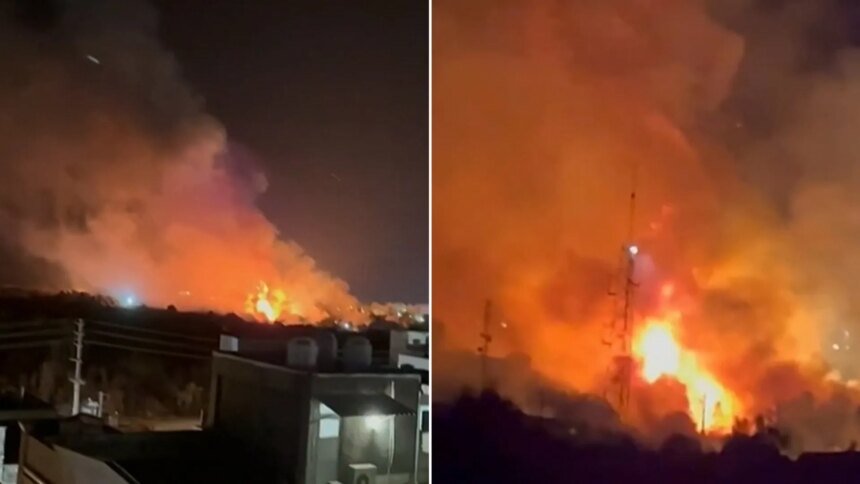
The Iranian Mehr Agency reported that explosions were heard in Bushehr on Thursday afternoon.
For its part, the US Central Command (Centcom) said that the strikes came to make Iran pay a heavy price for violating the ceasefire by targeting 3 commercial ships in the Strait of Hormuz.
Centcom added that the aim of the new strikes was to undermine Tehran’s ability to attack commercial and civilian shipping in the Strait of Hormuz.
On the other hand, Iranian Parliament Speaker Mohammad Baqir Qalibaf said that America has not yet learned that “bullying and breaking covenants will not be without a price, and I say it clearly: If you strike, you will receive strikes.”
Qalibaf stressed that the Strait of Hormuz will only be opened through Iranian arrangements and not through American threats.
In turn, the Iranian Foreign Ministry expressed its strong condemnation of the statements of Trump and other American officials, and said that the American attacks are a pretext to justify its continued non-compliance with the memorandum of understanding.
She stressed that these attacks are a flagrant violation of the Charter of the United Nations and the first and fifth articles of the Memorandum of Understanding, stressing her determination to defend the country’s national sovereignty and territorial integrity and to punish the aggressors, as she put it.
The Iranian Revolutionary Guard also reported that 3 of its forces were killed in American attacks at dawn today on Khuzestan Province, southwest of the country.
The Revolutionary Guard Navy said that any American adventures or interference in determining navigation routes in the Strait of Hormuz will face a decisive response from us, stressing that “foreigners have no interest in the Strait of Hormuz.”
The Revolutionary Guard said that the US military’s adventures would seriously hamper the process of gradually reopening the Strait of Hormuz.
This comes a day after Trump announced that the temporary agreement to end the war with Tehran had “ended.”
The US military announced – in a post on the X platform – the implementation of a new round of strikes on Iran, with the aim of “further undermining its ability to threaten freedom of navigation in the Strait of Hormuz.”

Work on the railway line between Tehran and Mashhad was halted, according to what was reported by Iranian official television, hours before the funeral of Supreme Leader Ali Khamenei in that city located in eastern Iran.
The railway operating company in Iran stated that the reason for the stoppage of the line was a “criminal attack carried out by the American-Israeli enemy” that targeted the railway track, adding that it had sent teams to repair the damage, and that the authorities were working to provide land transportation for the stranded passengers.
According to Iranian media, the strikes included several cities in southern Iran, including Bandar Abbas, Sirik, and Bushehr. The Iranian News Agency reported that about 10 explosions were heard in Chabahar and Qanark in southeastern Iran, and it also indicated a power outage in parts of the city of Chabahar.
Iranian television said that fragments of American projectiles – which targeted areas in the port of Chabahar – hit Imam Ali Hospital in the city, and the Iranian Mehr Agency reported that the United States targeted two naval piers and a maritime traffic control tower in Chabahar.
As for the Iranian Fars Agency, Badawi reported 3 explosions, which she described as strong, in the city of Jaghadak in Bushehr Governorate. The Iranian Noor News website had quoted an informed source that the attack on Bushehr did not cause any damage to the nuclear power plant.
Later, Iranian television said that explosions renewed on Abu Musa Island in the south of the country, noting that the number of explosions – which the island witnessed – rose to 10 during the American strikes yesterday.
Mehr Agency reported that Iranian air defenses shot down an “enemy drone” in the airspace of southern Iran, and that Iranian defenses confronted “hostile targets” in the vicinity of the city of Bandar Abbas.
Iranian Health reported that the American attacks yesterday and today targeted 5 provinces, killing 14 people and wounding 78.
Trump threatens Tehran
After the American bombing, Trump threatened that his country’s strikes on Iran would increase significantly if Tehran continued to attack ships in the Strait of Hormuz.
Trump wrote – on his “Truth Social” platform – over a photo he posted showing what appeared to be the bombing of a site in Iran: “This is retaliation for the strikes that Iran launched against ships yesterday. If this is repeated, it will become much worse!”
Trump said in statements to reporters: “I doubt how serious Iran is in concluding an agreement, and I do not trust that they will adhere to any deal in the future,” adding, “We dealt a very harsh blow to Iran, and our response will always be 20 times greater every time they launch an attack against us.”
The US President continued: “Our goal is not war, but rather the complete disarmament of Iran’s nuclear weapons, and preventing Tehran from possessing nuclear weapons.”
In turn, CNN quoted an American official as saying, “Trump’s decision to launch new strikes against Iran – on Wednesday evening – came in part because of his dissatisfaction with the failure to fully open the Strait of Hormuz.”
The American official added that Trump’s patience is beginning to run out due to the pace of negotiations, specifically what appears to be Iranian procrastination in the nuclear talks with Washington.
CNN quoted another American official as saying that tonight’s strikes included Iranian missile sites that “could be used against American assets.”
In turn, British Foreign Secretary Yvette Cooper said that Iran must abandon its claim to control shipping routes.
Iran threatens a crushing response
In the first official Iranian response to the American strikes, Iran’s representative said in a letter to the United Nations that the United States targeted facilities in southern Iran in Bushehr and a number of islands, and that in doing so it “violated the United Nations Charter.”
In his letter, the Iranian delegate considered that the American attacks amounted to a “fundamental violation” of the first clause of the memorandum of understanding signed between Washington and Tehran.
For his part, spokesman for the Iranian Parliament’s National Security Committee, Ibrahim Rezaei, said: “Expect a strong slap from the Iranians.”
Militarily, Fars Agency reported that what it described as “hostile projectiles” hit a bridge on the railway line west of the city of Ak Qala, in Golestan Governorate, northern Iran.
As a result, the Iranian Revolutionary Guard threatened that it would “respond overwhelmingly” to the targeting of the bridge, indicating that America had targeted it with a cruise missile, and stressing that there were no human casualties as a result of the targeting.
Axios quoted an American official as saying that the US Air Force bombed two railway bridges in Iran, adding that the missile attack was the first of its kind against Iranian infrastructure since the ceasefire.
The Iranian Nour News website had quoted a military source as saying that the Iranian armed forces would launch a “large-scale” attack on US army bases in the region, and “it will be a response that will bring remorse” on the American side.

America: We attacked 90 Iranian targets
On Thursday morning, the US Central Command (Centcom) announced that it had completed an “additional round” of its strikes on Iran on July 8, noting that it included about 90 Iranian military targets.
In a statement published on its account on the X platform, the US command said that the new strikes sought to “further undermine Iran’s ability to attack commercial ships and innocent civilian sailors in the Strait of Hormuz.”
It explained that the Iranian military targets it attacked included air defense systems, coastal surveillance assets, missile and drone storage sites, in addition to naval capabilities and military logistics infrastructure along the Iranian coast, according to the statement.
For its part, the New York Times reported that the US Central Command had carried out raids on more than 170 Iranian military targets during the past two days.
The strikes were preceded by official US threats, as US Vice President J.D. Vance said that US military action would continue unless Iran stopped shooting at ships.
He added: “Either Iran will fulfill its obligations or what happened last night will happen to it,” stressing that it will face an American military response if it tries to close the Strait of Hormuz.
He stressed that the agreement with Iran “stipulates that if they fire on the ships, we will respond forcefully, and our response will be stronger.”
Earlier, US President Donald Trump hinted at the possibility of launching attacks on Iran in response to its targeting of some ships passing through the Strait of Hormuz, announcing the cancellation of the memorandum of understanding with it, during his participation in the NATO summit in Ankara.
The context of the strikes
For its part, Axios newspaper quoted an American official as saying, “We will slap the Iranians a little so that they realize that we are not joking.”
The newspaper reported that the White House is preparing for what could become an exchange of fire with Iran around the Strait of Hormuz that could last days or weeks.
It quoted officials as saying that the duration and intensity of the new campaign depend entirely on the next steps that Tehran will take, and that the White House believes it has more room for escalation because hundreds of oil tankers have been able to leave the Gulf through the strait in recent weeks.
The officials indicated that the departure of hundreds of oil tankers from the Gulf through the Strait of Hormuz eased fears within the administration that the renewed clash would lead to an immediate significant rise in oil prices.
A US official added to Axios that the current escalation stems from frustration among the more extreme elements within Iran’s divided leadership who believe that the memorandum of understanding did not bring real benefits to Tehran, according to the official.
He pointed out that Iran has witnessed a decline in its influence in the Strait of Hormuz, with hundreds of ships passing through the southern route near the Omani coast.
The American official said that the framework agreement brokered by the United States between Israel and Lebanon made the Lebanon-related part of the memorandum of understanding unnecessary, and that part of the Iranian leadership was not happy with all these matters, as Axios quoted the official.