

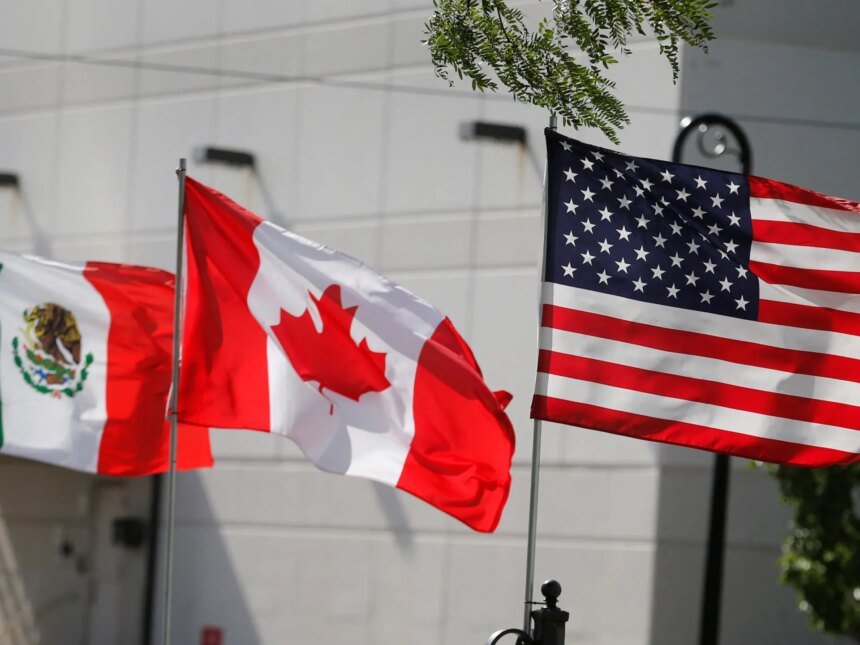
In light of the escalation of trade competition between the United States and China, regional agreements are no longer immune to this conflict, but have become one of its indirect arenas.
Washington’s decision not to renew the trade agreement with Canada and Mexico did not come in isolation from the details of the trade war with Beijing, but rather reflected an American attempt to re-engineer supply chains away from Chinese influence.
Read also
list of 4 itemsend of list
From this standpoint, Chinese local newspapers’ follow-up to the first review of the free trade agreement between the three countries (USMCA) reveals that tension with Beijing may creep into the details of the negotiation, and affect Washington’s calculations towards its closest trading partners, amid fears of reshaping global supply chains.

Negotiated political goals
Huan Chiu newspaper reports that the United States announced during the first tripartite review of the agreement that it refused to renew it in its current form, which entered the agreement into a stage of annual reviews until 2036, which contradicted expectations of long-term trade stability in the North American region.
The statement issued by the Office of the US Trade Representative justified the decision by seeking to address imbalances such as the trade deficit and the resettlement of industry within the United States, according to the newspaper, which quoted Western reports explaining that Washington is seeking to reformulate the rules of origin, especially in the automobile sector, to raise the proportion of locally manufactured components, in an attempt to reduce dependence on foreign supply chains.
Liu Dan:
Washington is seeking to turn economic relations between Canada and China into a negotiating “fault point”, with the aim of imposing more severe restrictions on cooperation with Beijing under national security justifications.
Although the official statement did not explicitly mention China, its presence was clear in the political discourse. The South China Morning Post reported that the US trade official criticized Canada for its openness to Chinese investments, considering that this undermines American re-industrialization efforts.
On the other hand, the Global Times newspaper indicates that linking the non-renewal of the agreement to China is a “narrative construction” that serves internal negotiating and political goals, stressing that the fundamental reason lies in the continued US trade deficit with Canada and Mexico.
The Global Times considers that using China as a pressure factor reflects a trend to impose geopolitical consensus on trading partners, as the numbers show a deficit in the trade balance with Mexico and Canada that in 2025 reached about $196.9 billion and $46.4 billion, respectively.
This opinion is confirmed by Liu Dan, a researcher at the Center for Canadian Studies at Guangdong University, who told the Huan Qiu newspaper that Washington is seeking to turn economic relations between Canada and China into a negotiating “point of error,” with the aim of imposing more severe restrictions on cooperation with Beijing under national security justifications.
The back door dilemma
The South China Morning Post highlights growing American concern about the use of Mexico and Canada as “back doors” for Chinese goods or investments to enter the American market through customs exemptions within the agreement, and this is what prompted Washington to demand tightening the rules of origin and raising the proportions of local components.
The newspaper quotes Alfredo Montufar Helu, managing director of the China-based Ancora Consulting Company, as saying that this proposal collides with a complex economic reality, as North American industries themselves depend on Chinese components, which makes complete separation difficult to implement, stressing that any attempt to completely exclude China will face practical challenges due to the intertwining of global production chains.
On the other hand, the Asia Times website goes to another explanation that explains that the main motivation for the American decision is related to internal priorities, especially re-industrialization and reducing the trade deficit, rather than being directed against China itself.
The US administration views the agreement as a “car deal” that serves production outside the United States, which contradicts the goal of restoring industrial jobs.
The site’s report also indicates that American sectors, especially the agricultural sector, are demanding reform of some detailed aspects, but they oppose terminating the agreement because of their heavy dependence on the markets of Canada and Mexico, and this reflects the internal division over the feasibility of the step.
The USMCA may gradually transform into separate bilateral arrangements between the United States and Canada and Mexico, which may open the way for other parties, including China.
Vacuum of non-renewal
The data do not indicate that China will directly fill a void if the agreement falters, but it may benefit indirectly. According to the South China Morning Post, American restrictions could push Chinese companies to deepen their industrial investments within Mexico, in accordance with stricter rules of origin, instead of just exporting.
In the same context, the Global Times believes that countries such as Canada and Mexico are already seeking to diversify their trading partners, and that cooperation with China comes within a natural economic logic based on comparative advantage, and is not a complete substitute for the American market.
Huan Chiu newspaper’s analysis also indicates the possibility of the agreement gradually turning into separate bilateral arrangements between the United States and Canada and Mexico, which may open the way for other parties, including China, to enhance its presence in some sectors.
The limits of Chinese influence
There are clear restrictions on China’s ability to impose its influence on any aspect of this agreement, even if it is not renewed. According to the Asia Times website, Beijing is working to reduce its dependence on American agricultural imports, which reduces its interdependence with the American economy compared to Canada and Mexico.
The American market also remains the main destination for exports from the two neighboring countries, which limits the possibility of redirecting trade relations quickly or in an integrated manner depending on infrastructure constraints, policies, and market needs.
Although the Chinese factor is strongly present in the background of the decision not to renew the free trade agreement between the United States, Canada and Mexico (USMCA), it is not a decisive reason as much as it is a pressure tool within a broader struggle over supply chains and industrial influence.
The United States is seeking to reformulate trade rules to serve its internal priorities, while Canada and Mexico are trying to maintain a balance between their partnership with Washington and their openness to the global economy.
In this context, China may benefit from the confusion of the tripartite framework by deepening its roles in the Mexican and Canadian production chains, and by expanding the margin of maneuver for these countries in the face of American pressure, which will gradually strengthen the multipolarity of the global trading system and move it beyond the control of the single commanding pole.