

Published On 7/8/2026
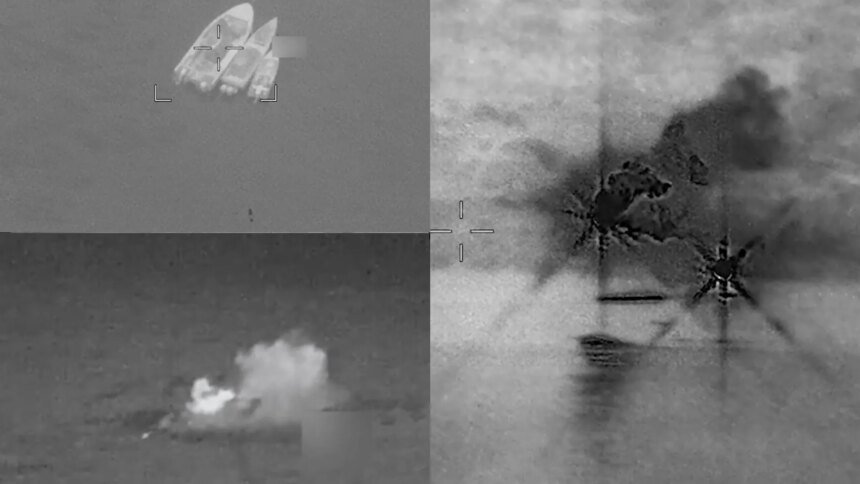
The American-Iranian conflict in the Gulf region entered a direct field turn, following the US Central Command (Centcom) announcement of launching a series of precise strikes targeting Iranian naval facilities and bases, extending geographically from Sirik and Qeshm all the way to the strategic Bushehr Governorate.
Analysts across Al Jazeera dismantled the dimensions of this rapid field transformation, wondering whether the recent bombing falls within the context of a precise clash, or whether it represents the first shot in a wide regional war that completely overthrows the political memorandums of understanding.
The military and strategic expert, retired Colonel Nidal Abu Zeid, explained that the US Central Command’s use of the term “strike series” has completely different technical dimensions from limited traditional operations, as the series militarily means launching a first bombing wave followed by an intelligence assessment of the destruction rates, then re-targeting again.
Abu Zeid compared this attack to the model of the previous operation, which lasted only 90 minutes and targeted 4 targets with 6 aircraft, indicating that the current escalation is considered the broadest and most accurate because it relies on precision missiles of the “Jassim,” “Hellfire,” and “Mark” models launched from “F-35” air fighters.
Abu Zeid pointed out that the positioning of the American aircraft carrier USS Abraham Lincoln 250 kilometers from Iranian shores allowed this complex attack to be carried out, taking advantage of its ability to direct long-range precise strikes.
Tehran’s abstention from targeting the American carrier and instead resorting to bombing regional bases was explained by the Iranian Revolutionary Guard’s awareness that the cost of compromising Washington’s sovereign territory would be high, based on bitter previous experiences, thus keeping the confrontation within the scope of buffering tactical friction without sliding into a comprehensive conflict.
Iranian response
On the other hand, Al Jazeera’s correspondent in Tehran, Rania Qasemi, reported that the Revolutionary Guard’s air defenses were able to shoot down an advanced American MQ9 reconnaissance plane in the Khormoj area of Bushehr Governorate while it was carrying out assessment missions.
The Iranian naval and air forces announced the targeting of 85 points in American military facilities, including Port Salman and the Fifth Fleet base in Bahrain, in addition to gatherings of forces at the Sheikh Salem Air Base in the State of Kuwait, with drones and missiles.
This coincided with the announcement of Kuwaiti air defenses responding to hostile attacks and the sounding of sirens in Bahrain.
Nidal Abu Zeid described the Iranian announcement of hitting 85 targets as carrying propaganda dimensions to demonstrate military equality and apply the principle of proportionate deterrence, since the targeted bases cannot accommodate this volume of targets on the ground.
In the same context, Richard Weitz, an expert in security and military strategy at the Wikistrat Foundation, considered that the American bombing of Bushehr represents an unusual development due to the presence of the nuclear reactor, stressing that Washington was forced to respond militarily to control shipping traffic after the Revolutionary Guard continued to harass commercial ships in the Gulf.
Undermining understandings
On the diplomatic level, Ali Akbar Darini, a researcher specializing in American studies, confirmed that the administration of President Donald Trump has completely undermined the chances of success of the ongoing negotiations and the joint memorandum of understanding.
Darini explained that Washington deliberately violated the agreement by imposing forced transit corridors south through the Sultanate of Oman, to marginalize Tehran’s legal powers to regulate “proper passage” in the Strait of Hormuz. He stressed that Iran rejects the “policy of attrition”; Either real peace or a comprehensive confrontation that extends over a wide geography in the region.
In response to the Iranian proposal, Weitz pointed out that Washington is moving to protect international navigation, which is guaranteed by law. He considered that the absence of details in the hastily signed initial document sparked this stalemate, especially since America possesses military superiority that allows it to fight decisive and rapid battles.
On the other hand, according to Weitz, the Iranian side is showing greater willingness to manage a long-term conflict. Through it, he seeks to impose his political and nuclear conditions, taking advantage of the regional power he possesses in the region.
The US Central Command (Centcom) had stated that the recent US strikes – which it described as retaliatory – came in direct response to the Iranian attacks against 3 commercial ships in the Strait of Hormuz, threatening Tehran to “pay a heavy price for targeting and attacking commercial ships.”
In a related context, Iranian television reported that 6 explosions were heard on Qeshm Island and 7 in the city of Sirik, and other explosions were heard in the coastal Bandar Abbas. Hours later, on Wednesday morning, he reported hearing several explosions in and around Bushehr.