


Geneva:
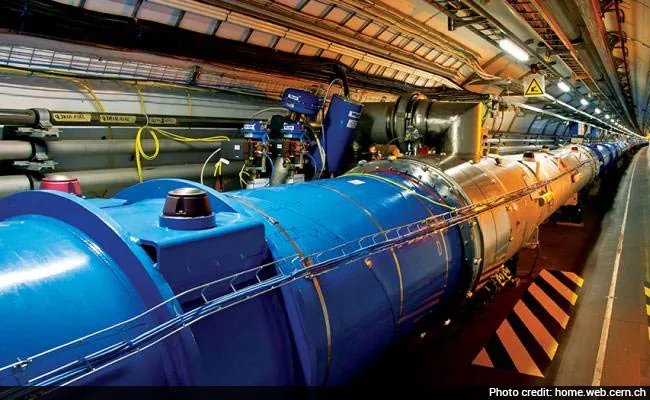
This is the world’s single-largest machine that has been made at $5 billion. It runs 27 km long through a circular underground tunnel. Over a hundred nations contributed to this project to decipher the secrets surrounding our universe’s origins. It was shut down this week after a dream run that saw the discovery of the God Particle. The same facility also gave the world the World Wide Web or the WWW of all Internet addresses, while also creating mini black holes on Earth.
The facility is now being upgraded at a cost of another $ 1.5 billion and will re-start smashing particles again in 2030. The Department of Atomic Energy says the upgrade and India’s contributions are ‘aimed at achieving precision physics results and looking for physics beyond the Standard Model.’
At the foothills of the Jura Mountains, on the border of Switzerland and France, lies the world’s largest and most powerful scientific machine, the Large Hadron Collider or LHC at the European Organization for Nuclear Research (CERN). Buried deep underground in a 27-km circular tunnel, this extraordinary machine has already transformed humanity’s understanding of the universe through the discovery of the Higgs Boson, often called the God Particle.
Read: What Is Higgs Boson And Why It Is Called “The God Particle”
Now, as CERN prepares for a major upgrade valued at about $1.5 billion for the High Luminosity-Large Hadron Collider, India finds itself at the centre of one of the most ambitious scientific quests ever undertaken: the search for dark matter and physics beyond our current understanding of nature.
CERN announced this week that ‘the Large Hadron Collider (LHC), the world’s most powerful particle accelerator, came to the end of an extraordinary chapter in its scientific journey. Following its final physics run, the accelerator has been switched off — to begin CERN’s Long Shutdown 3 (LS3), a major programme of maintenance, consolidation, upgrades and installation work that will prepare the Laboratory for the High-Luminosity LHC (HiLumi LHC), the next phase in the exploration of the fundamental laws of nature’.
India’s association with CERN is not recent. It stretches back more than six decades. From the early days of particle physics experiments to today’s giant international collaborations involving thousands of scientists, India has steadily expanded its role and influence. In the last few years, the country has contributed over Rs 100 crore every year in contributions to the CERN.
What began with visits by Indian scientists in the 1960s has evolved into a partnership that now spans accelerator technology, detector development, high-performance computing and some of the most important scientific discoveries of modern times.
Among those who have witnessed this journey first-hand is Prof Tapan Nayak, one of India’s most distinguished particle physicists and a longtime participant in CERN experiments.
Speaking to NDTV at CERN, Prof Nayak recalled how Indian scientists decided in the 1990s that they would not merely participate in the Large Hadron Collider but become significant contributors to its construction and scientific mission. “Indian scientists have been thinking that we should be a part of the Large Hadron Collider. Not merely a part, we should be a big part, making things in India and bringing them here,” Prof Nayak said.
That vision translated into substantial contributions from Indian laboratories and industries. Indian teams contributed to superconducting magnet systems, cryogenics, radio frequency technologies and beam instrumentation. Many components manufactured in India became integral parts of the world’s most complex scientific machine.
Read: The God Particle Through A Scientist’s Eyes
Today, Indian participation extends to two of CERN’s flagship experiments. Indian institutions and scientists have helped design, build and operate sophisticated detectors while conducting cutting-edge analyses of the data generated from high-energy collisions.
One of the most celebrated achievements of the LHC was the discovery of the Higgs Boson in 2012. The discovery confirmed a crucial missing piece of the Standard Model of particle physics and earned the 2013 Nobel Prize for Peter Higgs and Francois Englert.
For India, however, the discovery carried an additional significance. The word Boson in Higgs Boson honours the legendary Indian physicist Professor Satyendra Nath Bose. His pioneering work on quantum statistics laid the foundation for an entire class of particles that today bear his name.
Prof. Nayak emphasised this important connection. “The Bosons are named after our own Bose from Kolkata,” he said.
Yet despite the Higgs Boson discovery, physicists acknowledge that the Standard Model remains incomplete. One of the greatest mysteries confronting science today is dark matter, the invisible substance believed to make up most of the matter in the universe. While its gravitational effects can be observed, dark matter itself has never been directly detected.
This is where CERN’s next chapter begins.
The upgraded High Luminosity LHC will dramatically increase the number of particle collisions, allowing scientists to probe the universe with unprecedented precision. Researchers hope these collisions may reveal clues about dark matter, hidden particles and entirely new physical phenomena.
According to Prof Nayak, the search for dark matter is among the central goals of the upgraded collider. “That’s one of the main goals,” he said. “There are many searches going on beyond the Standard Model. There is a search going on for dark matter.”
He explained that scientists are also using the collider to recreate conditions that existed immediately after the Big Bang. “We are trying to understand what happened at time T equal to zero,” Prof Nayak said. “Everything started from a very, very small point with very high temperature and high-density matter.”
Indian scientists are deeply involved in these future efforts. Teams from across the country are participating in upgrades of the detectors. India is contributing to advanced detector technologies that will be essential for the next generation of discoveries.
Dr Archana Sharma, one of India’s most prominent physicists at CERN and a leading contributor to detector development, has often emphasised that India’s strength lies not just in scientific participation but in innovation, engineering, and human resource development. She highlights how Indian researchers, engineers, and students continue to play leadership roles in CERN projects while helping prepare the next generation of scientists.
“CERN is truly a mini living Universe,” says Sharma, who emphasises that ‘CERN is a powerful example of what becomes possible when people from different countries, disciplines, and backgrounds come together in the pursuit of knowledge. It is a place built on collaboration, patience, belief, and where innovation is driven not by certainty but by the courage to ask better questions. Now she embarks on a new journey to search for Dark Matter.
India’s connection with CERN is not limited to science and technology. It also carries a unique cultural dimension. In 2004, India gifted CERN a striking two-metre-tall bronze statue of Nataraja, the cosmic dancing form of Lord Shiva. Located prominently at CERN, the statue symbolises the cosmic dance of creation and destruction that mirrors, in a philosophical sense, the processes studied by particle physicists.
According to the Department of Atomic Energy, ‘as a testament to the long-standing scientific collaboration between India and CERN, in June 2004, India gifted a 2m tall statue of Shiva (Nataraja), the Lord of Dance to CERN. In choosing the image of Shiva Nataraja, the Indian government acknowledged the profound significance of the metaphor of Shiva’s dance, drawn by Carl Sagan for the cosmic dance of subatomic particles, which is observed and analysed by CERN’s physicists. This statue is a standing example of the fusion of technology with cultural traditions. A quote of the world-renowned physicist, Fritjof Capra is inscribed on a plaque alongside the statue which reads as, “Hundreds of years ago, Indian artists created visual images of dancing Shivas in a beautiful series of bronzes. In our time, physicists have used the most advanced technology to portray the patterns of the cosmic dance. The metaphor of the cosmic dance thus unifies ancient mythology, religious art and modern physics.”
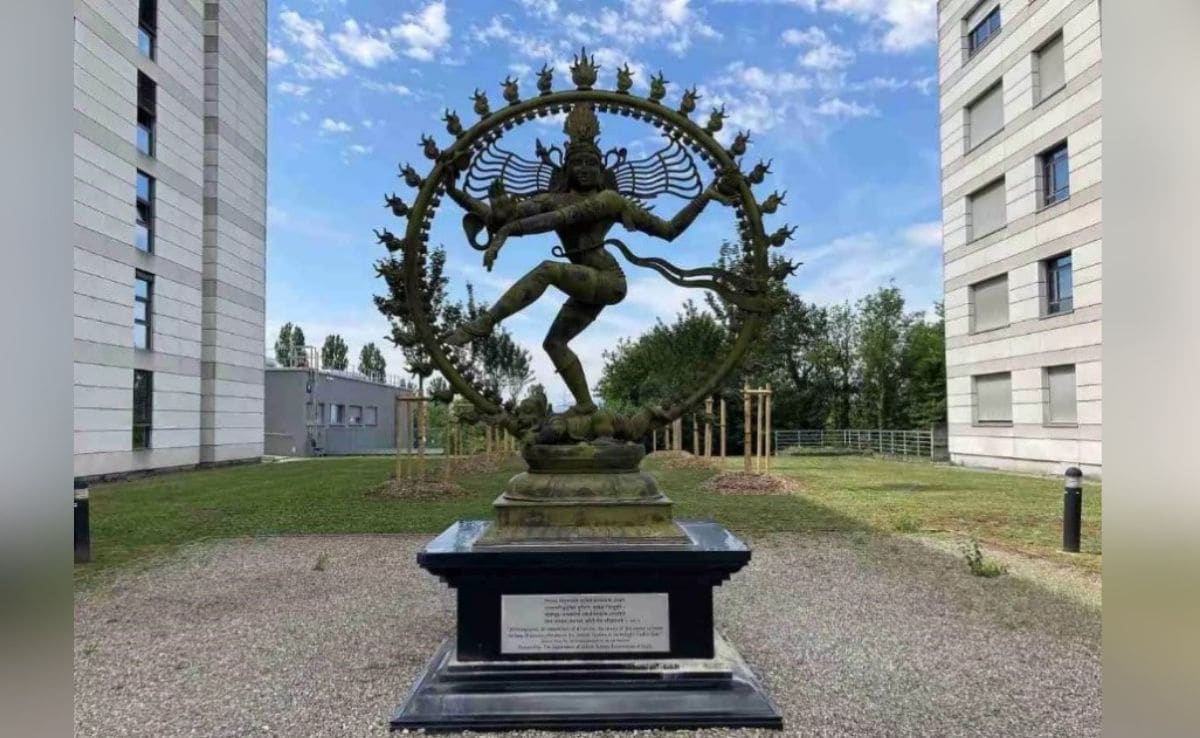
Today, the statue is being refurbished. Prof Nayak noted that the statue remains one of the most recognised symbols at CERN. The iconic image serves as a bridge between ancient Indian thought and modern scientific exploration, reminding visitors that humanity’s quest to understand the universe transcends cultures and centuries.
Today, India is not merely participating in CERN’s scientific endeavours. It is helping shape their future. From building parts of the accelerator to contributing to the discovery of the Higgs Boson and now joining the global search for dark matter, India has established itself as a respected and influential partner at the world’s largest machine.
As the upgraded collider prepares to unlock new secrets of the cosmos, India stands at the forefront of one of humanity’s greatest scientific adventures. The discovery of the ‘God Particle’ may have been a landmark achievement, but the next mystery awaiting solution could be even bigger. The quest to understand dark matter and the origins of the universe has begun, and India is firmly at the heart of that journey.