

Published On 7/8/2026
A Peace Council official revealed a plan to establish a pilot humanitarian zone in the southern Gaza Strip with the aim of accommodating tens of thousands of Palestinian civilians who will undergo security vetting procedures.
According to Agence France-Presse, the official explained that the area may constitute a “starting point” for the Palestinian technocratic committee, which is scheduled to take over the management of daily life in the Gaza Strip during the post-war transitional phase, according to US President Donald Trump’s 20-item plan.
He pointed to a pilot project that the Council is studying in particular, which may provide the National Committee for the Administration of Gaza with a starting point and a space in which to exercise actual management.
According to the official, multinational forces affiliated with the International Stabilization Force – an emerging body operating under the umbrella of the Peace Council – will secure the area that the Council is considering establishing in Rafah in the southern Gaza Strip.
The National Committee for the Administration of Gaza, a group of Palestinian technocrats established by the Peace Council, will undertake security checks and regulate entry into the area, with the support of the International Stabilization Force.
The official stated that entry and exit from the area will remain freely available to all unarmed civilians.
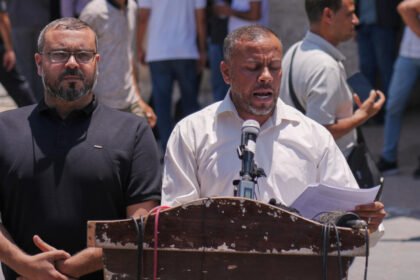
Last Monday, the government media office in Gaza announced the official dissolution of the government emergency committee, in preparation for transferring administrative tasks and governance in the Strip to the National Committee for Gaza Administration, affiliated with the Gaza Peace Council.
These developments come in light of the faltering efforts to move forward with the US-backed ceasefire plan in Gaza, as the National Committee for Gaza Administration is still present in Cairo and has not yet been able to enter the Strip.
Since the truce between the Israeli occupation and the Islamic Resistance Movement (Hamas) entered into force last October, Israeli forces have expanded their deployment inside the Gaza Strip, and now control about 70% of its territory, according to a statement by Israeli Prime Minister Benjamin Netanyahu at the end of last June.
Rejections and reservations
The idea of establishing closed humanitarian zones, which had previously been discussed in various forms over the past months, raised reservations.
Diplomats and officials from non-governmental organizations working in Gaza said – in statements to French – that this mechanism seems to them to be incompatible with international humanitarian law.
They explained that gathering civilians in specific areas subject to entry and exit controls may amount to forced population displacement, restrict the freedom of movement of Palestinians, and undermine the principle of humanitarian neutrality.
Although the council is considering establishing the project in Rafah, according to the official, it has not yet determined the exact location. He also indicated that construction work has not yet begun.
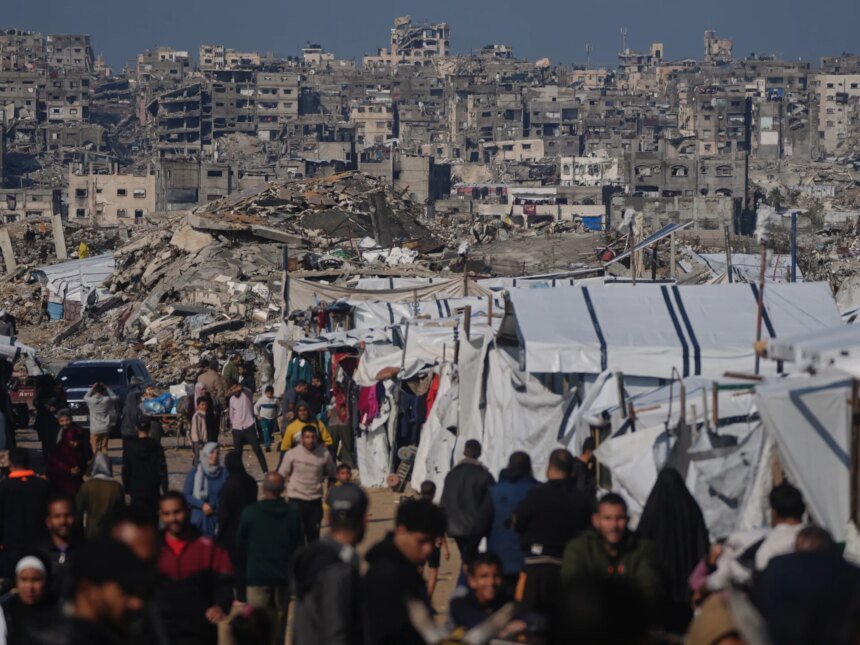
Rafah is located in the far south of the Gaza Strip. During the war, it was subjected to widespread destruction as a result of Israeli bombing, and the area is now largely under the military control of the Israeli occupation.
The official stated that the location of the International Stabilization Force’s deployment would serve as a “buffer zone” separating the Palestinian population from Israeli forces.
He added, “A security vetting mechanism will ensure that armed individuals or fighters do not enter these safe humanitarian areas.”
The official pointed out that “the Israeli army will not undertake this mission, and will not have any contact with the civilian population, or any role in isolating these areas from the rest of the Gaza Strip.”
A few days ago, Israeli media reported that the Peace Council would begin a pilot project within a few weeks to manage humanitarian shelters in areas of the Gaza Strip.
Israel Hayom newspaper said that multinational forces, within the International Stabilization Force of the Peace Council, will arrive in Israel within weeks, in preparation for their deployment in the Gaza Strip.
On September 29, 2025, Trump announced a plan to end the Israeli war of annihilation in Gaza, which in its first phase included a ceasefire, a partial Israeli withdrawal, the release of the remaining Israeli prisoners in the Strip, and the entry of 600 aid trucks.
While Hamas adhered to the obligations of the first phase by releasing Israeli prisoners, Israel shied away from its humanitarian obligations and continued its attacks and violations, resulting in the killing of 1,084 Palestinians and the injury of 3,491 others.
The second phase included a broader withdrawal of the Israeli army from the Gaza Strip, and the start of the reconstruction process, in exchange for starting to disarm the factions. However, Israel did not implement this phase, and insisted on the priority of disarmament.