

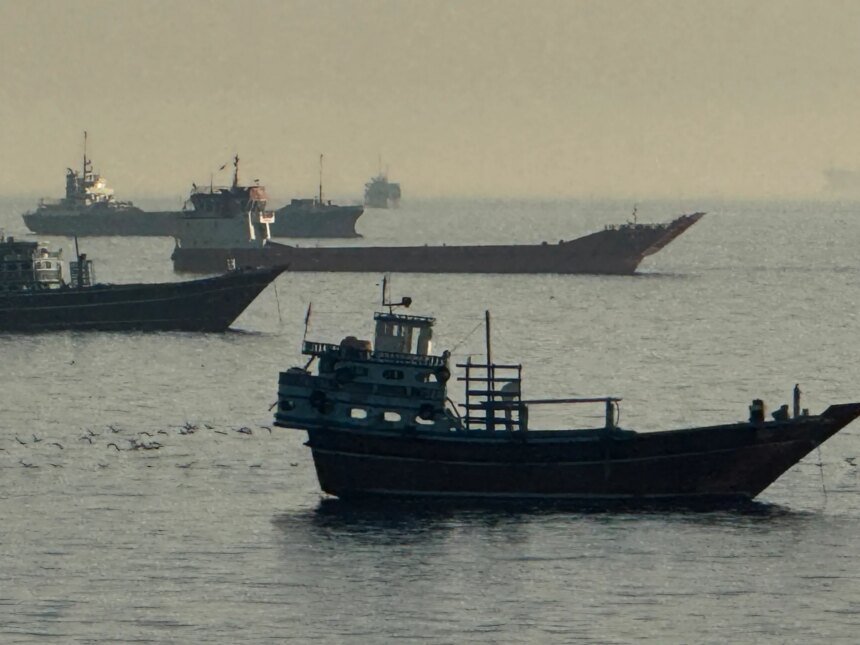
Tehran – The targeting of 3 tankers in the Strait of Hormuz within a few hours brought the question of war between Washington and Tehran back to the forefront, not only because of the number of ships targeted, but because the attacks affected highly sensitive corridors in one of the most important global energy arteries, and placed Gulf countries playing mediation roles, led by Qatar, within the circle of direct escalation.
Axios quoted an American official as saying that the Iranian Revolutionary Guard targeted a third commercial ship in the Strait of Hormuz, while the British Maritime Trade Operations Authority said that it had received a report about a new incident involving an oil tanker in the Strait. The American NBC network also quoted an American official that the Revolutionary Guard targeted a commercial ship with a drone near Hormuz, and that the American army shot down several drones launched by Iran, noting that Tehran attacked two ships at night with two missiles that traveled a short distance at high speed.
According to the Joint Maritime Information Center, 3 incidents occurred targeting gas and oil tankers east of areas in the Sultanate of Oman and east of Khor Fakkan in the Emirates, while the center announced that the threat level in the Strait of Hormuz was raised to “severe,” and spoke of the continuation of Revolutionary Guard attacks, radio calls from ships, and drone activity.
The Gulf’s condemnation quickly widened. The Secretary-General of the Gulf Cooperation Council said that Iran’s attack on a Qatari tanker and endangering its crew is an escalation that threatens the security of the region. The UAE Foreign Ministry also condemned in the strongest terms the aggressive Iranian attack on a Qatari tanker while it was crossing the Strait of Hormuz.
For its part, the Qatari Foreign Ministry announced its strong condemnation and denunciation of the targeting of the Qatari tanker “Al-Rakyat” while it was crossing near Hormuz. It summoned the Iranian deputy ambassador and handed him a protest note that included Doha’s categorical rejection of the attack and what it considered an infringement on the security of international navigation. Saudi Arabia also condemned the targeting of two Saudi and Qatari tankers while they were crossing the Strait of Hormuz, and considered the Iranian attacks “an attack on the security of international navigation and global energy supplies,” holding Iran fully responsible for these attacks and their damages and repercussions.
On the other hand, the Iranian Foreign Ministry expressed its regret at what it described as “Qatar’s accusations” regarding an incident that it said was “alleged” targeting a ship belonging to it in the Strait of Hormuz. She said that the behavior of some ships in Hormuz endangers navigation, makes the passage unsafe, and hampers Tehran’s efforts to facilitate transit.
The Iranian Foreign Ministry added that the fifth clause of the memorandum of understanding obligates Tehran to take measures to manage the Strait of Hormuz in the future and provide maritime services. The official Iranian Press TV channel quoted an informed official as saying that navigation traffic in the Strait of Hormuz is taking place in accordance with the arrangements made by Iran, warning that any provocative action by the United States will face an immediate and decisive response.
Controlled pressure
Iranian researcher in international security, Arif Dehqandar, believes that the existing tensions in the Strait of Hormuz are due to what he describes as the unilateral attempt by the United States to create alternative and unauthorized corridors, an attempt that he says contradicts Article Five of the “Islamabad Memorandum of Understanding,” which, according to his reading, the Islamic Republic of Iran is the only authority responsible for determining protocols and ensuring the security of the transit of commercial ships.
Dehqandar says that passing through routes not approved by Iran exposes the security of ships to danger, adding that the status of the Strait of Hormuz will not return to what it was before, because, according to his opinion, the Strait is not considered a bargaining tool, but rather an integral part of the Iranian doctrine of national security and deterrence.
The international security researcher considers that the current attacks, in the current circumstances, seem closer to “controlled pressure” and an explicit warning announcement, rather than a permanent change in the rules of war. Therefore, in his opinion, the crisis has not yet reached the threshold of comprehensive war.
Dehqandar believes that the American response, if it occurs, will be similar to the recent limited engagement, that is, limited and precise air strikes targeting Iranian missile, drone and naval installations in the vicinity of the strait, without penetrating deep into Iranian territory. As for Iran, it has – according to his assessment – options such as continuing attacks on ships, launching missiles at American bases in the region, or moving through its regional allies in the gray zone in Iraq and Yemen.
He adds that both parties will try to keep the level of engagement limited and below the threshold of war, and will not take a step outside the rules of the game. But he believes that indicators of the crisis turning to a more dangerous level are targeting deep into Iranian territory, the killing of American personnel, the complete closure of the Strait of Hormuz, direct entry into Israel, or a complete cessation of diplomacy.
Dehqandar concludes that none of these indicators have occurred yet, and that message transmission channels and back channels are still open, considering that “this incident alone does not spark war, but the subsequent responses of both parties may change the equations.”
Conflict over traffic rules
This reading is inseparable from the ongoing debate regarding transit routes in the Strait. The Joint Maritime Information Center said that navigation movement continues in the northern and southern corridors of Hormuz, and that there are no ships moving to the Omani route. But the Omani path remained present in the Iranian and American narratives.
Bloomberg quoted the US Chief of Naval Operations as saying that Iran’s goal is to force commercial shipping to cross along its coast in Hormuz. On the other hand, a member of the Expediency Discernment Council in Iran said that the United States is seeking to facilitate the passage of commercial ships through the Oman corridor, in preparation for the passage of its destroyers later.
Here the paradox of the Iranian position appears: Tehran says that the Strait of Hormuz is not a passage subject to American will, but rather a domain linked to the two bordering countries, Iran and Oman. But at the same time, it refuses to let any alternative or Omani route turn into a safe route outside of the arrangements it says it has put in place for the transit administration. Thus, the dispute becomes not only over a shipping line, but also over the party that has the right to define the safe path in the strait.
Broker ships
The most sensitive dimension of the recent attacks is the hitting or targeting of ships linked to intermediary countries, in particular Qatar. Targeting the Qatari tanker “Al-Rakyat” does not raise the question of navigation security alone, but rather opens a political door: Does the role of the mediator mean that its economic and navigational interests should be excluded from escalation? Or does Tehran want to say that mediation does not grant immunity?
In this context, Dr. Mohsen Farkhani, professor of international relations at the University of Isfahan, believes that the Islamic Republic of Iran saw, after what he describes as the illegal 40-day war on Iran by the United States and Israel, that the shift in military doctrine from strategic patience and defensive deterrence to the doctrine of offensive deterrence based on punishment has become inevitable.
Farkhani says that, in this doctrine, the Strait of Hormuz has become a strategic geopolitical element in the pattern of Iran’s regional and global role, and therefore Tehran will not tolerate any transgression of the red lines specified regarding what he calls the structure of Iranian sovereignty over the Strait.
From this perspective, Farrakhani considers that targeting ships belonging to intermediary countries, such as Qatar, in the Strait of Hormuz could be considered an indication of Iran’s seriousness in establishing this ideological shift and the sovereignty of the “Iranian regime in the region” in the face of what he describes as American hegemony, stressing that Tehran will not accept any exception if this regime is compromised or the American role in the Strait is indirectly strengthened.
He adds that the mediating Arab countries have two options: either regulate their behavior in the Strait of Hormuz in coordination with Tehran, or bear the political, economic, and even military costs of accompanying American policies. This approach, according to Farrakhani, means that Tehran does not grant immunity to intermediary Arab countries despite the role they play.
Farkhani does not believe that Tehran fundamentally needs the mediation of mediating countries, given what he describes as its military and diplomatic capabilities and standing.
Although the possibility of a US military response remained present, the first practical indication of a response was economic. Reuters quoted an American official as saying that the Treasury Department had canceled a decision allowing the sale of Iranian oil, in conjunction with another American official confirming that Washington “absolutely does not accept Iran’s actions in the Strait of Hormuz” and that it will be met with consequences. But at the same time, he stressed that American negotiators continue to work in good faith to reach a final agreement with Iran.
In the markets, the attacks quickly affected oil prices, as Brent crude futures rose by more than 3% to exceed $74 per barrel after targeting oil tankers and commercial ships in Hormuz, an indication of the sensitivity of the global market to any disturbance in this vital corridor.
Accordingly, the latest developments combine three highly sensitive elements: targeting Gulf ships, a conflict over traffic rules in the strait, and Iranian messages to mediators that the role of mediation does not necessarily grant immunity in the new deterrence equation. Therefore, the question of war has returned to the forefront, but it has not yet turned into an inevitable reality.
As long as potential American strikes, if they occur, are limited to the vicinity of the Strait, and as long as back channels are open, the crisis can remain within the equation of mutual deterrence. But the deaths of Americans, the targeting of the Iranian depth, the entry into Israel directly, or the complete closure of Hormuz could shift the scene from controlled pressure to a broader confrontation.
Therefore, it does not seem that targeting 3 tankers in Hormuz automatically launches a war, but it puts Washington and Tehran before a very sensitive test: Can they manage a new round of strike and response without breaking the ceiling of the calm, or will the conflict over transit bases and intermediary ships push the region once again towards open war?