

It seems that the growing popular discontent within the United States has begun to cast a shadow on its relations with Israel due to its decades-long conflict with its Arab neighbors, especially with the Palestinians.
One of the most recent manifestations of this reality is that an American official who held several positions during the administrations of US Presidents Bill Clinton, Barack Obama, and Joe Biden recently landed in Israel carrying a message that he intends to deliver through a speech he will deliver later on Wednesday, July 8.
Read also
list of 2 itemsend of list
A pariah state and corrupt leadership
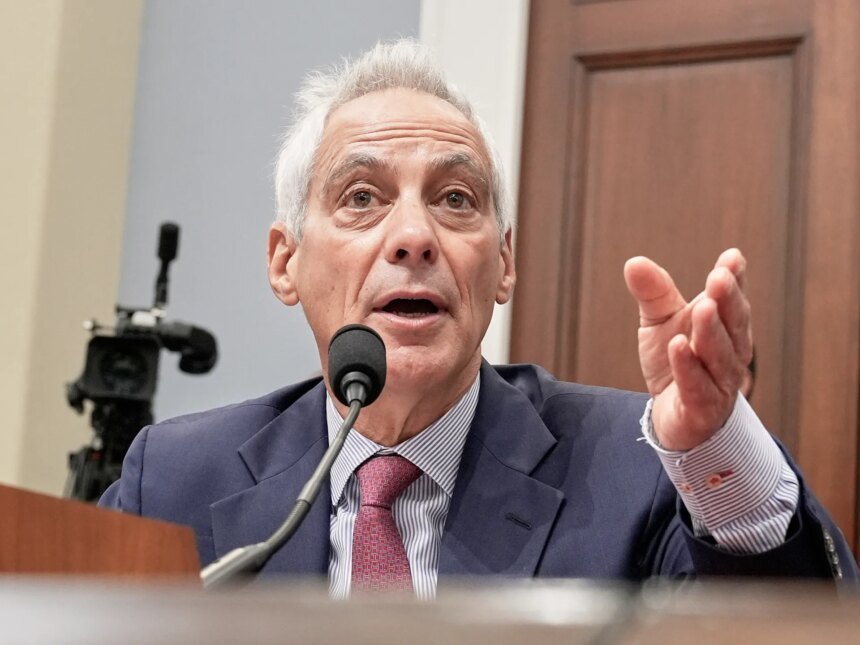
Rahm Emanuel, the former mayor of Chicago and former White House chief of staff who is seriously considering a 2028 presidential run, hopes his speech at Tel Aviv University will chart a course for the future on one of the most divisive issues in American politics.
Emanuel believes that Israel has become a “pariah state” under the government of Prime Minister Benjamin Netanyahu, and criticized the “corruption of the Palestinian leadership” and also questioned the continued “unconditional American support” for Israel.
According to the New York Times, Emanuel, since he began hinting at the possibility of running for president this year, has taken an unusual approach, especially his pledge to tell American voters what they need to hear, not what they want to hear.
The newspaper’s Jerusalem bureau chief, David Halfinger, based his report on the conversation he had with Emanuel on Monday regarding the upcoming speech in which he warns that the relationship between Israel and the United States “will not be able to continue in the way it was.”
The writer said that he had seen the draft of the letter, revealing that it includes criticism of all parties involved in the decades-long conflict between Israel and its Arab neighbors. He warns that Israel has become a “pariah state” under the government of Prime Minister Benjamin Netanyahu, criticizes the “corruption of the Palestinian leadership,” and also questions the continuation of “unconditional American support” for Israel.
According to the New York Times, Emmanuel clearly calls for an end to the policy of unconditional American support for Israel, stressing that the continuation of this support must be linked to the creation of real political changes, most notably reopening the door to the establishment of a sovereign Palestinian entity and abandoning projects to annex the West Bank.
In his awaited speech, the former American official launches an unprecedented attack on Israeli Prime Minister Benjamin Netanyahu, and holds him responsible for bringing Israel into a “dead end.”
The official believes that Netanyahu reduced all complex security dilemmas to military solutions, using an eloquent analogy that the Israeli prime minister “sees every security problem as a nail, and deals with military action as the only hammer available.”
The 23-state solution
In the speech, Emmanuel focuses on the harsh truth that “strategic isolation is not a basis for security, but rather a countdown clock” toward certain disaster.
But Emmanuel does not limit himself to directing criticism, but also offers what he describes as a “carrot” to Israelis who may be concerned about the decline of their international standing, but after the attack led by the Islamic Resistance Movement (Hamas) on southern Israel on October 7, 2023, they have become more cautious and fearful than ever before regarding the establishment of a Palestinian state on their borders.
In his speech, he also outlines the features of an idea for a new peace process aimed at reaching a “23-state solution,” which is similar in broad outlines to the Arab Peace Initiative proposed by the Kingdom of Saudi Arabia in 2002.
Through his review of Emmanuel’s speech, Halfinger revealed that under this scenario, Israel would obtain full recognition and establish diplomatic relations with all 22 member states of the Arab League, in exchange for those countries’ support for the establishment of a new Palestinian entity.
The newspaper notes that a poll it conducted in cooperation with Siena showed that 60% of Democratic Party supporters have become more sympathetic to the Palestinians, compared to only 15% who showed greater sympathy for Israel, a shift that reflects a broad change in the American political mood.
The New York Times highlighted that Emanuel will call in his speech to stop US military aid to Israel, considering that it is a rich country that can buy its defense needs like any other ally, while imposing sanctions on settlers involved in acts of violence against Palestinians, as well as on companies and banks involved in building illegal settlements in the West Bank.
Emmanuel’s criticism is not limited to the Israeli government, but he also accuses the Palestinian leadership of corruption, calling on Arab countries to bear greater responsibility in building a new Palestinian leadership that recognizes what he called “the Jewish historical connection to this land,” as he claimed.
But he singled out the Israeli right for the lion’s share of criticism, saying that the Israeli government is “complicit in the atrocities committed against innocent Palestinian families in the West Bank,” considering that this undermines Israel’s international legitimacy at a time when it cannot tolerate further isolation.
Rahm Emanuel is a man belonging to a Jewish family. His father saw the light in Jerusalem and fought in the ranks of the secret Zionist organization “Irgun” during the 1948 war. He has an uncle buried on the Mount of Olives.
Reproach out of affection
In an extensive analysis published by the Washington Post, writer Dan Merica says that Rahm Emanuel chose a completely unconventional path to present his political vision, and instead of launching slogans from comfortable platforms inside the United States, he chose to travel directly to Israel to direct his scathing criticism from a distance.
The writer described this move as a “combination of cruel affection” offered by an old friend and a historical ally, as he quoted Emmanuel as saying that the true burden of friendship lies in telling the truth, even if it is painful, stressing that this day is “the day of truth.”
The report dealt with the complex personal background of Emanuel. He is a man belonging to a Jewish family. His father saw the light in Jerusalem and fought in the ranks of the secret Zionist organization “Irgun” during the 1948 war. He has an uncle buried on the Mount of Olives.
This family and historical connection, combined with his role as an architect of centrist policies in the Democratic Party and his participation in peace negotiations during the eras of Bill Clinton and Barack Obama, gives him – according to Merica’s article – exceptional immunity against traditional accusations of hostility towards Israel, and makes his sharp tone a political slap that the Israeli government cannot easily ignore.
In his statements to the Washington Post, Emmanuel warned that bilateral relations “cannot survive or continue as they were,” expressing his conviction that radical change is the inevitable price for maintaining the alliance with the United States.

Thunder boomed
In a deep analytical reading of the scene, John Harris, the founding editor and chairman of the board of directors of Politico magazine, confirmed that this speech represents the “crawling of thunder” that officially announces the end of the old era in American politics.
He explained that Emmanuel was not speaking in a vacuum, but rather that his draft speech was the result of extensive consultations with leaders of the political and foreign establishment of the Democratic Party, including former President Bill Clinton and former Secretary of State Hillary Clinton.
Therefore, in his opinion, the message does not express the radical left wing of the party, as much as it represents “the main stream and the collective mind of the Democrats.”
Harris recalled the old rivalry between the former American official and Netanyahu, noting that the Israeli press previously quoted Netanyahu as describing Emanuel as a “self-hating Jew,” a charge that the latter mocks in his current speech and repurposes it as a tool that confirms the correctness of his position and his long history in confronting the intransigence of the Israeli right.
Harris believes that what Emanuel calls the “23-state solution” represents an attempt to overcome the deadlock that has befallen the idea of the “two-state solution” by integrating the Palestinian issue into a broader regional project that includes security, development, and economic integration.
The three newspapers agree, despite their different angles, that Rahm Emanuel’s speech goes beyond the limits of traditional criticism of the Israeli government, and reflects a broader shift within the American Democratic Party, where support for Israel is no longer a settled issue, as was the case decades ago.
Source: POLITICO + New York Times + The Washington Post