



Published On 7/8/2026
|
Last update: 14:01 (Mecca time)
“Marine Le Pen is a criminal and an outlaw. This is the only possible conclusion. She must ask herself whether it is appropriate for a criminal to run for voters.” “In common language, this is called theft. Who would want a thief in the Elysee?” and “Welcome to the Republic of Electronic Wristbands!”
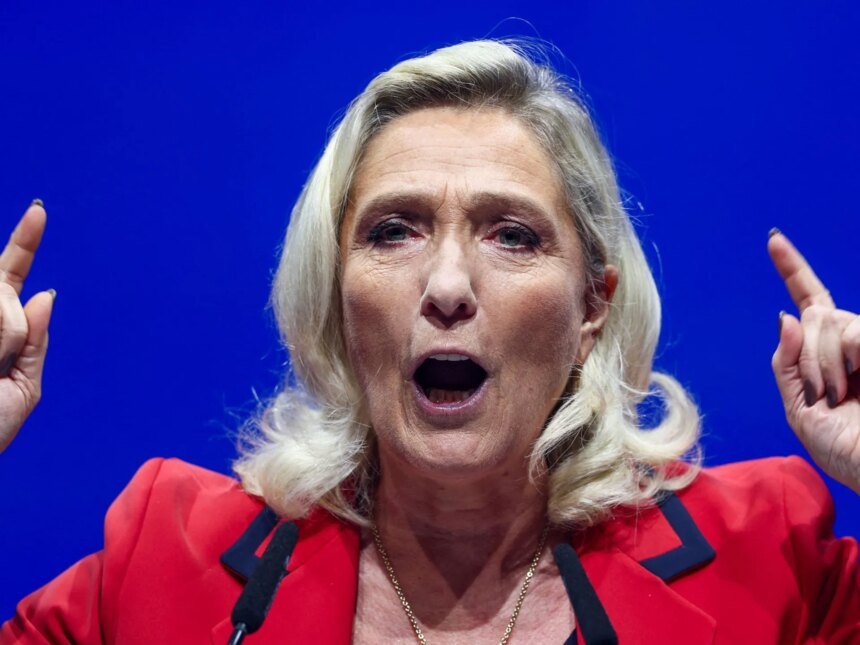
These are some of the comments of French left-wing parties on the ruling issued against the leader of the French National Party, Marine Le Pen, while her case was covered by French and international newspapers, all of which reviewed how Le Pen succeeded in maneuvering between the positions of “judicially convicted” and “presidential candidate,” thus turning her judicial crisis into fuel for her 2027 election campaign.
Read also
list of 2 itemsend of list
All newspapers, regardless of their political orientation, from the far left to the right, agreed on 4 main facts:
- First, establishing the conviction and seriousness of the crimeThey unanimously agreed that the charge was no longer in doubt, as Marine Le Pen was officially convicted of “embezzling public funds” in a systematic manner on behalf of her party, which was reflected in the ruling issued against her, as it proved the seriousness of the crime of Le Pen’s embezzlement of 2.8 million euros (about 3 million dollars) from the European Parliament’s funds for the benefit of fictitious jobs for her party, and she was sentenced to 3 years in prison, including one year with the punishment of wearing an electronic bracelet.
- Secondly, the flexibility of governance and the decision to acquit the political arenaAnalyzes found that the Court of Appeal judges deliberately reduced the “inéligibilité” penalty in order to throw the ball in the voters’ court and avoid accusing them of “political exclusion.”
- Third, the skill of maneuvering and clever escape through “veto.”On this point as well, there is a consensus that Le Pen’s immediate resort to appealing the ruling issued against her before the Court of Cassation is a brilliant political and legal tactic that allowed her to suspend the implementation of the sentence (especially the electronic bracelet) in order to fight the presidential battle with complete freedom.
- Fourth, entering a dark democratic tunnelThe readings agreed that this ruling did not end the controversy, but rather opened a presidential campaign for the year 2027 full of ambiguity, as the political future of France became dependent on a judicial timetable.
Le Monde was the only newspaper to provide a precise breakdown of the ruling’s operative part, highlighting the philosophical rationale adopted by the judges, as it focused on the concept of “the proportionality of the punishment with the voter’s freedom of choice” as a basic condition for authentic democratic expression, thus explaining the secret of the surprising judicial “lenity.”
Le Figaro was distinguished by its scathing literary editorial in which it formulated strong metaphorical expressions. It was the first to describe the electronic bracelet as “a contemporary tattoo for those sentenced to hard labor,” and to say that Le Pen enters the battle raising an implicit slogan to the Court of Cassation: “Stop me if you are able!”
In turn, the Media Part website criticized this ruling, and in an analysis by investigative writer Fabrice Arvi, it accused the judiciary itself of “giving up and being forced to retreat” under the weight of violent political and media pressure against judges since 2025.
He tried to dismantle what he called the “tunnel effect,” where he believes that the media was preoccupied with the “electronic bracelet” and ignored the fact that Le Pen was convicted twice in one year of embezzling millions.

He also called for correcting the historical lies popular on the right that corruption cases were considered “simple lapses” during the era of the late French leader de Gaulle.
Switzerland’s Lotan looked at the scene with a neutral, “external” eye, and was alone in a logistical analysis of Le Pen’s opponents. She indicated that Le Pen’s candidacy might be an unintended service to her enemies, given that competing with the young Jordan Bardella, who enjoys widespread “stardom” on social media and the idea of renewal, would have been much more difficult for the traditional political forces than Le Pen, whose repetitive speeches the public has grown tired of for decades.
La Croix newspaper focused exclusively on “the danger of democratic destabilization,” warning of the disastrous scenario imposed by Le Pen, as she will run an election campaign and threaten to withdraw at any moment weeks before the vote if a final veto ruling is issued against her, which puts the judiciary in direct, intense confrontation with millions of voters and reinforces destructive populism.
Le Nouvelle Ops was unique in conveying the harsh verbal attack of the left movement, as it focused entirely on exposing her morally before public opinion by repeating terms such as thief or criminal, and she scathingly mocked her party’s contradiction, forcing it to choose between “running an election campaign with a cup in the hand or an electronic bracelet on the ankle,” as some activists in “proud France” say.
As for the American newspapers, The New York Times and Politico, they were interested in placing the French case in a global context, as the former directly compared this case to the “model of US President Donald Trump” in the escalating conflict between populist leaders and judicial and oversight institutions globally, while Politico drew attention to Le Pen’s political genes, describing her as “The ultimate survivor” who thrives politically on crises and oppression.
While her opponents see her as a “criminal who escaped immediate punishment,” Marine Le Pen succeeded in re-presenting herself as an “extraordinary candidate,” as she brilliantly absorbed the judicial shock and turned it into an ongoing media campaign in which she imposes her personal judicial timing as France’s first political agenda, confirming the predictions of Le Tan newspaper that “this ruling opens the door to the French presidential campaign much more than it closes it.”
Source: Loops + Le Figaro + Le Monde + New York Times