

Tehran- In one of the largest shelter and feeding operations in the history of Iran, the capital, Tehran, turned into an open city of hospitality, receiving millions of mourners coming from various other provinces to participate in the funeral of the former Supreme Leader Ali Khamenei, who was killed in a joint American-Israeli bombing of his office on February 28 of last year.
While Iranian officials expected the participation of between 15 and 20 million mourners from inside and outside Tehran, since last Friday the city has been witnessing a state of alert to confront the unprecedented human influx into it, which required the work of all government agencies and service institutions in full coordination and according to an expanded plan to make this event a success, which the country seeks to record as “a turning point and evidence of the failure of the recent war launched against it.”
However, this human momentum not only presented a security and organizational challenge, but also opened a huge logistical file related to how to accommodate, feed, and provide basic services for millions of guests, which required transforming Tehran into a giant workshop extending from field kitchens, then tent cities, to service centers spread throughout it.

Great preparations
Al Jazeera Net conducted a field tour behind the scenes to determine the extent of preparations to accommodate and feed millions of guests, and to monitor the opinions of those coming from the governorates about the services provided to them.
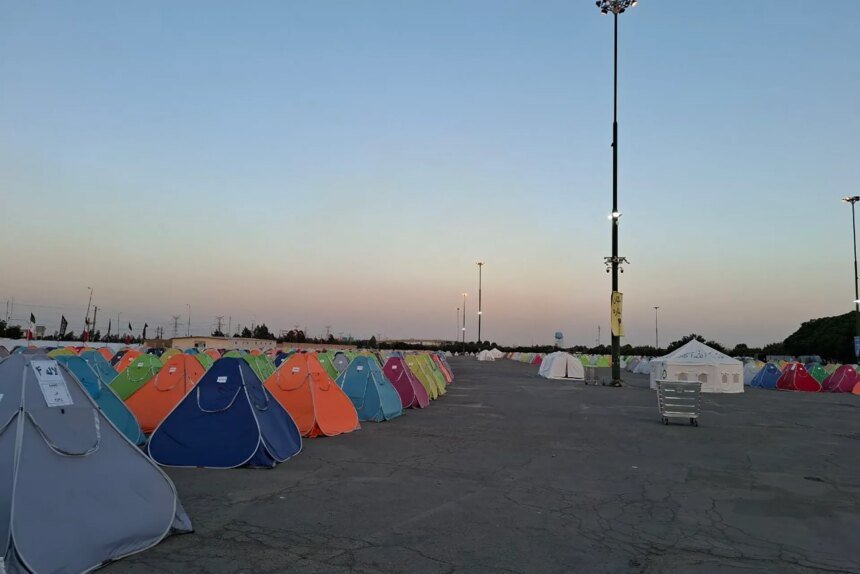
To accommodate this massive influx, the Tehran municipality coordinated with official institutions and other popular circles, and turned public parks and open spaces into tent cities and temporary housing, along with holy shrines, mosques, Husseiniyas, schools, gyms, and religious processions. There are hundreds of large and small kitchens that cook large quantities of food and distribute it for free to mourners through processions spread throughout the capital.
Hamid Reza Gholamzadeh, head of the municipality’s Center for Communications and International Affairs, says that the municipality alone planned to cook and distribute 20 million hot meals during the three days from Saturday to Monday of this week, in addition to other quantities adopted by religious processions, other government agencies, and popular volunteer agencies.

Regarding accommodation, the concerned committee has prepared a capacity of about 4 million beds, according to Gholamzadeh, who explained to Al Jazeera Net that this capacity has not been completely filled yet, revealing that tents and processions are being set up coming from other provinces in Tehran.
He added that about a third of those arriving to the capital need housing, while the rest stay with relatives, book hotels, or come on daily trips from neighboring governorates and return to their homes in the evening.
He pointed out that public transportation statistics recorded more than 9 million trips to the subway during the first 30 hours of the ceremony, with 5.5 million people traveling by metro, while the number of attendees in the Tehran prayer hall exceeded 6 million people as of the morning of the second day of the ceremony.

Tent city
Al Jazeera Net looked at the experience of the young man Hamid Farzad (36 years old), coming from the city of Shiraz in southern Iran. He found himself in a city of tents erected near the shrine of the founder of the Iranian revolution, Ruhollah Khomeini, south of the capital. He said: “When I arrived, the guidance teams directed us to this camp, which accommodates thousands of guests, and I was surprised by the size of the organization. The tents are equipped with simple mattresses, and we are provided with three meals a day, in addition to drinking water and basic sanitary facilities.”
He added to Al Jazeera Net that the services were not limited to shelter and food, as there is a medical dispensary and an ambulance, in addition to organizing the movement of cars in a designated parking lot near the camp.
Farzad did not hide the discrepancy in the levels of services between the different shelter sites, pointing out that one of his colleagues, who arrived in Tehran just one day before him, was accommodated in one of the famous shopping centers west of it, and “he enjoys more sophisticated services there than we do in the tents.”

On another tour of the streets surrounding the Grand Mosque of Tehran, Al Jazeera Net observed a dense spread of tents and service processions providing food and drink to the mourners. Most of those in charge of it confirmed that it was established in coordination with the concerned authorities without obtaining official financial support, but rather relied entirely on popular donations, as it was accustomed to in its previous activities during annual religious occasions.
For his part, Hajj Mahdi (62 years old), one of the people in charge of a service tent close to the prayer hall, told Al Jazeera Net: “We are a group of worshipers, mobilizers, and members of the boards of trustees of mosques in the sixth district of Tehran. We bear all expenses from our pockets and from the donations of charitable people,” adding that these processions work in informal coordination with the security and services committees to avoid crowding and ensure that aid reaches everyone, but they remain independent in their decision and sources of funding.

Government processions
On the other hand, there are other processions belonging to official institutions and government agencies, which operate from their annual budgets allocated for these events, ensuring their continuity and more organized equipment, according to what field officials confirmed to Al Jazeera Net.
Some service processions in the vicinity of the prayer hall set up designated tents as a temporary “kindergarten”, to serve as a refuge for parents who embraced their children in the midst of the crowd, as they provided shaded places and simple games for them, allowing the families a short period of rest and participation in the farewell ceremonies.
Shelter efforts extended to include holy places and religious shrines, which opened their doors to receive mourners. In dozens of holy shrines, carpets spread out in courtyards and shaded spaces were seen, as they were turned into temporary rest houses. Some of these shrines also packed their restaurants to provide hot meals to guests.

On the roadsides, some service convoys took the initiative to spread carpets on the shaded sidewalks to provide spaces for short rest, especially for the elderly and families. Zakaria, one of the volunteers, told Al Jazeera Net: “We know that standing for hours under the sun is tiring, so we brought these rugs to give the mourners an opportunity to sit, even for a few minutes, during which they are served quick meals, drinks and tea. This is the simplest service we provide to the guests of our city.”
Some swimming pools resorted to providing free bathing services to mourners, which relieved them of the burden of the heat. A number of citizens also opened the doors of their homes to receive a limited number of guests, in an individual initiative that reflects the spirit of social solidarity.
As for those looking for a higher level of comfort, the hotel sector has provided them with a subsidized option, as Muhammad Ali Farrokh Mehr, President of the Tehran Hotel Association, announced the provision of 13,000 beds at a 50% discount for ceremony visitors.
Despite the diversity of shelter options, including free tents, subsidized hotels, and open houses, the biggest question remains about the ability of these efforts to accommodate millions in the cities of Qom and Mashhad, as they are expected to turn into major human camps during the next few days.