

Published On 7/6/2026
Behind the scenes of international politics, where alliances are forged and broken, an unprecedented crack in the wall of transatlantic relations is unfolding.
In an in-depth investigative report published by the American newspaper The Wall Street Journal, prepared by journalists Joe Parkinson, Drew Hinshaw, and Daniel Michaels, details emerge of the critical moments in which the old continent realized that its historical ally and traditional protector, the United States, may have turned into the greatest threat to its stability.
Read also
list of 2 itemsend of list
According to the report, it was approaching midnight in Brussels, and about 30 European leaders were busy in their fifth hour of an emergency meeting, on the agenda of which there was only one topic: how to deal with the separation from America.
The organizing thread of the Wall Street Journal report was an attempt to clarify the path of a conviction crystallized in the dark corridors of Brussels, a conviction that appeasing Washington is no longer a viable strategic option, and that Europe stands today on the threshold of a new era of forced independence.
Psychotherapy night
It was a cold night in January 2026, and inside the headquarters of the European Council known as the “Space Egg”, European leaders met in an emergency and closed session, in which they and their companions were stripped of their phones.
The session was not ordinary. Some of the attendees described it as a “night of psychological therapy,” where a state of deep anxiety prevailed as a result of the US administration’s volatile policies and its sudden threats, such as threatening to annex the island of Greenland.
At that charged moment, French President Emmanuel Macron took the initiative to put an end to years of European hesitation, saying decisively: “We are drawing an end here… there is no going back.”
This sentence was not just an expression of passing anger, but rather an announcement of the start of a new strategic path. Macron was not alone in this proposal, as the Prime Minister of Belgium expressed the continent’s fears of turning into a mere tool in the hands of an American administration searching for mining and energy deals, ignoring its leadership role in the free world, warning that Europe risked becoming: “a miserable slave to the United States.”
Carney to the Europeans: Old America is gone forever
The winds of change are blowing from Canada
In the midst of this storm, the push for independence came from an unexpected side, from someone who was not in the room. It was the new Canadian Prime Minister, Mark Carney, who played a pivotal role in awakening the allies from the illusion of excessive dependence on Washington.
Carney, who came to power following American threats to annex his country, sent decisive messages to European leaders, assuring them that the crisis was deeper than the person of the American president, and that it reflected a structural shift in American policy, saying his speech, which was echoed by European capitals: “The old America is gone forever.”
Flattery diplomacy
This stark Canadian assessment encouraged European leaders to silently embark on a process of “De-Americanization” by replacing American technology, building European data centers, and testing the independence of their military arsenals.
On the other side of the scene, NATO Secretary General Mark Rutte was trying to salvage what could be salvaged by adopting “flattery diplomacy,” proposing to increase defense spending and granting the US President formal “political victories” to keep him committed to protecting Europe.
But this strategy quickly collided with the volatile reality of American politics, especially after the Alaska summit between Trump and Russian President Vladimir Putin and the resulting American-Russian understandings that marginalized European interests.

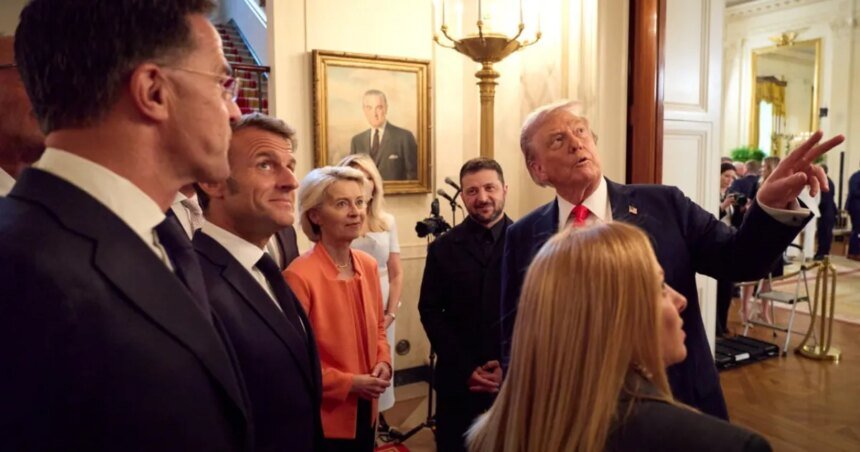
Six European presidents and prime ministers, as well as Rutte and von der Leyen, president of the European Commission, entered the White House with a string quartet and praised the president for his strength as a negotiator, while news cameras filmed them. Trump told Rutte: “Thank you very much, Mark. You are a great leader. You are doing a great job.”
But Macron, who was watching the scene, seemed uncomfortable, according to the report.
Here the leaders realized that they would not be able to force Trump to support the Western position on Ukraine – or perhaps even any other policy. One attendee described this as a “painful experience,” noting how little influence America’s closest allies, even as they moved as a bloc, had on the US administration.
This new reality prompted even the most initially optimistic European leaders to change their positions. Conservative Prime Minister of Italy Giorgia Meloni, who had previously argued that an understanding could be reached with the American administration, retreated from her optimism after the American escalation in the Middle East, to admit to her European counterparts the bitter truth: “Trump is not rational.”
The British Intelligence Agency likened the atmosphere of fear and sharp fluctuations in the White House to two famous literary works that embody paranoia and court intrigues: The White House has become a mixture between the play “The Crucible” and the novel “The Wolf’s Hall.”
Paranoia
The concern was not limited to political leaders, but extended to the corridors of European intelligence, which provided bleak assessments of the nature of decision-making in Washington.
European intelligence reports have observed a complete absence of the usual institutional work in the American administration.
Perhaps the most accurate and harshest description of this situation is what the British Intelligence Agency (MI6) provided to Prime Minister Keir Starmer, when it likened the atmosphere of fear and sharp fluctuations in the White House to two famous literary works that embody paranoia and courtly intrigue: The White House has become a mixture between the play “The Crucible” and the novel “The Wolf’s Hall.”
In the end, it seems that what happened in that closed room in Brussels was only the beginning.
Europe has passed the stage of shock and attempts at appeasement, only to find itself forced to walk a bumpy path towards strategic independence, a path imposed by Washington’s transformations, in which Europe assured itself that there is indeed… “no going back.”