

With the renewal of the anniversary of independence in the United States of America, Americans are retelling a familiar story about the merits of their country’s independence, and with repetition, the merits of that story become indisputable axioms.
The common narrative says that a united people rose up against a mad king, Britain’s King George III, declared a set of self-evident truths, and gained their freedom from British persecution.
This narrative has been repeated these days on the 250th anniversary of independence, which falls on July 4th every year, but a report in Newsweek magazine finds that the documents contained in the British archives tell a more complex story than what the American narrative says. The men who made the American Revolution realized that political freedom requires a convincing argument, and arguments are usually not neutral.
In its report, the magazine mentioned 5 myths circulating in the American narrative of the story of independence, as follows:
Myth 1: Advertising is a list of proven facts
The American Declaration of Independence included many accusations against the King of Britain, and was introduced by saying: “Let the facts be presented to a just world.” The Americans largely took this call at face value, treating the accusations against the king as proven facts.
But the document, signed by 56 delegates from the 13 colonies, reveals its own approach. After an eloquent preamble about inalienable rights, the body of the document appears as a long indictment detailing one injustice after another, each beginning with a repeated phrase attributing the action to the then King of Britain.
According to Newsweek, this was intentional, as the colonies’ real grievances were arranged in a one-sided indictment, and tangled disputes over taxes, trade, sovereignty, and self-government were compressed into a clear-cut story of tyranny in which the king was the prime suspect. This flaw was pointed out by British loyalists at the time.
Thomas Hutchinson, the exiled former governor of Massachusetts, published a response in 1776 dismissing the whole matter as a list of “imaginary grievances,” and the London lawyer John Lind responded with an entire book in the same year refuting the Declaration of Independence.
In the book “Tyrants and Rogues,” published on the occasion of the 250th anniversary of America’s independence, historian Robert Parkinson argues that the 27 counts included in the American Constitution – not the famous preamble – were the largest part that the framers of the Constitution drafted and engineered to portray George III as a “usurper ruler.”
The book also highlights an uncomfortable detail of the “King did everything” memory: only the first 12 complaints target the Crown, while complaints from 13 to 22 target the British Parliament, according to the book.
In short, the Declaration was America’s first great work of international propaganda, written to convince reluctant colonists, foreign courts, and posterity that this was not rebellion, but justified secession.
According to Newsweek, the charges contained in the American announcement were not invented, but were selective, hostile, and sometimes exaggerated. It also argues that the List of Grievances was an act of revolutionary propaganda, and a fair assessment of its accusations will find that many of them lack evidence.

Myth 2: George III was a crazy tyrant
The Newsweek report believes that the image of George III in the American collective’s memory as a “deranged, cruel king obsessed with crushing freedom” was nothing but an image produced by inventions that took place during wartime, and was renewed in the modern era through some comedic works of art, such as the musical “Hamilton”, which was produced and composed by the American artist Lin-Manuel Miranda.
As for the real king, according to Newsweek, he opposed independence and his stance against the colonies intensified later, and it indicates that the documents revealed recently show a serious constitutional monarch who runs Parliament, the ministers, and the war, and not a tyrant obsessed with power.
The magazine says that the latest evidence of the above was revealed by the “Georgian Era Papers Programme,” which was opened at Windsor Castle in 2015 in the presence of Queen Elizabeth II. It is a joint effort between the Royal Collection Fund and King’s College London to preserve and digitize hundreds of thousands of documents that have long been under embargo.
There is a document within the aforementioned program that casts doubt on the image of the tyrant that is entrenched in the American collective memory.
In a 1766 memorandum on the Stamp Act, King George III wrote that he found the repeal of the law “much preferable to its imposition,” urging Parliament to “justly redress any grievances” and expressing his fear that its forceful imposition might “enlarge the gap” with America.
This note shows a degree of compassion that common images of him often do not capture. But by the fall of 1774, with the First Continental Congress in session, George III told his prime minister that “the matter is decided” and that the colonies must “submit or conquer.”
George III wrote to Lord North: “I do not wish to resort to more stringent measures, but we must not retreat, and by calm and constant follow-up of the measures which have been adopted, I trust they will eventually submit.”
More broadly, George III was a constitutional monarch loyal to his country, committed and often serious, working extensively through written papers, correspondence and ministerial advice, rather than ruling as a despot. The Georgian papers show a king deeply involved in government affairs and closely following policy details.
His reign also coincided with a great flourishing of literature, art, science, and philosophy, and he was a patron of many endeavors in these fields. His private papers reveal intellectual interests that go beyond politics.
According to Newsweek magazine, George III was not a monster as the American collective remembers, but he was not completely innocent of some of what was attributed to him.

Myth 3: The Boston Massacre happened as the painting shows it
On March 5, 1770, five people were killed at night on King Street in Boston in an incident that gained widespread fame.
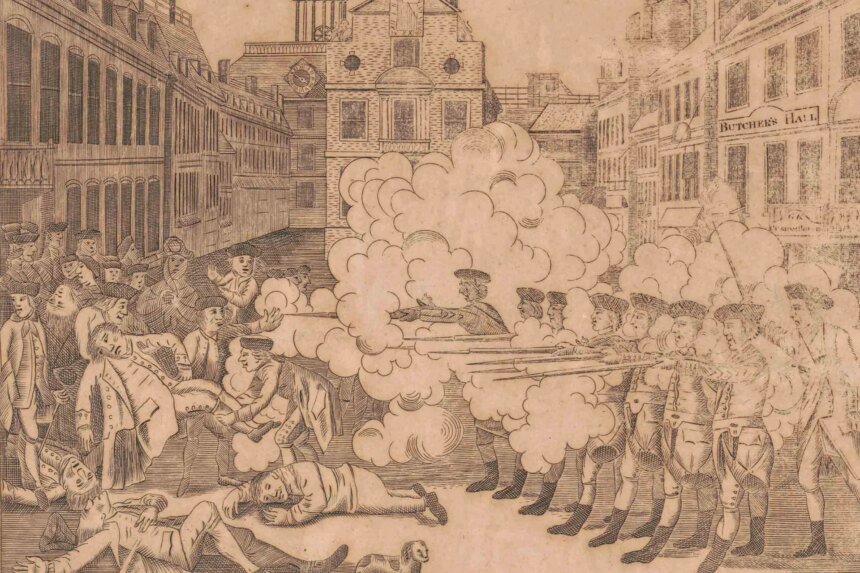
Although the incident is horrific, the image most Americans have of it is not from court records, but rather from a photograph of artist Paul Revere.
His hand-engraved and colored painting appeared within weeks, depicting a line of British regular soldiers firing on orders at unarmed civilians, while renaming the customs building where the victims died “Butchers’ Hall” to convey a specific message about the incident.
According to Newsweek magazine, the painting was the most effective means of that era, and it contributed to inflaming feelings against British rule, even though it did not agree with what witnesses narrated during court sessions regarding the incident.
During the court sessions, the accounts of the witnesses conflicted, and many of them disagreed on the uniform worn by the British Commander Thomas Preston, who was accused of issuing orders to fire, and many of them swore that he was standing in front of his men, and did not issue orders while standing behind them, contrary to what was stated in the accounts of some.
Preston was acquitted, along with 6 of the eight soldiers who were accused in the killing of the five people in Boston. Two were convicted not of murder but of manslaughter. Their defense attorney was a young man from Boston named John Adams.
This incident illustrates how propaganda works at the height of its power: it rarely invents an event, but rather simplifies it and turns it into a politicized symbol.
Before the Boston Massacre became part of history, it was a painting drawn by an artist, but it was more clear and decisive for people than what was stated in the actual evidence of the incident.
Myth 4: Americans wanted independence
The Newsweek report notes that independence was not inevitable, nor was it even a majority opinion in 1775.
A full year before the declaration – and months after the shootings began in the cities of Lexington and Concord, events that marked the beginning of the American revolution against British rule – the Second Continental Congress sent King George III the “Olive Branch Petition,” drafted by John Dickinson, one of the founding fathers of the United States. The petition opened by addressing him as “His Majesty’s loyal subjects in the colonies” and pleaded for reconciliation.
The petition said: “The union between our mother country and these colonies, and the vitality of a flexible and just government, have produced benefits of so great importance, and afforded such a guarantee of their permanence and increase, as to arouse the wonder and envy of other nations, as they witness the rise of Great Britain to a power more extraordinary than the world has ever known.”
According to Newsweek, this document was signed by prominent names, including John Adams, Thomas Jefferson, and Benjamin Franklin. But George III refused even to receive it, and in August of that year declared the colonies in a state of outright rebellion.
So, independence was not the first idea of a unified people. Rather, it was closer to the final step in a collapsing reconciliation, the moment when a divided movement, after begging to save the relationship, crossed a line from which it could not turn back.

Myth 5: The American people were united against Britain
The magazine confirms the fact that the American Revolution was a civil war. In the South, it was described as “a bloody civil war that often pitted neighbor against neighbor.” The state of Carolina, for example, experienced a civil war that included raids, acts of revenge, and confiscation of property, which tore apart the cohesion of society.
Those who described themselves as “patriots” fought those who were described as “loyalists” to the British throne. Slaves, indigenous people (Red Indians), and border settlers formed alliances based on their own interests in a war that carried various slogans.
Therefore, Newsweek magazine says – the myth of the “one people” rebelling against British rule does not reflect the conflict that was present from the moment of its founding, over who should be included in this term and who should be excluded from it. These divisions fueled the civil war that broke out in the United States after that.
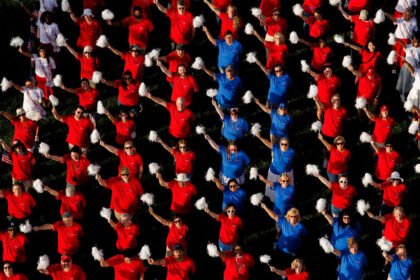
Newsweek says that on the Fourth of July, fireworks will light up America’s skies, the founding document will be formally read at the celebration ceremony, and the familiar story will be told again, but the true story of Independence Day is stronger than the idealized myth told at Independence Day ceremonies every year.