

Published On 7/6/2026
The Chinese People’s Liberation Army newspaper reported that the United States is intensifying its military and organizational steps in the Pacific region, by combining a large-scale naval exercise with the renaming of one of its most important military commands, which reflects its increasing focus on the Western Pacific within its security arrangements.
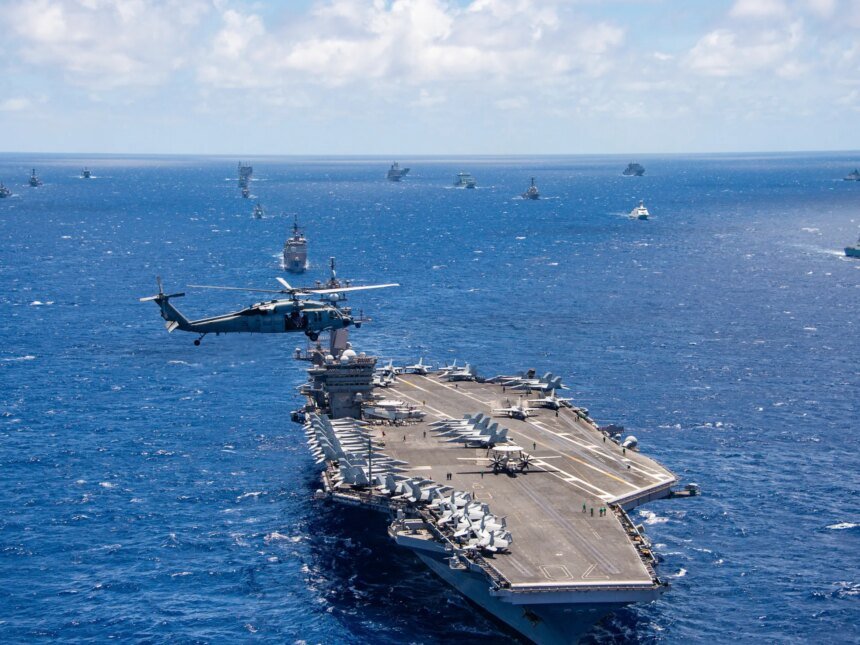
The US-led RIMPAC naval maneuvers began in Hawaiian waters and surrounding areas on June 24, with the participation of 31 countries and about 25,000 military personnel, in addition to more than 40 surface ships, 5 submarines, and about 140 aircraft of various types, marking the largest edition since the launch of these maneuvers, which will continue until July 31, 2026.
Read also
list of 4 itemsend of list
The newspaper also indicates that the maneuver bears the slogan “Partnership: Integration and Preparedness,” and that the structure of participation reflects a pivotal role for the United States alongside its main regional allies, namely: Japan, South Korea, Australia, and Canada, while other roles are divided between coordination tasks and logistical and intelligence support.

The maneuvers program focuses on exercises of an intensive practical nature, including detecting potential enemy submarines and ships operating in the open ocean, operations to close sea lanes, and dealing with large combat ships, in addition to the “ship sinking” exercise carried out by the United States with a number of its closest allies using live munitions against “decommissioned” American ships with a large tonnage. With the aim of testing the effectiveness of anti-ship weapons systems and the capabilities of the participating units to coordinate in striking complex targets.
The maneuvers highlight the integration of new areas into training, as they include for the first time missions in space, cyberspace, and electronic warfare, in addition to a wide deployment of smart unmanned equipment such as drones and underwater vehicles, as part of what the newspaper describes as an attempt to test the concepts of “distributed maritime operations” and raise the level of joint readiness in a multi-domain environment.
At the leadership level, the United States adopted in this session an expanded model of the command structure, where the Commander of the US Third Fleet assumes command of the joint force, with sub-leadership positions assigned to senior officers from countries such as Japan, Chile, Canada, and South Korea, which reflects a trend to increase the participation of allies in managing multinational operations, and enhance the ability to work according to unified standards and procedures.
Brian Clark:
Deleting the word “Indian” from the name symbolizes a greater focus on the Pacific Ocean, and that the American strategy is to reduce burdens in some directions in exchange for enhancing capabilities in the Western Pacific.
In parallel, the US Department of Defense announced on June 16 that the “Indo-Pacific Command” would regain its previous name (Pacific Command), while keeping the scope of responsibilities and tasks the same.
This command was established in 1947 under the name (Pacific Command), and continued for more than seventy years before its name was changed in 2018. Which means that returning to the old name is a re-evaluation of military deployment and directing attention more clearly towards the Western Pacific region, according to what the newspaper reported.
The Chinese People’s Liberation Army newspaper quotes Brian Clark, a defense analyst at the Hudson Institute, as saying that deleting the word “Indian” from the name symbolizes a greater focus on the Pacific Ocean, and that the American strategy is to reduce burdens in some directions in exchange for strengthening capabilities in the Western Pacific, especially at the level of island chains, advanced bases, and naval and air deployment.
The newspaper concludes that it is expected that this change in naming will be accompanied by practical moves that include increasing reliance on allies for some tasks, with a growing role for Japan, South Korea, Australia, and the Philippines in supporting the American deployment, at a time when multinational maneuvers continue, led by “RIMPAC,” playing the role of a major platform for testing this pattern of coordination and positioning in the Western Pacific.