


Published On 7/6/2026
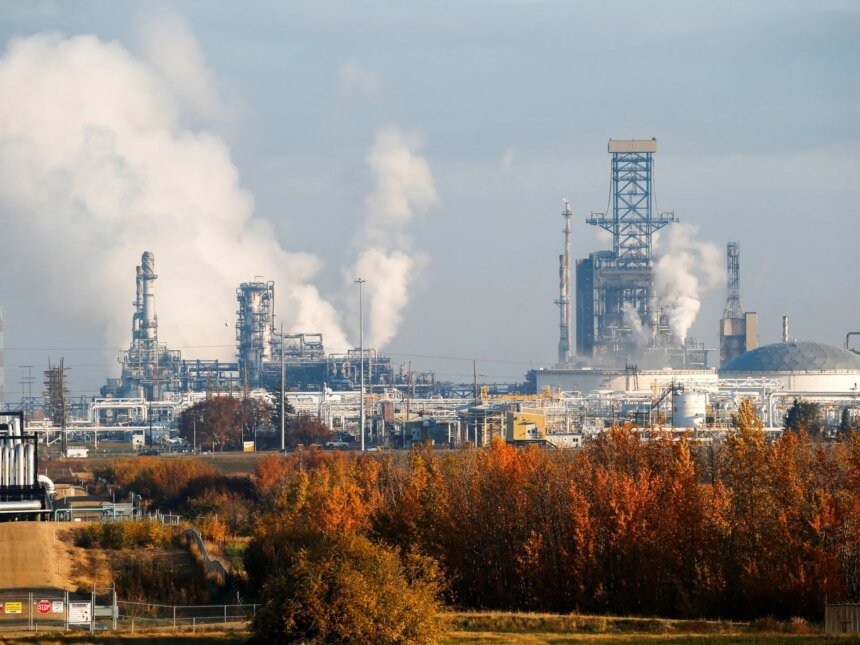
Canada is moving to accelerate the development of its oil sector by expanding traditional production and creating a new corridor for transporting crude within the country, as part of a strategy aimed at increasing supplies, diversifying export routes, and reducing dependence on American infrastructure, taking advantage of the rise in oil prices during the Iran war.
Data from the Province of Alberta showed that the authorities issued 1,764 drilling licenses between the beginning of the year and June 12, the highest level for the same period since 2014, while the Clearwater formation accounted for about a fifth of the licenses, which is the highest share ever recorded.
Read also
list of 3 itemsend of list
The Clearwater field is one of the most prominent conventional oil reservoirs in Canada, as it allows crude production using multi-branch horizontal drilling techniques, without the need for expensive thermal extraction techniques used in oil sands, which allows production to increase within months instead of years.
The field’s production witnessed rapid growth from about 30,000 barrels per day in 2017 to 230,000 barrels per day in 2025, while its reserves are estimated at about 1.6 billion barrels, according to the Alberta Energy Regulatory Authority.
Increasing investments
Companies operating in the field increased their investments to take advantage of higher prices, as Tamarac Valley Energy increased its capital budget to between 430 and 450 million Canadian dollars ($302 million to $317 million), after selling other assets to focus entirely on Clearwater.
Headwater Exploration also raised its investment budget to 250 million Canadian dollars ($176 million) while increasing its oil price forecast to $78.85 per barrel, and expects its production to grow by 10% during the year.
Sector officials believe that the low development costs and rapid start of production make Clearwater one of the most competitive oil projects in North America, with mergers and acquisitions expected to continue among the companies operating in it.
New pipeline
In parallel, the governments of Alberta and Ontario have proposed the construction of a new 3,300-kilometre “Northern Energy Corridor” energy corridor and pipeline, linking the oil storage hub at Hardesty to the refining hub in Sarnia.
The project aims to transport about 500,000 barrels per day in its first phase, with the possibility of raising its capacity to 800,000 barrels per day, to meet local demand and open new export outlets.
The initiative comes as part of Canada’s efforts to reduce its dependence on American infrastructure, especially after trade tensions with the United States. Ontario is also considering establishing a strategic oil reserve, while the feasibility study of the project is expected to be completed by the end of the year.

Standard production
The expansion of drilling operations coincided with the continued growth of Canadian oil production to unprecedented levels, as the average production reached 5.35 million barrels per day during the year 2025, compared to 5.14 million barrels per day in 2024, recording a new record level for the second year in a row, while production rose to 5.64 million barrels per day in December, which is the highest monthly level ever.
Alberta accounts for about 83.8% of Canadian oil production, followed by Saskatchewan with 8.2%, Newfoundland and Labrador with 4.5%, and British Columbia with 2.8%.
Alberta was the main driver of production growth in 2025, after it added 182,000 barrels per day, an increase of 4% year-on-year, driven by an increase in unrefined bitumen production from oil sands, while Newfoundland and Labrador production increased by 15%, and British Columbia by 7%, compared to a decline in Saskatchewan production by about 3%.
The operation of the Trans Mountain Pipeline Expansion Project since May 2024 has also contributed to increasing oil transportation capacity from Western Canada, allowing continued production growth through 2025 and absorbing additional quantities heading to the markets.