

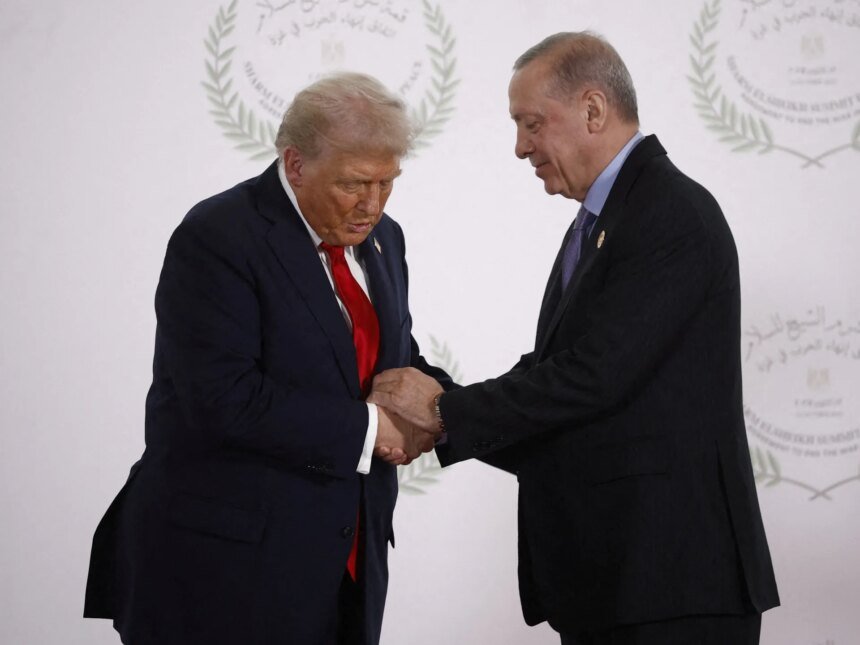
Turkey issued a five-lira commemorative coin in a symbolic step to commemorate the thirty-sixth summit of the North Atlantic Treaty Organization (NATO), hosted by Ankara. But the importance of the summit goes beyond just celebrating ways to advance cooperation between members at the height of tensions, which makes aspirations for the results of the upcoming meeting between Turkish President Recep Tayyip Erdogan and US President Donald Trump of great importance.
The long-standing relations between the two countries, which share early diplomatic ties since the nineteenth century, reflect their status today as the two largest military institutions in the North Atlantic Treaty Organization (NATO), and two of the most advanced and efficient defense industries in the world.
While the former enjoys broader global influence and influence, the latter is characterized by a unique geographical location and a group of bilateral alliances, which makes each of them a very important contributor to NATO’s strength, with ties driven by personal relationships despite the difference in views and outstanding differences between the two countries on more than one file.
The following report answers questions at the forefront of the NATO summit and the upcoming meeting between the two presidents.
Personal relationships: integration or clash?
Relations between Türkiye and the United States have been characterized by cordiality under President Donald Trump, who praises constantly In his statements to Turkish President Recep Tayyip Erdogan, which strengthened Türkiye’s position within NATO in the wake of tensions with a number of Western capitals.
The impact of the personal relationship between Trump and Erdogan is highlighted as one of the most important factors in this transformation. The US President announced that he would participate in the NATO summit in Turkey specifically for Erdogan, describing him on more than one occasion as a “friend” and “exceptional leader.”
He also indicated that had Türkiye not hosted the summit, he would not have decided to attend it, which observers considered an important diplomatic gain for the Turkish president and a message that strengthens Ankara’s position within the alliance.
advertisement
In general, the characteristics of both the United States and Turkey contribute to determining the extent of NATO’s strength, and the relationship between them also contributes to drawing its borders, which is emphasized by a report issued by the American research center, the “Atlantic Council.”
The Council adds in its analysis: “When the national leaderships in both countries agree, the horizons for military, diplomatic and strategic coordination expand, and when they do not agree, stagnation and tension prevail.”
But although the two presidents maintain a positive tone and constructive agenda, much remains uncertain about the future of US-Turkish relations and what it portends for NATO more generally.
What are the thorny issues between the two countries?
Despite the positive atmosphere between Trump and Erdogan, through the meeting at the summit, the two presidents seek to thaw several controversial issues, most notably:

- Washington’s decision to exclude Turkey from the F-35 fighter program and impose sanctions on it in 2020 after Ankara acquired Russian-made S-400 air defense systems, which the United States considers a security threat.
- Washington imposed sanctions on the Turkish state-owned Halkbank, which is accused of circumventing the US economic sanctions imposed on Iran, as the volume of money transfers that form the core of these accusations is estimated at about $20 billion, according to the indictment issued by the US federal prosecutor.
- Ankara had previously objected to American support for the Kurdish People’s Protection Units in Syria (SDF), which Ankara considers an extension of the Kurdistan Workers’ Party and classifies as a terrorist organization, but American support later declined with the SDF signing the integration agreement into Syrian institutions in February 2026.
Will the Iran issue be raised?
The meeting comes after the United States and Iran signed, last June, a memorandum of understanding stipulating the cessation of fighting, the lifting of the US naval blockade on Iran, and the reopening of the Strait of Hormuz.
However, there have been public complaints by President Trump about the failure of allies to play a role in efforts to keep the Strait of Hormuz open to freedom of navigation or in the military effort against Iran. This file is supposed to be among the talks between Trump and Erdogan.

Türkiye maintained a balanced stance towards the war, strengthening its diplomatic role to prevent the conflict from expanding regionally and harming its interests in the region. Regarding the memorandum of understanding signed between the United States and Iran, Turkish Foreign Minister Hakan Fidan said: “In terms of political will, both parties are very serious about the ultimate goals.”
But he also clarified that the signed memorandum left many contentious issues for future discussions, including the Iranian nuclear program, the lifting of sanctions imposed on Iran, and freedom of navigation through the Strait of Hormuz.
The American research center, the Atlantic Council, says in a report that sound American-Turkish relations would help secure the interests of the United States and its allies in the Middle East and Europe, and the 2026 NATO summit should be a platform to showcase these relations.
advertisement
European officials are concerned that the war on Iran, and Trump’s dissatisfaction with European governments over their response to it, may cast a shadow over the summit.
According to what Reuters reported, the leaders are expected to state in the summit declaration that “the allies reaffirm that Iran should never possess a nuclear weapon, and call on Iran to fully respect freedom of navigation in the Strait of Hormuz.”
What about the Ukraine war?
The US administration relied on Türkiye to play a mediation role in order to end the war in Ukraine, as Ankara is credited with following a balanced diplomatic approach since the outbreak of the crisis, by standing at the same distance from the conflicting parties.
Erdogan says that his country “is the only party capable of speaking directly with both the Russian and Ukrainian presidents.”
It is expected that this file will be on the discussion table between the Turkish and American presidents. Turkish Foreign Minister Hakan Fidan announced on the eve of the summit that Turkey is ready to host a new round of negotiations aimed at ending the Russian-Ukrainian war, but he indicated that he does not expect it to be held in the near future.
The Turkish minister revealed that Russia and Ukraine are ready to enter into talks and negotiations, but the process still needs the influence of the United States.
Trump spoke ahead of the summit tomorrow, Tuesday, saying: “We will go to NATO, and we will talk about this, and I believe we will do that. I believe we will end this war.”
It is expected that during the summit, as revealed by Reuters, the allies will pledge to provide 70 billion euros in the form of military equipment, assistance and training to Ukraine, and to confirm their sovereign commitments to maintain at least equivalent levels in 2027. But the United States is unlikely to contribute to the financing.
What is the nature of the differences within NATO?
The summit takes place at a crucial time for the alliance as the United States reduces its security role in Europe, and Washington pressures its allies to shoulder more of the burden of military spending.
At last year’s summit, the 32 member states agreed to spend 5% of their gross domestic product on defense, including 3.5% in their defense budgets and 1.5% on roads, bridges and ports, so that troops and equipment could move faster in times of conflict, but a small number of member states showed actual commitment to the proposed percentages.
In principle, Türkiye supports increasing military spending, but demands a fair distribution of burdens within the alliance and its participation in European defense initiatives and plans. Through the upcoming meeting between Erdogan and Trump, Ankara can count on Washington to put pressure on its European allies.
Before the summit, the US Ambassador to NATO, Matthew Whitaker, said that his country has measures that it will take with those who do not comply with what is required of them, without providing explanations about that.
A text seen by Reuters indicates that European allies and Canada are expected to announce greater burdens within the alliance in cooperation with the United States, after increases in their investments in defense needs estimated at more than $139 billion in 2025.
What does Türkiye want behind arms deals?
Turkey seeks to highlight its growing defense industry capabilities and reiterate its longstanding call for NATO members to lift all restrictions on defense trade within NATO.
In bilateral talks with Trump, Erdogan is expected to highlight improved relations between Ankara and Washington, while pushing for the lifting of US sanctions and the resumption of participation in the F-35 fighter jet programme.
It is also expected that deals worth tens of billions of dollars will be announced during a defense industry forum in parallel with the NATO summit in Ankara.
advertisement
Although the Turkish army is the second largest army in NATO, it lacks integrated missile defense systems of its own, and relies heavily on NATO systems and fighter aircraft.
Ankara is working to overcome its faltering negotiations with Paris and Rome, to obtain the SAMP/T system within the integrated air and missile defense network that it plans to possess, called (Steel Dome).
This system can track dozens of targets simultaneously and intercept multiple threats simultaneously, and it is the only system made in Europe that is said to be capable of intercepting ballistic missiles.
The head of the NATO Military Committee, Giuseppe Cavo Dragoni, stated that Turkey’s possession of about four thousand companies in the defense industries, and its presence among the ten largest arms exporting countries, along with more than 100,000 engineers and specialized technical staff, makes it an important partner appreciated and followed by NATO allies.