


Published On 2/7/2026
The water and environmental catastrophe in the Gaza Strip has reached its peak after 1,000 days of continuous war, as programmed thirst and water pollution have turned into a deadly reality that encircles the lives of millions of displaced people, and outbreaks of epidemics in their tents under the heat of summer, exceeding the limits of a fleeting crisis into a comprehensive destruction of all elements of hygiene and health safety.
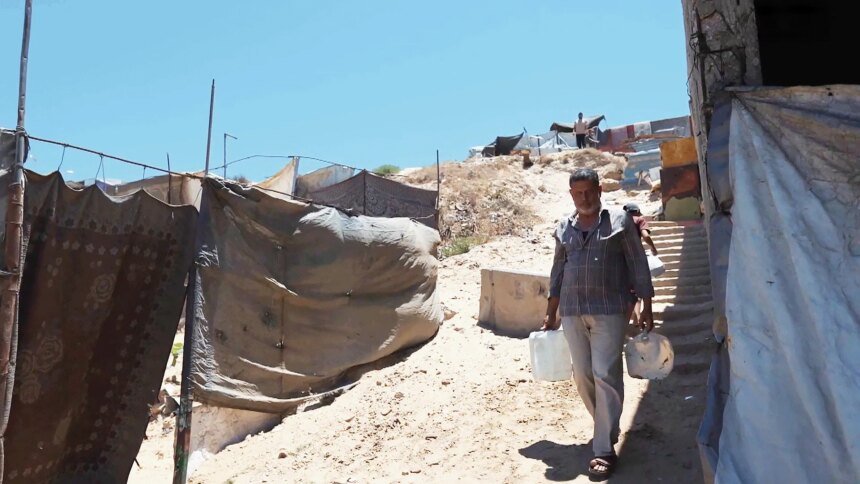
On the ground, the testimonies of the displaced sum up this hell, as women are forced to fetch water with buckets from long distances, at a time when displaced people scream that “most people wish to die,” unable to bear the war of thirst that has destroyed any alternative to life in Gaza.
In the displacement camps, the arrival of the water tanker has become a weekly appointment, based on which household chores are scheduled, including cooking, washing, bathing, and medication. With the advent of summer and the need for water increasing, limited amounts of water turn into a daily expense within each tent.
Water security zeroing
According to UN reports, 82% of Gaza’s displaced people were deprived of their water security, and more than 70% of them became completely dependent on transported water tanks, and 90% of water and sanitation facilities were out of service, completely depriving 200,000 people in one location in Gaza City of service.
For his part, environmental and water expert Mazen Al-Banna explained to Al Jazeera that the occupation destroyed more than 85% of water desalination networks, tanks, wells and plants, in addition to sewage networks and treatment plants for conveyor lines.
This destruction caused the daily per capita share of water to drop to only between 5 and 10 liters at the beginning of the war, compared to 85 liters before, noting that the World Health Organization standard is 100 litres.
Despite the efforts of municipal crews and the Water Authority to raise production currently to 150,000 cubic meters per day for approximately 2.2 million people, the operation of the facilities – according to Al-Banna – faces the specter of permanent cessation due to complete reliance on generators and the scarcity of fuel, following the destruction of the power station and transmission lines.

Disastrous scene
The disaster does not stop at the borders of thirst, but extends to the destruction of the environment, as Al-Banna revealed that 60 thousand cubic meters per day of raw sewage water is pumped directly into the sea by gravity as a result of the destruction of pumping and treatment stations.
The remaining 20,000 cubic meters are drained into cesspits in the camps, especially in the southern region with sandy soil, high permeability and near-surface water, causing total and chronic destruction of the aquifer and surrounding wells on which municipalities depend.

Epidemic outbreaks
This environmental pollution was immediately translated into a terrifying health crisis, as the Director of Medical Relief, Dr. Muhammad Abu Afsh, confirmed the daily influx of huge numbers of patients suffering from severe skin and intestinal problems due to the lack of clean water, amid a complete lack of medicines and antibiotics.
With the onset of summer and the spread of insects and stagnant water, scabies and flea diseases have spread, as the United Nations Children’s Fund (UNICEF) recently recorded 9,300 cases of chickenpox among children in just two weeks in 130 health centers as a result of weak immunity and the fragility of the humanitarian situation.
Since Israel launched the war of extermination on the Gaza Strip in October 2023, more than 73,000 Palestinians have been martyred, and more than 173,000 others have been injured, in addition to widespread destruction that affected about 90% of the civilian infrastructure in the Strip, according to Palestinian data.