

Egyptian artist Aiten Amer documented scenes of a fox wandering among the trees of her home garden in one of the residential neighbourhoods, “a compound,” expressing her concern after the control workers she hired were unable to catch it.
Although this incident seems unusual in Egypt, it is not unique, as urban expansion has caused wild animals, including foxes, to lose their traditional habitats. They found what they were looking for in cities, which not only entered them, but also developed genetic and behavioral characteristics that help them live there.
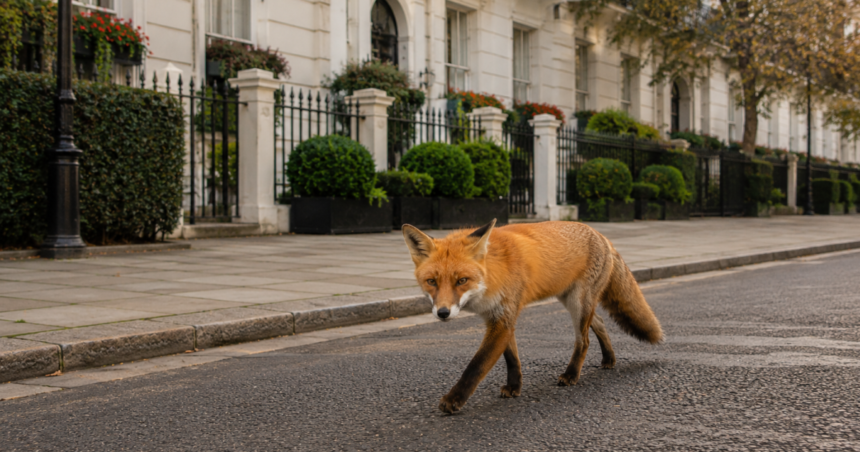
Residents of British residential neighborhoods complained a lot about red foxes, which became denser in low-density suburbs, which resemble a “compound” environment. In America, residents of Chicago and Los Angeles complained about coyotes, and Texas suburbs suffered from wild cats. Many residential areas of California witnessed repeated intrusions by black bears in search of food and water. As for India, incidents of cheetahs entering residential areas occur repeatedly, and on one occasion they injured five people while trying to catch them.
The common denominator between these incidents, including the incident of the Egyptian artist, is that wild animals were able to adapt to city life, which is the mystery whose secrets many studies have tried to understand.

Resource dispersion hypothesis
One of these studies was conducted in Britain, and it was trying to solve the mystery of the repeated appearance of red foxes in residential neighborhoods, by knowing the preferred environment for these foxes.
This study, published in the journal Animals, was based on the “resource dispersion hypothesis,” which means that “if resources such as food, water, and shelter are abundant and concentrated in one place, the animal needs a smaller space to live, and on the contrary, if the resources are distributed, it will spread throughout the place.”
To test this hypothesis, the researchers attached GPS collars to the necks of 20 foxes, recording their locations every 15 minutes across four seasons. Then they used the Geographic Information System, which is a digital system used to collect, analyze and link data to the place on maps. They focused on the size and number of gardens and the extent of their connection to each other, and whether or not there are barriers such as fences and walls.
The researchers found that “the fox prefers an area that contains large, interconnected gardens and is easy to move between, because this enables it to live in a small range, where all the ingredients, including food, water, and hiding places, are available.”
On the contrary, an area that contains small gardens and is intersected by streets or buildings and has many walls and walls is not preferable because he will then need a larger area to obtain his needs.
In light of the results of this study, Dr. Mohamed Adel Qadri, Professor of Zoology at Cairo University, told Al Jazeera Net, “The compound’s environment is very similar to what the fox prefers in terms of the presence of many gardens with a connected green network, permanent irrigation, relative calm at night, and rodents for food.”
He adds, “For the fox, any garden in the compound is not a home garden, but rather part of an integrated ecosystem.”

Behavioral and genetic adaptation
Another study published by the journal Urban Ecosystems agrees with much of what was stated in the previous study, as the researchers found, after analyzing data collected from GPS collars that were hung on the necks of five foxes, that they do not prefer dense residential areas, and find their comfort in green spaces within cities.
The same study found that the movements of one male covered a very large area, amounting to about 7,368 hectares, which is approximately equivalent to the area of a small city.
Muhammad says, “The interpretation of these results means that the fox may move between very many neighborhoods, and not just within one area. This means that its presence in a park within a compound does not mean that it permanently resides there, but most likely it passes through it as part of its path, which includes gardens and other green spaces.”
These behavioral adaptations were not the only change that happened to foxes, as a study published by the journal Ecology and Evolution revealed that they developed new genetic characteristics that help them adapt to the urban environment.
During the study, researchers analyzed the DNA of foxes using advanced genetic techniques, and found clear genetic differences between foxes that live in cities and those that still live in the wild, especially in genes related to immunity, behavior, and energy consumption.
The results revealed that urban foxes are bolder and less afraid of humans, in addition to having developed immune systems that are more capable of confronting diseases associated with living in cities.
Muhammad says, “These genetic results support the fact that the foxes that appear in the gardens of residential complexes are not just a visitor who has lost his way, but rather a member of a new generation of urban foxes that have adapted to human life.”
Foxes are no exception
Foxes are no exception to these behavioral and genetic adaptations, as a study published by the journal Landscape and Urban Planning showed that California black bears have begun to prefer residential suburbs to their natural environment.
The study recorded the highest density of bears in the “extended suburbs,” which are areas that combine natural cover and scattered housing, where the average density was about 0.18 bears per square kilometer, compared to only 0.12 in the less urbanized rural areas.
But the study also showed that this adaptation has limits, as bear numbers begin to decline gradually as construction density increases, reaching almost zero when the construction rate approaches 50 homes per square kilometer.
The researchers explain this by saying that the extended suburbs provide bears with an ideal mix of natural resources and easy access to food, whether from plants or human waste, while remaining some natural cover that allows them to take shelter and move.
Likewise, an Indian study published in the journal World Development Perspectives revealed that daily contact between humans and wildlife has become part of the reality in India, as cities expand and become increasingly close to natural areas, which has put major cities like Mumbai in direct confrontation with one of the most dangerous wild predators, cheetahs.
According to the study, Mumbai is located on the borders of the Sanjay Gandhi National Park, a natural reserve that extends over an area of 120 square kilometers and includes about 40 leopards, making it one of the most prominent areas of contact between wildlife and urbanism in the world.
She explained that the rapid urban expansion in recent years has pushed residential neighborhoods closer to forests, which has increased the frequency of cheetah sightings within the city.
Based on the above, Muhammad believes that “the challenge is no longer in searching for solutions that prevent animals from entering cities, but rather in developing smart strategies to coexist with them, especially in light of increasing urban pressure and shrinking wild spaces.”