


Published On 5/7/2026
In our everyday world, things seem very clear. If you throw two small balls at a barrier that divides the road into two lanes, you would naturally expect one to go right and the other to go left, or to choose the same path by chance.
But in the quantum world, where atoms, photons, and other small particles live, things are not that simple. Sometimes particles do not behave as independent balls, but rather as interfering waves that know each other’s existence.

A very special experience
This is exactly what a recent experiment has demonstrated. A team of physicists succeeded in observing what is known as Hong-O-Mandel interference, not using only two photons as in classical experiments, but also using up to 12 identical rubidium atoms, in an experiment published in the journal Nature Physics.
To understand the idea, imagine the previous experiment involving two exit doors, and two small particles entering a device that divides the path between them. In ordinary physics, each particle could exit through a different door, but in the case of the Hong-O-Mandel effect, if the two particles are exactly identical and there is no way to distinguish one from the other, then the probability that each one will exit through a different door almost disappears. The reason for this is that in quantum mechanics they are no longer two independent entities in the way we imagine them.
This effect was first observed in 1987 using two photons, and photons are particles of light, and since that time it has become one of the famous experiments in this scope, but what is new in the latest study is that the researchers transferred the idea to atoms, and expanded it from two particles to several particles that all interfere at the same time.

The secret of rubidium atoms
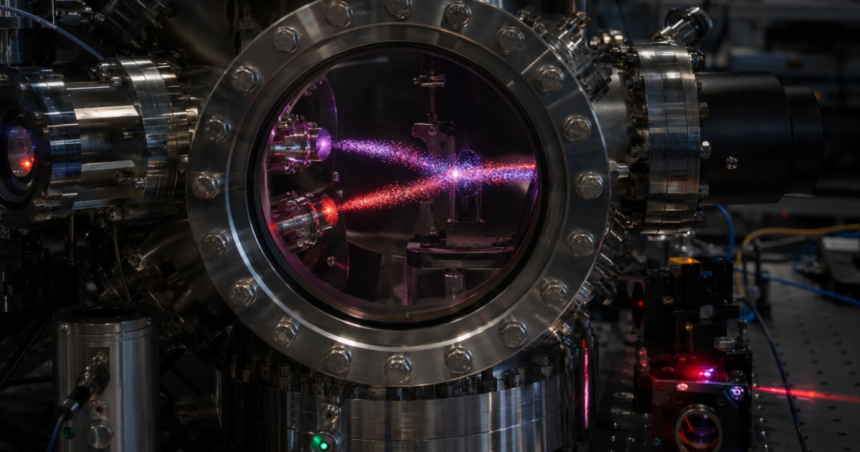
The team began by cooling the rubidium atoms to degrees very close to absolute zero, conditions in which the atoms become calm enough to allow their quantum behavior to appear clearly. At this cooling, the atoms can enter a special state called a Bose-Einstein condensate, which is a state in which a group of atoms becomes like one large quantum wave, and not just separate atoms moving randomly.
The researchers then used different spin states of the atoms and microwave pulses that acted as a “beam splitter” similar to what is used in light experiments.
But the greatest difficulty was not only in making the atoms overlap, but in counting them. In order for scientists to know the success of the experiment, they must know how many atoms emerged from each path. Therefore, the researchers used a method that relies on illuminating the atoms with laser beams from different directions, in a technique that makes the atoms slow down and emit light that can be monitored.
When the experiment was conducted on numbers of atoms up to 12, clear signs emerged that what was happening was not just a coincidence. The team noticed that the atoms were not randomly distributed between the two exits, but rather showed specific patterns indicating that a large number of atoms tended to gather in one exit instead of being divided equally, and this is what the quantum effect would expect.
Wide applications
At first glance, it may seem like just a strange display of the curiosities of quantum mechanics, but it is deeper than that. These quantum states could help in practical applications in the future, which may extend to what are called atomic interferometry, which are tools that use atoms to measure very minute changes in gravity, motion, time, or physical fields.
As the ability to control, count, and entangle atoms increases, it becomes possible to build more precise sensors, which may be useful in navigation, geodesy, monitoring gravitational changes, and perhaps in basic tests of quantum mechanics itself.