

After waiting nearly 15 years for justice, a group of Syrian survivors of torture watched on Monday as a court in Vienna found two former Syrian officials guilty of charges related to their roles in a brutal crackdown against the Arab Spring uprising.
Khaled al-Halabi, a former intelligence commander under the dictator Bashar al-Assad, and Musab Abu Rukbah, a former police commander, were sentenced for crimes committed against detainees during the democracy protests in the city of Raqqa between 2011 and 2013.
Both men were sentenced to eight years in prison. Mr. al-Halabi was convicted of torture among other charges. Mr. Abu Rukbah was convicted on charges of aggravated coercion and sexual coercion among multiple charges.
Before the verdict, Tatiana Urdaneta Wittek, co-founder of the Centre for the Enforcement of Human Rights International, which represented 17 of the Syrian witnesses, said, “Clearly the outcome of the trial was that the systematic torture by the Syrian secret service was depicted in this courtroom in the statements of the witnesses and became very vivid.”
“And this is the historic aspect for Austria,” she said. “The Austrian public and all members participating in this trial understood what torture means, the severity of the crime, and why it has to be criminalized in a distinct manner.”
The case against the two Syrians, who had both been living in Austria since 2015 and who pleaded not guilty, is one of the first that Austria has brought under the principle of universal jurisdiction, and one of the first dealing with extreme and systematic torture.
That the case came to trial at all represented a triumph for Syrian activists and human rights lawyers who had spent more than a decade tracking down the culprits and gathering evidence against them. During their work, they discovered that Austrian intelligence officials, in collusion with the Israeli intelligence service, had secretly given shelter to Mr. al-Halabi and arranged his asylum.
The trial has been a momentous occasion for the survivors, who are all refugees living in Europe and who traveled to Vienna several times to give testimony and finally to face their former torturers in court over the past month.
Asyad Almousa, 47, a Syrian lawyer, was so tense he huddled in a cafe with a psychologist before his hearing. He walked stiffly into the courtroom during the trial, not looking at the defendants at first.
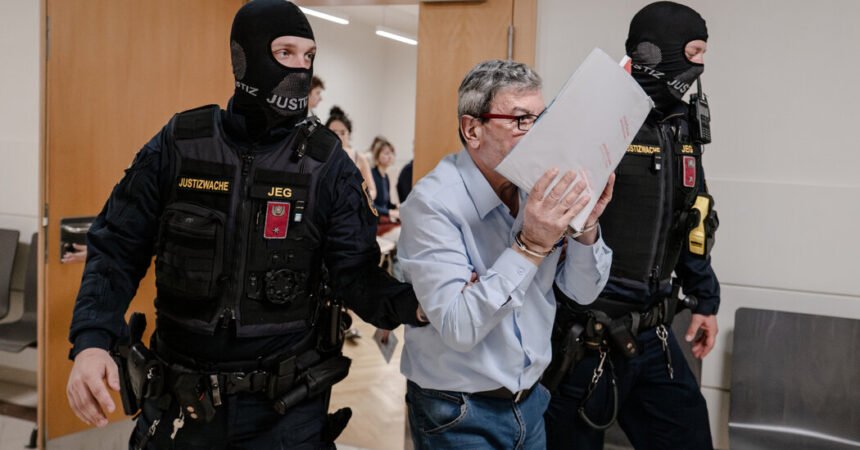
Mr. al-Halabi, 63, a slight, gray-haired man with red spectacles, showed little emotion during the trial, staring ahead and gripping a notebook tightly. He has been detained in an Austrian jail since December, and arrived at court handcuffed and flanked by masked police officers.
In his closing remarks, Mr. al-Halabi denied seeing or knowing most of the witnesses and dismissed the claims of others, saying that they were opponents of the regime.
When pressed by the judge that they could not all be lying, he explained his dilemma at the time.
“I had two options: I wanted to leave Syria so I wouldn’t have blood on my hands, but that would have taken months. Or confrontation with the government, but then I would have lost my life. I opted for the former, and now I’m paying the price for it.”
Mr. Abu Rukbah, 54, who had not been jailed because he was not considered a flight risk, initially appeared more relaxed, but his demeanor changed as the damaging accounts mounted, and he began sweating heavily.
The prosecutor in his closing statement compared the case to trials of Nazis and of drug cartels.
“It’s about the central question: the responsibility of the individual in a dictatorship,” he said. “Even within the Nazi Party, there were members with more and less power.”
Neither defendants had shown remorse or insight, he said, and he asked for a full custodial sentence for both men.
In a hearing last month, the judge cleared the public gallery before one witness, Basel Aslan, 33, gave his testimony. Mr. Aslan was only 17 at the time of his detention, and his ordeal, which included sexual coercion, was particularly harrowing, Ms. Urdaneta Wittek said.
Mr. Aslan said he was certain that Mr. Abu Rukbah had recognized him. “Looking into his eyes, and see him look down at the ground, was a victory,” he said in June after his testimony.
Mouaz Alwaidi, a politician, gave a pained smile when asked what it was like to see his torturer again.
“It was murder,” he said. “Seeing him again was like recording again all the feelings of torture. I spent days hung to the wall by my hands and, if by some miracle I could fall asleep, a guard would come and blow smoke in my face to wake me.”
Another witness, Muhammad Alhamoud, said he had almost felt pity when he saw how diminished Mr. al-Halabi had become after years in hiding and six months in jail.
“When I saw his situation, his skin, I found him a poor man,” he said. “But then I collected myself, remembering the days when I was under his control.”
Naz Kucuktekin contributed reporting from Vienna.