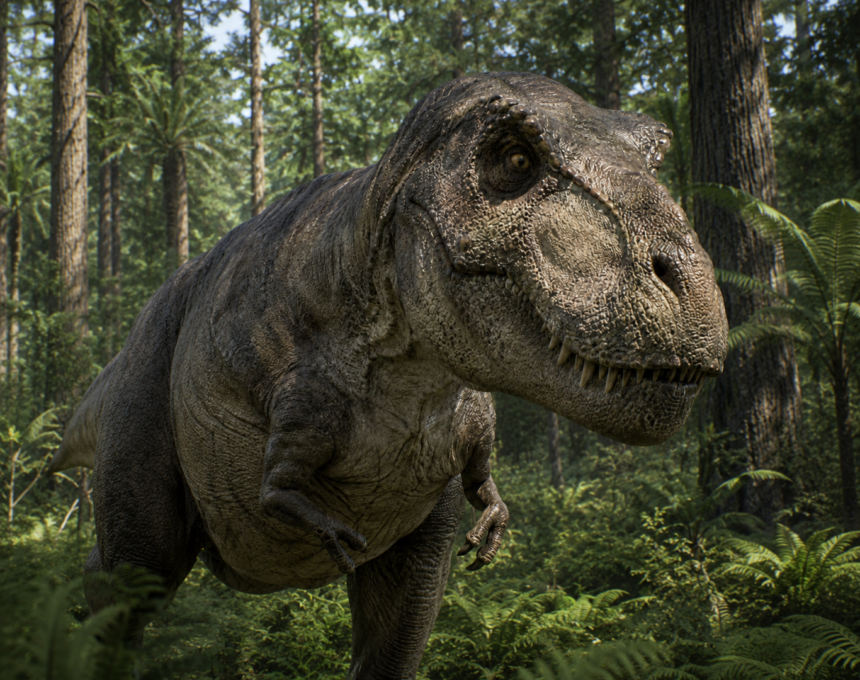
Despite the terrifying image that Tyrannosaurus Rex is often presented in films and popular culture as one of the most brutal and ferocious predators in history, there is an anatomical feature that has always diminished its prestige a little. This giant apex predator, which had jaws capable of crushing bones and teeth the size of daggers, had small arms that were disproportionate to its size and exceptional offensive power.
The length of the arms of this dinosaur, known by the abbreviation “T. rex”, which lived during the Cretaceous period, was only about 90 centimetres, that is, less than a third of the length of its legs. Its front limbs appeared clearly short compared to a body whose length in adult individuals might exceed more than 12 metres, and it was practically unable to be used in attack or direct combat.
To put it sarcastic, if someone could – theoretically – keep the T. rex away from him with an outstretched arm pressed against his forehead, the latter would not be able to respond using his fists, because his small arms would keep moving ineffectively at a distance from the body. It is true that in the end he will use his jaws to bite off the arm, uproot it, and then devour his opponent entirely, but the essence of the idea remains scientifically correct.
For many years, these famous and remarkably weak arms constituted one of the most exciting mysteries in paleontology, as many hypotheses attempted to explain the reason for their shrinkage throughout history, and a wave of scientific questions and debates were raised about their true function, including their use to catch or stabilize prey, or to display strength and attract partners during mating.
More recent studies have also indicated the possibility that the contraction of the arms came to reduce the risk of being bitten during frenetic group feeding on carrion or prey. On the other hand, an old theory assumed that these limbs became “vestigial organs” that gradually lost their practical function, and then their size decreased as a result of the absence of the need for them.
However, none of these explanations have yet achieved complete scientific consensus, and the question of the real reason behind the small arms of this massive killing machine remains open to research and debate.
Today, a recent study recently published in the journal Proceedings of the Royal Society B seeks to end this controversy by providing an actual explanation for this ancient mystery, and reveals that the skulls and jaws of several groups of carnivorous dinosaurs have become so efficient that they no longer need large arms to carry out the task of attacking and finishing off prey.

When the head replaced the arm
The study, led by researchers from University College London and the University of Cambridge, relied on analyzing data from 82 species of theropods, including species belonging to the tyrannosaurid family, which includes “T. rex” and other carnivorous dinosaurs that walked on two legs.
The study concluded that a combination of major factors, the most important of which were huge skulls, crushing jaws, and increasingly large prey, led to a decline in the dependence of many of these dinosaurs on their front limbs, as another organ – the skull – began to grow constantly and take over vital resources within the body.
To understand the relationship between skull adaptations and the contraction of the forelimbs in carnivorous dinosaurs, a doctoral student in earth sciences at University College London and lead author of the study, Charlie Roger Shearer, says that his research team has developed a new methodology to measure the durability and functional strength of the skull.
Shearer explains in his interview with Al Jazeera Net, “This measure was based on several anatomical and mechanical factors, including the force of the bite, the shape of the skull, the extent of the cohesion of the head bones and their connection to each other, in addition to the general dimensions of the skull and its geometric structure.”
Through this scale, Shearer and his colleagues were able to rank the skulls on a scale of strength. It was not surprising that “T. rex” recorded the highest levels of strength and skull durability, followed by “Teranotitan,” a giant carnivorous dinosaur similar to “T. rex” in size. It lived in what is known today as Argentina during the Early Cretaceous period, that is, more than 30 million years before the appearance of “T. rex.”
Shearer suggests that the gradual increase in the size of prey, particularly giant sauropods and other large herbivorous dinosaurs, may have led to the emergence of what might be described as an arms race between predators and their prey.
He explains, “As the size of herbivores increased, carnivorous dinosaurs were subjected to selective pressures that led them to develop harder skulls, stronger jaws, and were more efficient in dealing with prey that became larger over time.”
As these predators adapted and developed powerful bites, heads and jaws began to perform the primary function that arms had previously performed during hunting. In other words, the skull turned into the main attack tool, while the forelimbs lost a large part of their functional importance.
Small arms are not limited to T-Rex.
In a separate analysis, the researchers compared the length of the forelimbs with the length of the skull, and identified – in addition to the tyrannosaurids, which is the family to which T.
Previous studies had indicated a relationship between the enlargement of the skulls and the shrinkage of the forelimbs in carnivorous dinosaurs, but the new study shows that the shrinkage of the arms is related to the strength and durability of the skull to a greater extent than it is related to the size of the skull alone or the size of the overall body, which indicates that small arms were not just an incidental side effect of physical growth.
Shearer explains that “the size of the body was not the decisive factor in this phenomenon, as some dinosaurs had strong heads and small arms even though they were not huge in size,” noting that “some species had relatively smaller arms – compared to the size of their bodies – than those known to T. rex itself.”
The researcher cites the “Majungasaurus” dinosaur, which lived in what is known today as Madagascar about 70 million years ago. Although it was an apex predator in its environment, it weighed about 1.6 tons, equivalent to approximately one-fifth of the weight of a T. rex. However, it had a robust skull and severely reduced forelimbs.
This result is supported by other examples, most notably “Carnotaurus”, which is a theropod that resembles “T. rex” in its general structure, but it had exaggeratedly short arms compared to the rest of the body. However, this dinosaur compensated for its lack of arms with a striking formal advantage, as it had a prominent pair of horns above the eyes, which gave it an exceptional appearance.
Different paths towards small arms
The study showed that the process of contraction of the forelimbs did not occur in the same way in all groups. Some species began to reduce the fingers first, while others reduced the forearm.
In abelisauridians, for example, the hands and post-elbow segments experienced the greatest degree of shrinkage over time. This trend reached its peak in later species such as Majungasaurus, which evolved extremely small hands.
As for tyrannosaurids, they followed a different pattern, as all parts of the forelimb shrank in close and balanced proportions, which led to maintaining the relative symmetry between its components.
Either way, Shearer argues, these groups, not directly related to each other, became increasingly dependent on their powerful skulls and jaws to capture and subdue prey, before the process of arm reduction began over millions of years, becoming a common feature of a number of different carnivorous lineages.
Thus, the study indicates that the small arms of these predators were not a strange or useless characteristic, and that their shrinkage was not a random event or an anatomical deficiency, but rather a direct result of a large-scale transformation that made the head and jaws the most efficient weapon in controlling prey.