

Published On 5/7/2026
American journalist Greg Ebb and British writer Simon Schama – in two different articles – paint a complex picture of the United States’ experience from the moment of its founding until its tense political present, in a single narrative that combines economics, politics, and intellectual history, and poses a fundamental question: Are the institutions that created American wealth still able to protect democracy itself?
The common line in the two articles stems from the founding idea that the United States did not become the largest economic power in the world due to resources or chance, but rather due to a precise political design established by the Founding Fathers, which is based on the principle of curbing and distributing power, protecting individual rights, and building confidence in the law and institutions.
Read also
list of 2 itemsend of list
These institutions – as the two articles suggest – were not just a political framework, but were also an economic engine that made investment and innovation possible and stable.
In this context, Greg Epp’s article – in the Wall Street Journal – brings to mind the observations of the French thinker Alexis de Tocqueville, who visited the United States in the 19th century, and saw that American democracy creates unprecedented economic energy, because citizens feel that they are active in their political and economic destiny.

The author also relied on the theses of prominent Nobel Prize-winning economists, Daron Achamoglu and James Robinson, and distinguished between two types of institutions: “extractive” institutions that concentrate power and wealth in the hands of a limited elite, and “comprehensive” institutions that distribute power, protect rights, and provide equal opportunities for economic activity.
An unprecedented test
The writer believes that the United States has succeeded historically because it adopted the second model, unlike many developing countries that still suffer from a monopoly of power and wealth, which limits their ability to achieve sustainable development.
This analysis extends to the development of modern American institutions, such as the Federal Reserve and the Federal Trade Commission, which were designed to be independent of political pressures, ensuring market neutrality and investor confidence.
The writer believes that this independence was one of the secrets of the rise of the American financial system and the dominance of the dollar globally, but this model – according to his opinion – faces an unprecedented test today, as the controls that formed the core of the American system began to be eroded with the rise of political visions that push towards the concentration of executive authority and the decline of public confidence in institutions.
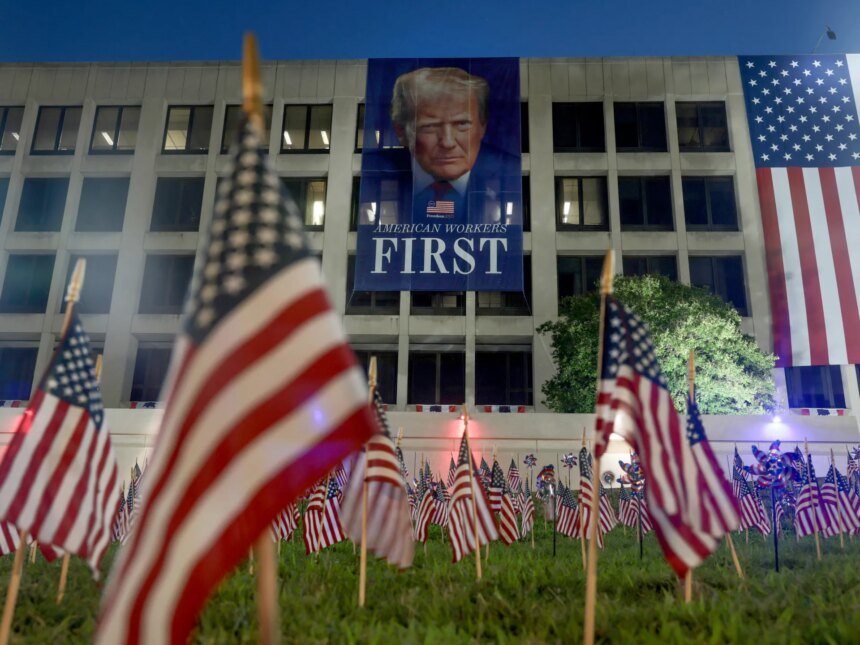
Hence the controversy over the policies of President Donald Trump, who sought to expand the powers of the presidency and influence independent bodies, reaching judicial decisions that redefined the boundaries of the relationship between the White House and these institutions.

The article warned that reducing the independence of these bodies may not only change the way the economy is managed, but also reshape the balance of power within the democratic system itself, which may allow any subsequent president from any party to use broader powers in the direction he wants.
In parallel with this institutional anxiety, Simon Schama’s article – in the Financial Times – provides historical and intellectual depth that takes it back to the moment of the first founding, when the idea of “America” was not a complete project, but rather a political and intellectual experience full of contradictions.
A long path of conflict
This is because the American Revolution – as he portrays it – was the product of intense reading of Enlightenment philosophers such as John Locke and Montesquieu, but it was also a turbulent practical project between the principles of freedom and the reality of slavery, and between the declaration of equality and the practices of exclusion.
Schama reconstructs the founding scene through figures such as John Adams and Thomas Jefferson, who simultaneously represented the spirit of the revolution and its internal conflicts, before their political differences turned into an intellectual friendship at the end of their lives, ending symbolically with their death on the same day of the fiftieth anniversary of independence in 1826, as if history was closing the page on the founding generation in a single moment.
The strength of the American experiment lies neither in its purity nor its completion, but in its continuing ability to balance ambition and limits, between authority and freedom, and between the national narrative and self-criticism.
The article also highlights that the Declaration of Independence was not just a political document, but rather was the product of deep intellectual discussions based on the same British heritage against which the colonists revolted, from the Magna Carta to the Glorious Revolution, in addition to the ideas of the social contract and the right to resist illegitimate authority.
However, the founding text itself carried its contradictions, as paragraphs condemning slavery were deleted from it even though one of its main authors was a slave owner, which reflects the gap between the moral ideal and social reality from the beginning.
Schama links this intellectual legacy to contemporary reality, warning against the tendency to simplify American history and turn it into a celebratory narrative devoid of complexity, because history, in its essence, is not a straight success story, but rather a long path of struggle between freedom and oppression, between the idea and its implementation, which is what gives the American experience its true strength.
Erosion of institutional controls
Thus, the writer presents a comprehensive vision that considers that the “American Dream” was not an ideal founding moment, but rather a long historical process of tension between principles and reality, and this tension is still what gives the American experience its meaning and continuity to this day.

At the intersection between the two articles, one picture becomes clear, which is that the United States as an entity was founded on an advanced idea of restricting and distributing power, but today it is experiencing a new test of this idea, whether in economics, politics, or historical memory.
While economic analysis warns of the erosion of the institutional controls that created prosperity, historical analysis reminds that this system itself was born of deep contradictions that have never been resolved.
In the end, the two texts implicitly agree that the strength of the American experience does not lie in its purity or completeness, but rather in its continuing ability to balance ambition and borders, between authority and freedom, and between the national narrative and self-criticism.
But the question that remains open is: Can this experience maintain this balance at a time when pressure on its institutions is increasing and its narrative about itself is fragmenting?