


Published On 5/7/2026
|
Last update: 20:28 (Mecca time)
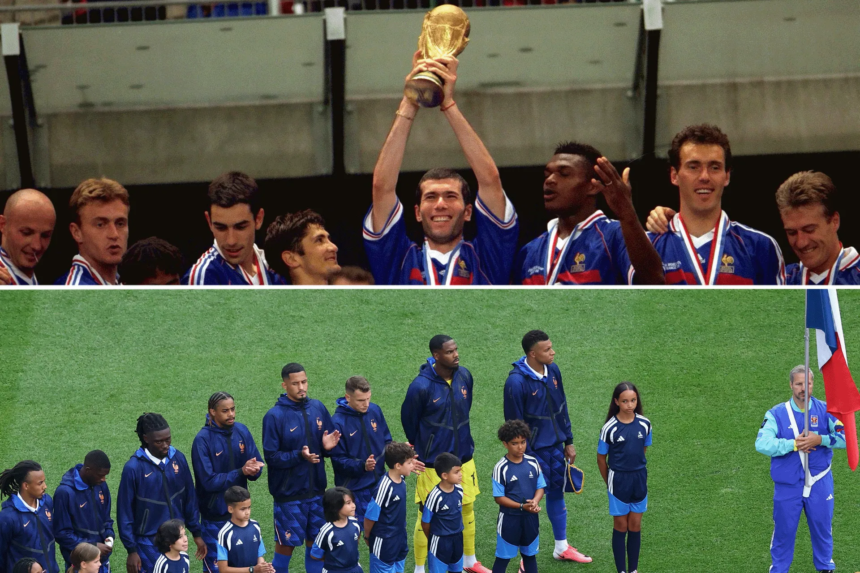
The beginning of the 2026 World Cup was not the only thing that put the French team at the forefront of the candidates to win the title. Rather, a series of historical coincidences brought to mind the scenario of the 1998 World Cup, which France hosted and won its title for the first time in its history after defeating Brazil in the final.
Since the draw was made, comparisons between the two versions began to follow. The draw placed Brazil in the same group with Scotland and Morocco, a trio that had also previously met in the first group of the 1998 World Cup, along with Norway.
Read also
list of 2 itemsend of list
As for the French team, it found itself in the 2026 World Cup in a group that included Senegal, Iraq, and Norway, while in the 1998 edition it played in a group that included Saudi Arabia, South Africa, and Denmark. Despite the difference in the teams, the common denominator remains remarkable; On both occasions, the Roosters faced an African team, an Arab team, and a European team, a similarity that aroused the interest of observers.
These coincidences became more frequent as the tournament progressed, until some began to wonder whether the 2026 edition was actually reproducing the features of the path that led France to its first title in 1998, and this time towards a third title led by the current generation.
Group stage: similarity in results and numbers
One of the most notable similarities is that France did not achieve the full mark in the group stage in the history of its participation in the World Cup except in the 1998 World Cup, before repeating the achievement in the 2026 edition.
In the current edition, the French team achieved three consecutive victories over Senegal (3-1), Iraq (3-0), and Norway (4-1).
As for the 1998 World Cup, he began his career by defeating South Africa (3-0), then Saudi Arabia (4-0), before defeating Denmark (2-1).
The similarity was not limited to the number of victories, but also extended to the scoring tally. In the 1998 edition, the French team scored 9 goals and conceded one goal, ending the first round with a goal difference of (+8). In the 2026 World Cup, he scored 10 goals and conceded two goals, achieving the same goal difference (+8).
Another coincidence is that the Brazilian team finished the group stage on top in the 1998 World Cup, and this was also repeated in the 2026 edition, which in turn gives the “Seleção” a degree of optimism in restoring the scenario of the edition in which it reached the final.
The knockout rounds… a replay of old scenes
The comparisons increased after the completion of the 16-final matches, as the draw pitted France against Paraguay, just as happened in the 1998 World Cup, in one of the most exciting coincidences between the two versions.
In that World Cup, Zinedine Zidane’s teammates clashed with the Paraguayan national team, led by legendary goalkeeper Jose Luis Chilavert, and the match remained tied until the 115th minute, when Laurent Blanc scored the golden winning goal that gave France a pass to the quarter-finals, where it faced Italy.
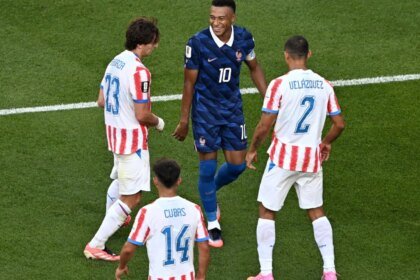
The scene will be repeated in the 2026 World Cup, as France met Paraguay in the same round at Philadelphia Stadium, and France won 1-0, the same result as the 16th round in 1998.
Kylian Mbappé scored France’s only goal, and France will face Morocco in the quarter-finals.
France’s 1-0 victory over Paraguay is a great indicator and support for the idea of French optimism and a continuation of the very strange series of coincidences in the similarities between the two versions.
For its part, in the 1998 World Cup, Brazil faced the runner-up of the France group, which is the Denmark team, in the quarter-finals, while in the 2026 edition it will also meet the runner-up of the France group, which is the Norway team, but in the round of 16.
The final route… the scenario itself?
It is also a remarkable coincidence that the paths of France and Brazil in the 1998 World Cup were completely separate, so that it was not possible for them to meet except in the final match, which was actually achieved in the final of July 12, 1998 at the Stade de France.
Brazil was also a candidate to face Argentina in the semi-finals, but the latter exited the tournament in the quarter-finals after losing to the Netherlands.
The picture will be repeated in the 2026 World Cup, as France and Brazil can only meet in the final scheduled for July 19, and the possibility of holding a classic semi-final between Brazil and Argentina remains if the two teams continue their journey successfully.
A lucky charm for France and Brazil?
It is difficult to consider these coincidences as evidence of what the tournament will lead to, as football history is full of similarities whose endings have not necessarily been repeated, and the playoff matches are decided more by technical and physical details than by numbers and memories.
However, France seems to have the largest share of these coincidences, as the similarity is not limited to its path in the group stage, but rather extends to the identity of its opponent in the eighth final, and the result of its match against it, in addition to the fact that its path does not meet Brazil except in the final match, just as happened in the 1998 World Cup.
On the other hand, Brazil’s path is also not without indicators similar to that version. It topped its group as it did in 1998, and found itself again on a separate path from France, which only brings them together in the final, with the possibility of facing Argentina in the semi-finals remaining, a scenario that was also on the table 28 years ago.
In the end, these facts remain merely historical coincidences that add more excitement to the tournament, but they do not give a real advantage to any team.
If the 1998 edition ended with France being crowned after a path that bears many similarities to the 2026 World Cup, the coming weeks alone will reveal whether history is repeating itself, or merely recalling its memories.