


Published On 4/7/2026
Since the discovery of the first giant planets very close to their stars in the mid-1990s, the class of “Hot Jupiters” have become some of the most exciting objects in exoplanetary science. These worlds have revealed that planetary systems may differ radically from our solar system, where giant gas planets orbit their stars in only a few days.
But a new study has reopened the file of one of the most famous of these planets, after revealing that it behaves in a way that is inconsistent with everything scientists thought they knew about this type of planet.

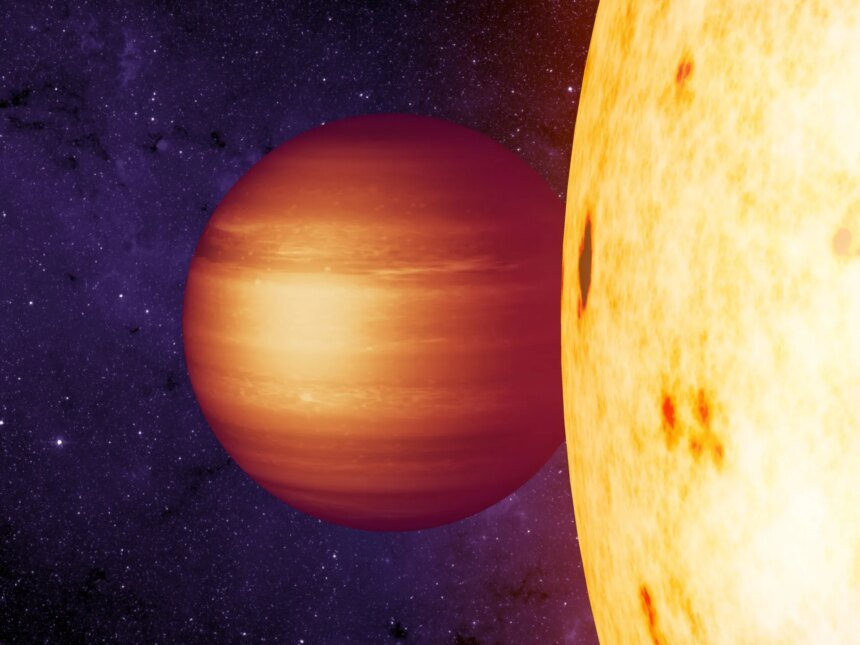
The planet “CoRoT-2 b” is located about 696 light-years from Earth, and its size is about one and a half times the size of Jupiter, while its mass is about 3.5 times greater than Jupiter’s mass, and its orbit around its star takes place in only 41 hours, making it one of the fastest orbiting planets known.
Read also
list of 2 itemsend of list
A world that does not behave as it should
The new study focused on the planet’s thermal behavior, as scientists expected it to be tidally locked, a state in which the same face always remains directed towards the star, just as the moon faces the Earth with one face.
In this case, one side of the planet is very hot, while the other side remains relatively cold, with heat being transferred through the atmosphere.
But the surprise is that recent measurements showed that Corot-2b does not follow this pattern, but rather has an extremely hot spot located in almost the opposite direction to what current models predict, which is something that was not expected.
“I love studying strange planets that do not fit into the traditional picture, and trying to solve their mysteries,” said Aurora Kisely, a researcher at NASA’s Exoplanetary Science Institute. She added: “We now realize that one model is not suitable to explain all planets, even those that we have been studying for years.”

To understand this behavior, the researchers tested three different hypotheses to explain the location of the hot spot. Calculations showed that one day on this planet takes about three Earth days, while the length of its year does not exceed approximately one and a half Earth days.
Thus, the planet completes approximately two revolutions around its star before completing one revolution around its axis, which is an unusual situation for this type of planet. “I was very excited when the results started to clearly indicate that one of our hypotheses was correct,” says Kiseley.
Scientists believe that these results may mean that the planet does not rotate in the way previously thought, or that its atmosphere behaves in mechanisms that have not been observed before, which requires developing climate models for giant planets.
Why does this discovery matter?
The impact of these results is not limited to giant planets alone, but extends to the study of rocky planets that may be habitable, especially those orbiting red dwarf stars.
Many of these planets lie within the region where planets are expected to quickly become tidally locked, so understanding how planets rotate and distribute heat is a key factor in assessing their climate and potential for habitability.

Kisely explained that the way the planet rotates directly affects temperatures, wind movement, and climate systems, which is reflected in the possibilities of stable environments that can embrace life.
For this reason, any discovery that breaks previous rules helps scientists build more accurate models for all exoplanets, not just hot Jupiters.
Future telescopes may reveal more surprises
The researchers believe that the next step is to find out the real reason why Corot-2b is rotating in this unusual way. “Hot Jupiters were the first type of planet that enabled us to develop detailed climate models,” Kisely says, “and with the next generation of telescopes we will be able to make deeper measurements of a greater number of planets, and perhaps even habitable planets.”
Future observatories, such as the Habitable Worlds Observatory and the European Extremely Giant Telescope, are expected to provide more precise measurements of atmospheres, winds and rotation, allowing a better understanding of the diversity of planets in our galaxy.

The results of the study were presented during the 248th meeting of the American Astronomical Society in Pasadena, California, in America, and were also published in the scientific research repository “arXiv” in preparation for scientific review.
Whenever a person thinks that he has drawn a complete picture of the universe, a distant object appears to remind him that nature is more complex and expansive than our perceptions. Science does not advance by confirming prevailing ideas, but rather by discovering exceptions that push researchers to rethink and build a deeper understanding of the universe.
Perhaps this strange planet, which rotates unexpectedly, reminds us that the greatest discoveries always begin with a simple question: Why did this happen?