


Published On 4/7/2026
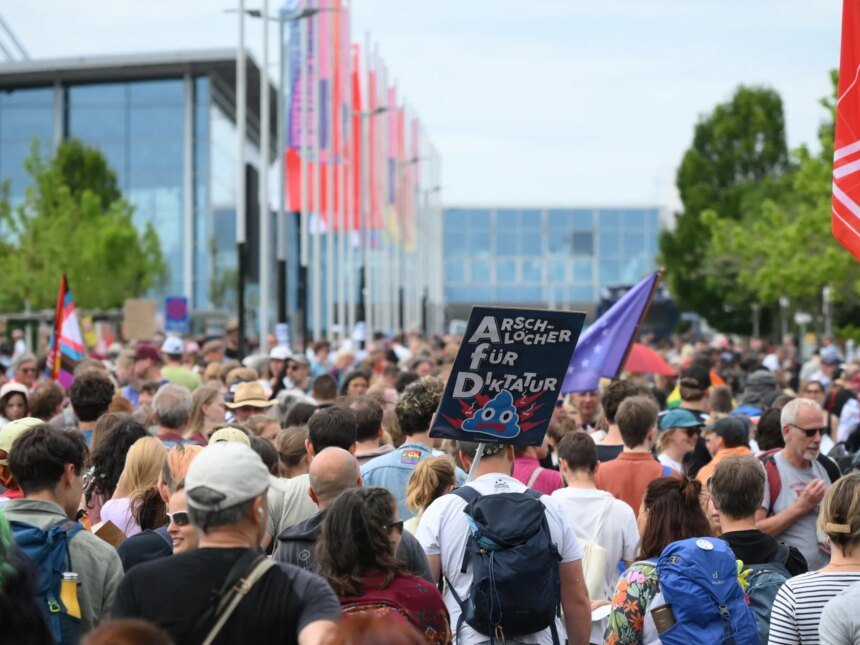
Thousands of opponents of the far-right Alternative for Germany party demonstrated in the streets of the city of Erfurt in the state of Thuringia in central Germany, on Saturday, in conjunction with the party’s annual conference, before regional elections that may pave the way for the party to gain power at the state level for the first time.
German police said that about 20,000 people gathered in the city to protest the holding of the party conference, which leads in opinion polls at the national level.
The protesters, who were from trade unions, civil society organizations and left-wing parties, gathered under the leadership of a coalition known as “Federzeitsen” or “Resist,” while the police deployed large numbers of their members, supported by reinforcements from various parts of Germany, to secure the party’s annual conference, which lasts for two days.

The demonstrators, under the supervision of riot police, sat in rows on the highways and streets leading to the conference center hosting the meeting, in an attempt to block access to it.
Despite attempts to disrupt the conference, most of the Alternative for Germany (AfD) delegates were able to reach the conference center, where the meeting began as scheduled.

Evoking the Nazi era
“We want to make it clear that we simply will not tolerate this, and that fascism is on the rise here in Germany,” said Georg Becker, spokesman for the Federzeitsen coalition.
The rapid rise of the Alternative for Germany party has alarmed many who believe that the German government has a special responsibility in confronting the far right.
Some critics considered that the party’s choice to hold its conference in Erfurt, coinciding with the centenary of a Nazi conference held in the neighboring city of Weimar, as a deliberate provocation.
But Tino Khrupala, one of the party’s co-chairs, attacked the protesters, saying they were “brought here from all over the country by establishment political parties.”
He added in an opening speech during the conference: “They are protesting against democratic decision-making. They believe that they alone have democracy.”
During its conference, the party is expected to re-elect co-chairs Alice Weidel and Tino Kruppala.

Battle of the “Separation Wall”
The Alternative for Germany party’s conference comes before elections in the eastern German states of Saxony-Anhalt and Mecklenburg-Vorpommern, and the party hopes that their results will pave the way for success at the national level.
This year, the party is looking to gain power for the first time with the approaching local elections in the former eastern states of communist Germany, which are its main electoral stronghold.
Opinion polls indicate that the party may achieve an absolute majority in the Saxony-Anhalt state elections scheduled for September.
At the national level, the party has remained at the top of opinion polls since the elections that took place last year, when it came in second place by obtaining 20% of the votes.
Since its founding more than a decade ago, the Alternative for Germany party has strengthened its lead in opinion polls, clearly outperforming the conservatives led by Chancellor Friedrich Merz, based on a combination of nationalist rhetoric and calls to tighten immigration policies, attracting voters dissatisfied with successive governments and years of economic stagnation.
Meretz has made curbing the party’s rise a political priority, at a time when the Alternative for Germany (AfD) is still excluded from power due to the refusal of all other parties to cooperate with it.
The main parties ruled out any cooperation with him as part of what is known as the “isolation wall” strategy, which aims to isolate him and keep him out of government coalitions.