

Oman The Jordanian dress has returned to take center stage at weddings and national events after years of decline in the presence of traditional costumes, in light of an increasing demand among young people to wear the traditional Jordanian costume as an expression of pride in national identity and a revival of popular heritage.
Craftsman Rashid Al-Bardini, who has been working on detailing Jordanian clothing for more than 20 years, says that the damr is no longer just a traditional costume, but has become a symbol of belonging, noting that his family inherited this craft from fathers and grandfathers, and is still working to pass it on to the new generation.
Read also
list of 4 itemsend of list
A set bearing heritage features
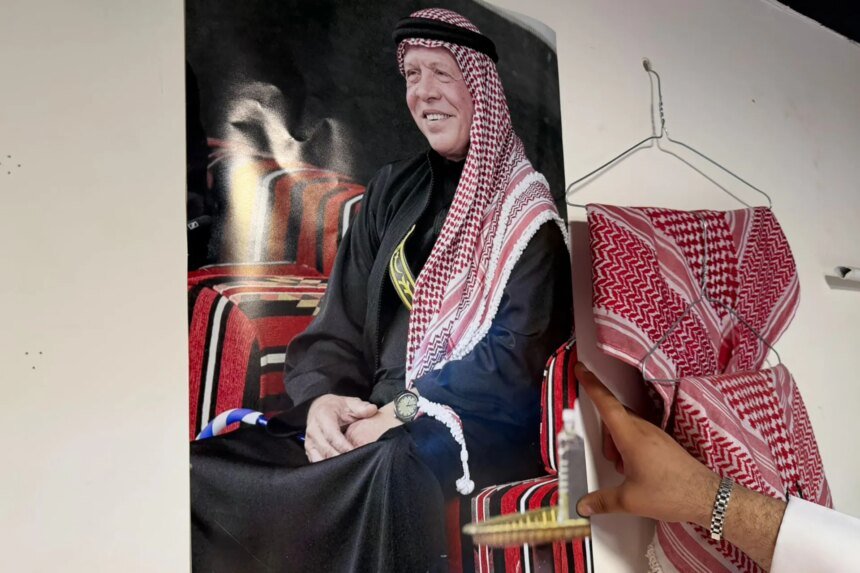
Al-Bardini explains to Al-Jazeera Net that the damr forms part of the traditional Jordanian set, which consists of the embroidered dress or “kibar,” the robe or waistcoat known as the “jokha,” then the damr, along with the fringed Jordanian shemagh and the headband, while the look is completed with the abaya in the summer or the fur in the winter.
He adds that the dahmer is distinguished by its short cut that is worn over the garment, its long sleeves, and its embroidery executed with authentic Jordanian stitches such as wrapping, twisting, and lattices. He explains that this piece was, in its beginnings, limited to tribal sheikhs and notables of society, before it spread among various groups of Jordanians, then inspiring women’s designs inspired by its heritage shape.

Jordanian embroidery… engineering with an independent identity
Al-Bardini believes that what distinguishes Jordanian dress from others in the Levant is the embroidery’s reliance on geometric shapes and sharp angles, unlike many traditional costumes that are dominated by the use of circles and curves.
He points out that these patterns are inspired by the nature of the Jordanian environment and its mountainous terrain, which gave Jordanian embroidery an independent character that is easy to distinguish. He also points out that the Jordanian shemagh is distinguished by its hand-made fringes, while the traditional aqal is made of goat hair, which are elements that have long been associated with the national dress.

From the first measurement to the last stitch
Al-Bardini explains that the manufacture of a dress goes through several stages, starting with identifying the occasion on which the dress will be worn, then choosing the appropriate fabric and color, explaining that dark colors – primarily black and navy blue – are the most in demand, along with white on some occasions.
After that, the customer chooses the shape of the embroidery, then measurements are taken to suit the nature of the body, before moving on to the stages of cutting, sewing and embroidery, all the way to ironing, final finishing, and installing accessories.
He confirms that the embroidery stage is the most precise, because it depends on implementing geometric shapes with great consistency, which gives the embroidery its visual identity and reflects the image of Jordanian dress in the best way.

Young people bring Al-Dahmer back to the forefront
Al-Bardini points out that the last ten years have witnessed a clear shift in young people’s demand for the dhamar – especially at wedding parties – as many people began to prefer to appear in the complete Jordanian outfit with the fringed shemagh instead of Western suits.
This demand is due to the growing sense of pride in national identity, in addition to the spread of images of Jordanian dress across social media platforms, which contributed to its reaching members of Jordanian communities abroad and turning it into a symbol that represents Jordan in various forums.

A family craft for half a century
Al-Bardini points out that his family has been practicing this craft since 1976, when his grandfather founded the profession in Amman, before it was passed on to his father, who worked to revive and develop Jordanian embroidery, and then it reached his children, who today continue to develop designs to suit modern tastes, while preserving the authenticity of Jordanian dress and its traditional techniques.
A garment worn by kings
Al-Bardini confirms that his family had the honor of detailing the Jordanian set of the late King Hussein bin Talal, which is the appearance that later appeared on the twenty Jordanian dinar note. They also detailed the Jordanian set of King Abdullah II, who appeared wearing the same dress on the fifty dinar note.
He added that the family also supervised the detailing of the Jordanian suit for Crown Prince Hussein bin Abdullah II on the occasion of his wedding, considering that this represents an extension of continued confidence in the Jordanian craft, and reflects Al-Dahmer’s status as one of the most prominent symbols of national identity.

An identity is worn, not just a costume
Al-Bardini believes that Al-Dahmer’s return to the forefront confirms that traditional clothing is still able to keep pace with the times, as long as craftsmen preserve its authenticity and develop it to suit new generations, so that it remains a piece that carries Jordan’s history and culture, and not just a costume worn on special occasions.