


Published On 7/3/2026
The war in the Gaza Strip has passed for 1,000 days, without the days bringing a breakthrough that would end the human suffering of the population. Although 8 months have passed since the ceasefire agreement entered into force and direct military operations stopped, the living reality in the Gaza Strip is still deteriorating, in light of the continued closure of crossings, the cessation of reconstruction projects, and the absence of basic services.
The difficult reality in the Gaza Strip appeared clearly in a field report – by Hani Al-Shaer prepared for Al-Jazeera – from Khan Yunis camp and the areas of displaced people’s tents in Al-Mawasi, where the camera monitored the continued signs of destruction and the absence of steps to remove the rubble.
The families’ hopes of returning and stabilizing their lives were also delayed due to the continuous violations by the occupation army, which made the existing truce described as fragile and unable to provide safety for the people.
A Palestinian citizen stated in her testimony: “After 8 months of the truce, we expected to remove the rubble, expand the roads, and provide aid, but we cannot find clean water to drink, and a shell fell directly on top of the tent a few days ago.”
Queues for hospice…the battle of searching for a living
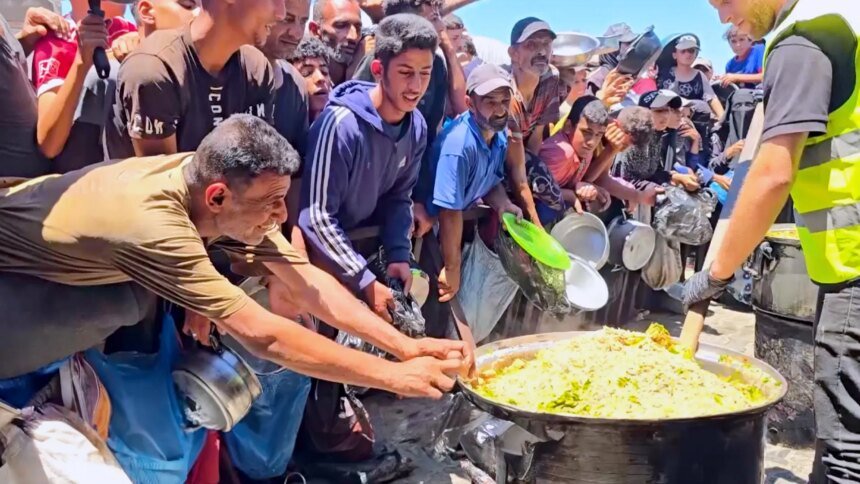
Food shortages and malnutrition are linked to continued restrictions on crossings, as displaced families rely entirely on charitable food donations to secure daily meals.
Citizens queue in crowded lines under the sun for hours to obtain limited amounts of food, amid complaints of meals running out and families returning to their tents without receiving their allotments.
One of the citizens in the aid queue reported that he had not received food since the morning of the previous day because his house was empty of food supplies, pointing out that the hospice represents his only option to feed his family.
A displaced woman explains that women and children are forced to wait for about 6 continuous hours in the midst of crowding to obtain a ration of food that is not sufficient for the family members, which illustrates the extent of the humanitarian difficulties facing the population.

(Al Jazeera)
The testimonies of the displaced indicate that the tragedy of living in tents continues for 1,000 days, and displaced women expressed their hopes for an end to the siege and permission for reconstruction, coinciding with the return of stability to other areas in the region that witnessed military conflicts, while the sector faces restrictions on the entry of basic materials with no prospect of ending the current situation.
Observers say that the repercussions of the war are linked to the extent of destruction, displacement, and the decline in living standards, which leaves the fate of about 2 million people dependent on temporary housing in tents and on the rubble of destroyed homes.
Blood bill
The official data issued by the Ministry of Health shows the registered human bill as follows:
- Victims and martyrs: Recording the martyrdom of more than 73 thousand Palestinians, the largest percentage of whom are women and children.
- Wounded and injured: More than 173 thousand citizens were injured with varying injuries.
- Missing persons file: About 11,000 people remain missing under the rubble without the ability to recover them.
Reports from international food security organizations indicate that 1.6 million people in Gaza suffer from a severe lack of food security, especially in the northern Gaza Strip, as a result of the restrictions imposed on the entry of food, fuel and medicine, and the repeated closure of crossings.
The official figures announced at the Union of Municipalities conference reflect the extent of damage to infrastructure and service components throughout 1,000 days of war, according to the following indicators:
- Destruction of streets and roads: Bulldozing and destroying more than 4 million linear meters of road networks and main and secondary streets in various cities and camps.
- Water and sanitation networks: About one million linear meters of water distribution networks were taken out of service, and another million linear meters of wastewater drainage networks were destroyed.
- Targeting water wells: Destroying and retargeting 725 water wells across the municipalities of the Gaza Strip, restricting residents’ access to drinking water.
- Destruction of machinery and equipmentDestruction of more than 500 heavy machinery, bulldozers, pumps, and vehicles designated for waste collection and public cleaning.
- Losses in human resources: Recording the killing of 300 employees, engineers, and technical personnel in municipalities while performing their field duties.
Geography of resilience
Khan Yunis camp and the Al-Mawasi coastal area represent the most prominent current gathering centers for the displaced for 1,000 days. The Al-Mawasi area – which lacks infrastructure and sanitation networks – has turned into a gathering of hundreds of thousands of tents that shelter displaced families from the northern and central areas of the Gaza Strip.
The damage to roads and service networks led to the isolation of these areas and the emergence of health and environmental problems as a result of water pollution, which increases the difficulty of the humanitarian situation in light of the continued restrictions on crossings and the prevention of the entry of maintenance and reconstruction supplies.