Published On 1/7/2026
|
Last update: 17:01 (Mecca time)
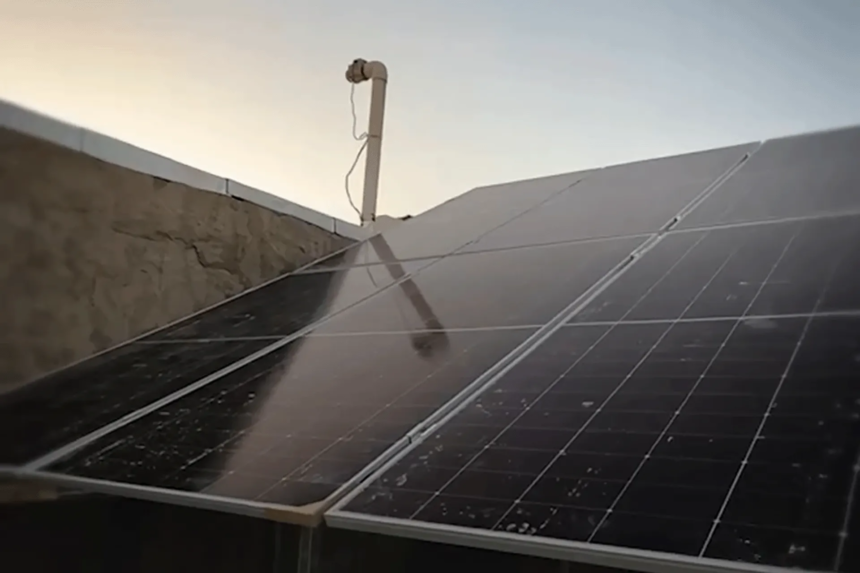
In light of the continuing stifling electricity crisis and the increasing hours of frequent outages in Iraq, solar energy systems have become an option and investment that an increasing number of citizens are turning to to secure their daily energy needs.
This step comes in a serious attempt to reduce complete dependence on private generators and the huge financial burdens and ongoing environmental pollution they cause, as Iraqis search for stability that has been absent from the national grid for many years.
Ibrahim Nihad talks about his experience in this field, saying that the lack of reliance on national energy puts the citizen in constant confusion, as the price of a private generator amp in some areas reaches 20 thousand dinars ($15), while the national electricity bill sometimes exceeds 100 thousand dinars ($76).
Nihad explains that solar systems directly provide electricity during daylight hours, and use the battery system to provide energy at night, which avoids generator malfunctions and network fluctuations, and relieves citizens of sudden outages.
For his part, Kamel Al-Kaabi explains that he installed the system in his home after long suffering and daily problems that affected his family due to the electricity crisis, stressing that the result was positive and very comfortable and changed the reality of their daily lives.
Al-Kaabi calls for companies to provide offers and financial facilities for sale in installments to include all segments of society, such as workers, health and educational personnel, and journalists, so that the trend towards renewable energy becomes a project available to everyone and not limited to the affluent.
Challenges
Despite the increasing demand for solar panels, the spread of this technology faces serious practical and economic challenges.
In this context, Mustafa Sakr says that shared housing and the division of homes into small spaces in the capital, Baghdad, creates a major problem regarding the right to exploit the roof of the house, which hinders the installation of solar panels.
He adds that this matter is completely different from the rest of the governorates and regions where the experiment was remarkably successful due to the availability of large areas.
For his part, engineer Ali Al-Marsoumi, who specializes in installing solar systems, confirms that “demand has doubled remarkably during this year compared to last year due to the ongoing outages, problems with private generators, and gas outages.”
Al-Marsoumi continues that obtaining these systems has become an urgent necessity to face difficult life circumstances, noting that the cost of a system with a capacity of 20 amps reaches about 5 thousand dollars.
Despite the initial cost, Al-Marsoumi believes that the operational life of the system is about 10 years, which is the cost of subscribing to the private generator for only two years, warning at the same time of the varying quality of the devices and the necessity of choosing reliable types.
Relative energy
Solar energy is a complementary solution and supports the state’s efforts. Energy expert Ahmed Moussa explains that solar energy is classified as complementary and auxiliary energy and is not a complete alternative to traditional generation plants, indicating that there is a large gap between the current production, which ranges between 22 and 23 thousand megawatts, and the actual need, which exceeds 60 thousand megawatts.
The government’s plans continue to establish major solar energy plants to reduce loads in the governorates of Basra, Najaf, Karbala, Diyala, and Anbar, and to reduce the financial burden on citizens.
Moussa refers to the Central Bank’s initiative to obtain soft loans, explaining that it has not been implemented in the desired manner yet, even though it is an effective idea. 48 specialized companies have been nominated and their addresses and offers have been circulated to citizens.