Published on 6/30/2026
|
Last update: 7/1/2026 00:37 (Mecca time)
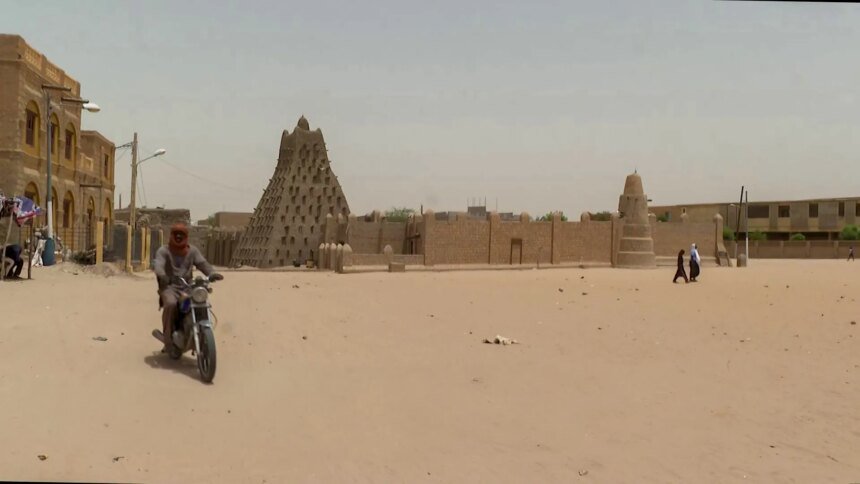
In the heart of the Sahara Desert, the city of Timbuktu stands alone in the face of the winds of security and economic crises, which intensify day after day, sweeping away the ability of the population to preserve their country and its ancient human heritage.
The city located in northern Mali represents the link between the edges of the desert, and has a great history of science, culture and arts, which were formulated in the footsteps of caravans and the tales of travelers and merchants about gold, salt and the pen, as Baba Ould Horma said in a report he prepared for Al Jazeera.
Read also
list of 2 itemsend of list
But the city, which for decades represented a scientific and religious beacon in the heart of the African Sahara, today appears empty, threatened by fear and besieged by poverty, after most of its residents left and only those who were unable to leave remained there, according to Al-Fadi Wangara, the director of the Sidi Yahia Mosque School.

Residents flee
The crisis that Timbuktu has been experiencing since the armed groups took control of it 15 years ago has forced most of the city’s old residents to flee, although these groups later left the city.
Security, economic, and climatic pressures also reinforced the idea of leaving the city and prompted local library supervisors to transfer manuscripts to the capital, Bamako, before some of them were recently returned.
Even the tourists who used to boost the city’s economy no longer visit it as they did in previous years, prompting the majority of inns and shops to close their doors.
However, Alpha Mega still clings to the inn that his father built two decades ago, and continues to work there even with the scarcity of visitors. Since 2009, the number of tourists has declined significantly and the city has almost been devoid of them completely.
But some initiatives contributed to bringing in some tourists, such as the Coexistence Festival and the annual art festival, which attracted a large number of Americans, Mega said.
Amidst all the reasons for silence, the city is still full of memories and monuments. Through many generations of cultural intermarriage and the mixing of tongues and races, Timbuktu’s cultural and scientific status has been consolidated.

Scientific and cultural wealth
The city has accumulated cognitive and artistic traditions that have been refined over the centuries. The footsteps of passers-by and those who inhabited the lands remain in the paths, minarets and echoes, which the city is trying to lean on as it tries to dispel the specter of isolation and brokenness.
In the libraries and the manuscripts they contain, evidence of the city’s renaissance and those who once passed through it are evident, which were subjected to much damage and some sacrificed their lives to save what was left of it.
Among the important edifices in the city is the Ahmed Baba Timbukti Institute, which bears the name of one of the city’s figures and pioneers of its scientific renaissance more than 4 centuries ago. In this place, Timbuktu is trying to piece together the sciences and arts written by copyists and pens over many years.
Those in charge of the institute are striving to preserve thousands of manuscripts that are threatened by harsh natural conditions and sometimes burned and destroyed by human hands, as happened when armed groups took control of the city in early 2013, a scenario they fear will be repeated in the future, after these groups regained control over many major cities in the north of the country during the past few months.
When the armed groups entered the city, those in charge of the institute tried to remove the manuscripts with difficulty and succeeded in transporting many of them to the capital, Bamako, after young men sacrificed themselves and carried 780 manuscripts in their bags, according to the head of the institute’s manuscripts department, Abu Bakr Mega.
As the security and livelihood crises worsen, the residents’ ability to protect the city’s heritage and antiquities declines, putting this human wealth on the verge of damage or loss.