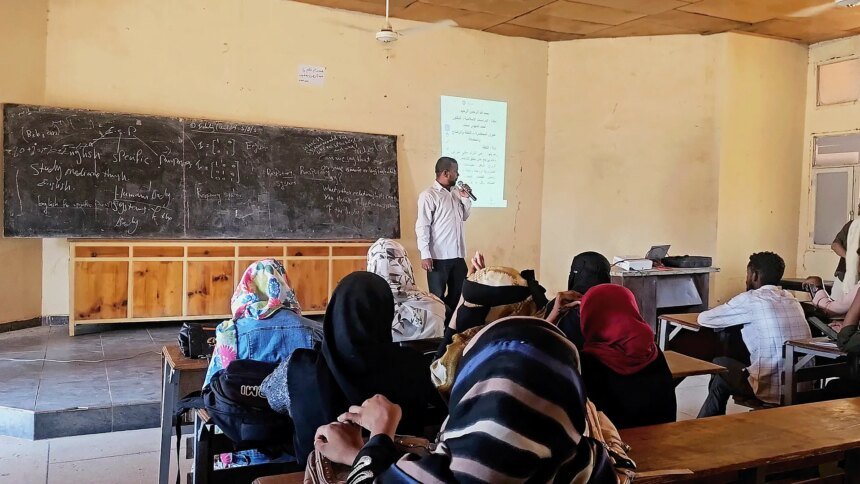
Khartoum- Design Department student Marwa Al-Taj returned to her university in Omdurman after a long hiatus from studying due to the war in Sudan. She said that she felt sad upon her arrival, as she found the place transformed into destruction and ruin, but the presence of her colleagues on the university campus gave her a glimmer of hope that restored her sense of belonging to the university.
For Marwa, simply returning to the halls and laboratories, despite the poor equipment and the power outage, represents a first step towards restoring the normal academic life that students have missed for years.

Murals herald a new beginning
In the colleges of Omdurman National University, students not only returned to their studies, but also sought to revive the colleges with drawings on the walls of the College of Design. Colorful murals appeared carrying messages about steadfastness and peace, while bright colors covered the ruins to announce a new beginning.
This artistic activity was not just an attempt to beautify the place, but rather was a collective initiative that reflects the students’ desire to restore the identity of their university and return the spirit to the campus.
Student Ahmed Muhammad Ali points out the difference in the educational situation before, during, and after the war. He pointed out that force majeure imposed the distance education system due to the displacement of students and teachers, but he believes that it was not a real alternative to direct attendance, especially for students in specializations that depend on the practical aspect.
Ahmed adds to Al Jazeera Net that students are now demanding that lectures be made available in person within the college, because returning to the halls and laboratories represents for them a restoration of direct interaction with professors and colleagues, and a revival of the normal university life that they missed.

In turn, the director of Omdurman National University, Abdel Hafez Al-Taher, said that the university was able to maintain more than 80% of the classrooms, and maintenance operations are still continuing to rehabilitate the remaining facilities.
He explained that they returned more than eight months ago to resume lessons in person and interactively simultaneously via a dedicated e-learning platform, including the College of Medicine and medical laboratories, with the aim of returning academic life to normal.
Regarding the electricity problem, Al-Taher confirmed to Al Jazeera Net that the university had resorted to using solar energy as a practical solution to provide a suitable environment for students and professors. They were able to introduce 6 solar energy stations, including a station containing 97 solar panels, which allowed about 60% of the university to be covered with alternative energy systems.
He explained that this step is not limited to addressing the electricity crisis, but also represents a trend towards sustainability and reducing dependence on traditional energy sources. He added that the university is working on a long-term plan that includes:
- Expanding maintenance to include libraries and research laboratories.
- Rehabilitating cadres through training programs for professors and employees.
- Encouraging student initiatives and cultural activities to enhance the spirit of belonging.

Well thought out plan
The Sudanese Ministry of Higher Education and Scientific Research decided to return all institutions of higher education and scientific research to their original headquarters, and to stop work in alternative and temporary centers next August.
The Minister of Higher Education and Scientific Research, Ahmed Mudawi Musa, said that this decision, whether from outside Sudan or from areas of displacement, came after a careful study that included the current analysis of the situation of universities in terms of academic structure and reconstruction, as well as in terms of student housing.
He explained that the goal is to return universities to their natural environment so that they can regain their role in education and scientific research, stressing that the Ministry has developed a gradual plan that takes into account the different circumstances of each university.
Mudawi explained in exclusive statements to Al Jazeera Net that all universities were supposed to return to their headquarters at the end of last December, and the Ministry had appealed to university administrations to do so.
As the year 2026 enters, he said that they have become more certain that the environment has become suitable for the return of public universities in January 2026, which has already been achieved as the return has been completed. He stressed that they inspected all universities, including private ones, to determine their conditions and educational environment, and came to the conviction of the necessity of everyone returning to their original headquarters.
The Ministry of Higher Education and Scientific Research estimated the amount of damage to higher education institutions as a result of vandalism and looting at about $3 billion. These losses include university buildings, classrooms, laboratories, libraries, and educational equipment that were destroyed or looted during the war.

Efforts to support academic cadres
The Minister of Higher Education and Scientific Research added that there is no longer a need for students to remain outside Sudan after the educational environment has been prepared, and therefore the Ministry has set this time limit. He pointed out that more than 95% of government centers and universities have already returned, and with regard to private universities, he confirmed that they are all ready, and that their administrations have adhered to the decision to return.
Regarding the return of faculty members and employees, Mudawi confirmed that the ministry has made efforts to support academic and administrative staff by doubling wages by 100%. He explained that this step came in recognition of the importance of the role of professors and employees in the success of the return process, and to encourage them to settle within universities after years of displacement and economic challenges.
As the specified date approached, the majority of Sudanese public and private universities rushed to return to their original headquarters in Khartoum, trying to restore their academic and administrative activity despite the difficult circumstances. Some universities have opened their doors to students and professors, while others have begun urgent maintenance work for their buildings and laboratories, at a time when the electricity crisis and the instability of basic services remain a daily concern.

Essentially for the return of normal life
The director of Al-Zaim Al-Azhari University, Nasr al-Din Muhammad Ahmed, believes that the step of returning universities represents a basis for rebuilding and returning life in the capital to normal, stressing their readiness to implement the state’s thoughtful plan that ensures the continuation of the educational and administrative process within the university.
Nasr al-Din explained in his speech to Al Jazeera Net that they began returning gradually in May 2025 from within the university’s headquarters, where they were able to hold two exam sessions in the cities of Bahri and Omdurman, which reflects the university’s ability to restore its academic activity despite the difficult circumstances.

For her part, Ola Omar Ahmed, Director of the Human Resources Department at Al-Zaim Al-Azhari University, said that the university is on a strong path to return in terms of providing aids and a suitable study environment for students.
She explained in her interview with Al Jazeera Net that the majority of professors have already begun to return, which is reflected in attendance within the university and enhances the regularity of the educational process.
She expected that upon the expiration of the specified deadline, a large number of professors and teaching assistants would return, which would contribute to the stability of studies and the restoration of normal academic activity.