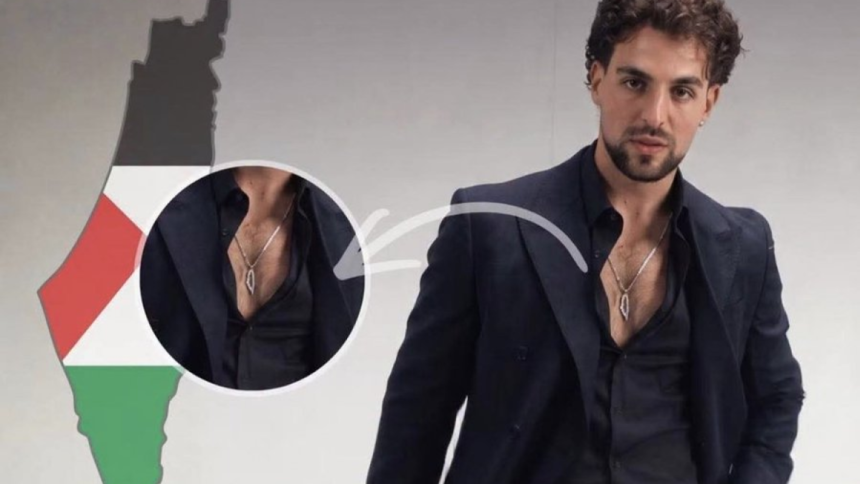
The appearance of Palestinian singer Marwan Abdel Hamid, known as “Saint Levant”, at the Prada men’s fashion show in Milan turned into a widespread attack on social media platforms, after the Italian brand published a clip of him as its ambassador, wearing a necklace that pro-Israel accounts considered a map of “historic Palestine.”
The interaction did not stop at criticizing the necklace or choosing Saint Levant as Prada’s ambassador, but rather extended to accusing the Italian brand of promoting “the erasure of Israel,” and the campaign called for a boycott of it, recalling the artist’s previous positions on Gaza and Palestine, in addition to linking him to the events in Amsterdam in late 2024.
Read also
list of 2 itemsend of list
The Al Jazeera Network’s Open Source Unit tracked a sample of posts circulating on social media platforms, and the sample reveals that the campaign was not just an objection to a visual detail in a fashion look, but rather turned into a digital pressure wave led by pro-Israel accounts, which attempted to present the appearance of a Palestinian artist in a global campaign as a political message against Israel.
A post that sparked controversy
The controversy began after Prada’s official account published a clip of Saint Levant from the Prada men’s spring/summer 2027 fashion show in Milan, and the brand presented him as its ambassador, in a post bearing the tags PradaSS27, PradaPeople, and SaintLevant.
But after the clip spread, pro-Israel accounts focused on the necklace that the artist wore, and considered it a map of “historic Palestine” that includes the entire land between the river and the sea.
Accounts supportive of Israel considered that Prada and Saint Levant were promoting a product that showed a necklace bearing a “fake map of Palestine,” claiming that this meant promoting the “genocide of Israel” and that the Italian brand’s products should be boycotted.
In the same vein, other accounts described Saint Levant’s campaign with Prada as a “punch in the stomach,” adding that the appearance of the “Historical Palestine” pendant in the Italian brand’s advertisement is “a source of deep disappointment.”
Erase Israel
In a more severe manner, pro-Israel accounts attacked the appearance of the necklace in the Prada campaign in front of millions of followers on Instagram, considering that it carried a political message calling for “the erasure of Israel,” as they described it.
The post quickly turned into a starting point for a broader campaign, as pro-Israel figures and accounts recirculated it and built on it. The interactions included questions and criticism of Prada’s decision to choose Saint Levant as the brand’s ambassador, while some of them considered the move to be an announcement of the company’s position, concluding their calls with phrases such as: “Goodbye, Prada.”
Boycott calls
The interaction did not stop at criticizing the necklace or the choice of Saint Levant, but rather developed into explicit calls to boycott Prada, as pro-Israel accounts considered that the company was aware of the consequences of its choice, and called for expanding the scope of the boycott campaign, while sending messages to accounts and organizations active in monitoring and combating anti-Semitism.
These publications indicate that the campaign went beyond objecting to a visual symbol in an advertising campaign, and turned into an attempt to exert direct consumer pressure on Prada, by linking the purchase of its products to positions related to Israel and anti-Semitism, as it claimed.
From the necklace to Saint Levant’s past
The attack did not stop at the necklace, but rather extended to recalling previous positions attributed to Saint Levant, as one of the pro-Israel figures asked whether Prada’s choice of him as ambassador reflected the company’s adoption of what it described as his “disgusting praise” of participants in the Amsterdam events in late 2024.
Former Israeli government spokesman Elon Levy re-published the post, commenting sarcastically: “Sometimes the devil wears Prada,” in reference to the famous movie, but this time he used it to direct political and moral criticism of the brand.
These accusations were repeated in other publications, as pro-Israel accounts demanded that Prada clarify its position on choosing St. Levant as the brand’s ambassador, while other publications accused him of publicly praising the participants in the Amsterdam events, considering that his appointment raises questions about the company’s position on those statements.
This stage shows that the campaign has gone beyond the controversy over the necklace, to adopt a broader indictment that linked Saint Levant’s appearance in the Prada campaign to his previous positions, in an attempt to present the brand as tolerant of what these accounts describe as “hostility to Israel” or ignoring the concerns of Jews.
Multiple languages
The campaign quickly went beyond English-language accounts, spreading through pro-Israel accounts in other languages. In publications in Italian, Prada was accused of promoting its products through Saint Levant, with the necklace he wears being considered an embodiment of what was described as a “map of Palestine from the river to the sea,” and claiming that it carried a connotation of seeking the elimination of Israel.
Publications in German also repeated the same accusations, claiming that Prada and its Palestinian ambassador were promoting a symbol bearing the “Map of Palestine.”
The interaction also appeared in Hebrew through posts that described St. Levant as a Palestinian artist who was born in Jerusalem and grew up between Gaza and Jordan, and focused on the necklace that she said showed the “map of Palestine” and included the entire area of Israel.
Campaign network
The interaction map prepared by the Al Jazeera Network’s Open Source Unit supports this path, as it shows that the controversy over Prada and Saint Levant did not move as separate individual comments on a fashion look, but rather formed within a clear digital network led by pro-Israel accounts and accounts active in the discourse of combating anti-Semitism.
This network pushed the necklace from being a detail in a propaganda photo to a broader issue about “erasing Israel,” “from the river to the sea,” and “boycotting Prada.”
The sample analyzed included about 2,828 posts, and resulted in a network that included 1,519 accounts and 1,689 interaction relationships in a directed network.

The map reveals that the Prada account itself emerged as the largest node within the network, not as a party participating in the campaign, but rather as the targeted account mentioned extensively in the wave of criticism.
Prada’s account was centered around mentions, replies, and quotes, which reflects a direct attempt to put pressure on the Italian brand and push it to react to the controversy or review Saint Levant’s appearance in its campaign.
In this context, the campaign was no longer directed at the artist alone, but rather at the company as a platform that gave him a global presence, which made Prada at the center of the digital pressure network.

Influential accounts
At the heart of the network, accounts such as Gantelle Segule, Hen Mazigh, Heidi Bakhram, Elon Levy, and strength4israel emerged as influential nodes in pushing and expanding the narrative.
Gantel Ségol played a pivotal role in turning the necklace into a direct boycott call, by linking it to the idea of “Palestine from the river to the sea” and “the annihilation of Israel.”
As for Hen Mazig, he helped give the campaign a broader reach by framing Prada’s post as a political message directed to millions of followers.
On the other hand, Heidi Bakhram expanded the angle of attack from the necklace to Saint Levant’s previous positions and the Amsterdam events, which was re-inflated by Elon Levy with a sarcastic formulation that made Prada itself part of the accusation.