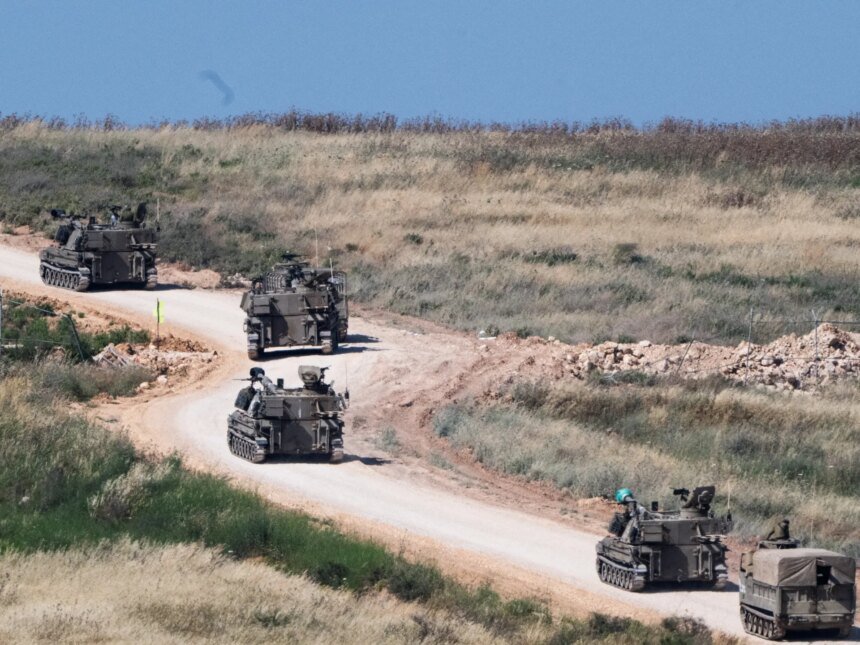
Although the Israeli-Lebanese agreement stipulates that Tel Aviv withdraws from experimental areas in southern Lebanon, the Yedioth Ahronoth newspaper quoted Israeli Prime Minister Benjamin Netanyahu as confirming that the occupation army will continue to be stationed there.
Netanyahu used the excuse of staying in what he called the safe sector in southern Lebanon as he sought to prevent Hezbollah from building tunnels that penetrate the border with northern Israel, accusing Iran of pressuring to impose an Israeli withdrawal from southern Lebanon in accordance with the memorandum of understanding with Washington.
This statement is consistent with what was made by Israeli Defense Minister Yisrael Katz, who also stressed that the occupation army will remain in the security areas in Lebanon, Syria and the Gaza Strip “as long as necessary” without setting a timetable for withdrawal.

Security areas
Israel Katz confirmed today, Wednesday, during a memorial ceremony for soldiers killed in the war with Lebanon in 2006, that the occupation army forces will remain in the “security areas” in Lebanon, Syria and Gaza, in order to protect the residents of Israel.
Katz did not separate Iran from the Lebanese file and its ally Hezbollah, as he threatened that Israel would launch a new raid on Tehran “if necessary,” after it and its ally the United States bombed it last year and on February 28 of this year.
In parallel with his commitment to maintaining the occupation forces in southern Lebanon, Netanyahu, in his statement to the Yedioth Ahronoth newspaper, tried to present the recent agreement with Beirut as a “historic achievement” that, according to his claims, allows the occupation army to remain in southern Lebanon.
On June 26, Beirut and Tel Aviv signed, in Washington under American sponsorship and led by US Secretary of State Marco Rubio, an agreement stipulating a gradual Israeli withdrawal from Lebanese territory, starting with two experimental areas.

Netanyahu allegations
In his statement to the newspaper, Netanyahu combined the threat of continuing the occupation of parts of southern Lebanon with the transition to a new phase of relations with Beirut, claiming that his government would do its “utmost” to reach a peace agreement between the two sides.
In a scene that reflects the Israeli field penetration, the occupation army established crossing gates between what is known as the Yellow Zone and the border area in southern Lebanon, in conjunction with its continued military presence inside Lebanese territory.
The yellow line is a line imposed by Israel during its recent aggression against southern Lebanon, which it calls the security tape. It extends in some parts of it from the border with Israel to about 10 kilometers deep into Lebanese territory.
The Lebanese National News Agency reported on Wednesday that the Israeli army established crossing gates between the Yellow Zone, the border zone, and the South Litani area, without providing further details regarding the nature of the gates, their number, or their locations.
Israeli orgy
In a related context, the agency said that Israeli forces bulldozed roads, especially the road extending from the Hamoul area to the town of Naqoura to the town of Aita al-Shaab, and also cut down old trees on both sides of the road.
According to the agency, Israeli forces also carried out bombing operations on a number of homes in the Beit Yahoun area, in addition to bombing other homes in the town of Al-Tiri in the Bint Jbeil district.
This coincides with a tour conducted, hours ago, by Israeli Prime Minister Benjamin Netanyahu, accompanied by Defense Minister Israel Katz, in areas occupied by Israel in southern Lebanon, which he describes as a security zone, according to Israeli Army Radio.
This is Netanyahu’s first visit to the occupied Lebanese territories since the Israeli and Lebanese governments reached a US-brokered security agreement last Friday stipulating that Israel would hand over two areas to the Lebanese army.
Israel invaded Lebanon after Hezbollah opened fire on it on March 2, in response to the attack launched by the United States and Israel on Iran on February 28.
More than four thousand Lebanese were killed and more than a million were displaced as a result of the Israeli military campaign in Lebanon since March. At least 32 Israeli soldiers and four Israeli civilians were killed by Hezbollah, most of them in southern Lebanon.

Misleading statements
On the other hand, Gadi Eisenkot, the former chief of staff of the Israeli army and leader of the opposition Yashar Party, launched an attack on Wednesday against Prime Minister Benjamin Netanyahu, considering that he was frightening Israeli public opinion with allegations that Iran possessed nuclear bombs.
Yedioth Ahronoth quoted Eisenkot as saying, during a conference held in central Israel: “Netanyahu made misleading statements. Iran did not possess any nuclear bombs at all. He is making allegations to frighten Israeli public opinion.”
She explained that Eisenkot was referring to statements made by Netanyahu, on Tuesday evening, in an interview with Israeli Channel 14, in which he said that he attacked Iran twice to save Israel from annihilation with nuclear bombs “which they already had.”
Yesterday, Tuesday, Eisenkot, who served as Chief of Staff of the Israeli Army between 2015 and 2019, announced his intention to run for the position of Prime Minister.