The law banning the eating of dog meat and the manufacture of dog meat in South Korea, which is scheduled to enter into force next year, is considered a historic achievement that those concerned with animal rights see as a strong example of the success of the political will in changing the food and social customs that the Korean people have been accustomed to for centuries. There is a belief, especially among the elderly and rural residents, that dog meat is an important source of energy, especially in the summer.
A long campaign preceded the announcement of a national ban on eating and processing dog meat in 2024, a victory for this pet. The law regarding this ban is scheduled to enter into force as of next year 2027, but what is striking is that dogs disappeared before this ban.

Legislation
On January 9, 2024, the South Korean Parliament passed a special bill prohibiting the consumption of dog meat. The Parliament approved the bill prohibiting the breeding, slaughter, distribution, and sale of dogs for their meat by a majority of 208 votes, with two abstentions.
The law did not neglect those in charge of this activity, which is their source of livelihood, and called for government subsidies to help workers in the dog meat industry change jobs.
According to government statistics, there are about 1,150 dog farms, 34 slaughter companies, 219 distributors, and about 1,600 restaurants that sell dog meat foods in South Korea.
Therefore, Parliament gave a grace period of 3 years before the law comes into effect starting next year, and after that Violators face a maximum of two years in prison or a fine of up to 30 million won ($22,768).
For its part, the government has also prepared plans to motivate workers in this industry to move to different jobs or close their businesses, by offering financial incentives. But support measures are limited only to those who report to the local government and submit an implementation plan.
Following the passage of the law, animal rights groups were quick to welcome it and considered it an important turning point in South Korea’s stance toward animal protection. A South Korean human rights official also considered it “a testament to the determination of our people and animal-loving politicians who have reached a turning point to consign this outdated industry to our history books.”
The International Society for the Animal Welfare also issued a report containing policy recommendations and lessons learned for other countries still facing this challenge.

Slaughterhouses are deserted and dogs are disappearing
With South Korea’s historic dog meat ban about to come into effect next February, Agence France-Presse noted that dogs have disappeared in South Korea.
In a field report from an abandoned dog slaughterhouse in the town of Pyeongtaek, south of the capital, Seoul, the agency observed electric shock devices placed on a wall near rusty cages containing dog skulls in an abandoned dog slaughterhouse in a South Korean town.
The agency’s correspondent sees the case of the slaughterhouse as evidence of an industry that has begun to fade in South Korea, however This raises an important question: What happened to the hundreds of thousands of dogs that were raised for human consumption?
Government figures show that in 2024, between 400,000 and half a million dogs were being raised for meat. Today, the Ministry of Agriculture estimates that only 20,000 dogs remain on farms.
The agency notes that there are no accurate statistics on trends in dog meat consumption, but it is known that it is common among only a small group of South Korea’s 51 million population.

Already eaten
To help farmers transition to a new system, the government has offered up to 600,000 won (about $390) for every dog euthanized.
The agency quoted an inspector at the South Korean Ministry of Agriculture – who declined to be named – saying, “Our role is to verify that there are no dogs on farms or slaughterhouses before providing compensation.” He added: “We are not concerned about what happened to the dogs.”
Data obtained by a lawmaker show that by February, only 623 dogs had been adopted, and fewer than 500 had been sent to shelters. Animal welfare organizations and former farmers believe that most of the remaining dogs have already been killed and eaten.
“If large numbers of rescued dogs had entered adoption programs, animal welfare organizations like us would have been aware of them,” said Kim Young-hwan, a representative of animal rights organization CARE, adding, “We have not seen any adoption campaigns for dogs rescued from dog farms.”
CARE says it has rescued and rehomed about 2,500 dogs from dog farms over more than two decades, most of which were sent abroad.
Only about two dozen dogs have been adopted locally, partly because South Koreans prefer small breeds that are suitable for living in apartments.
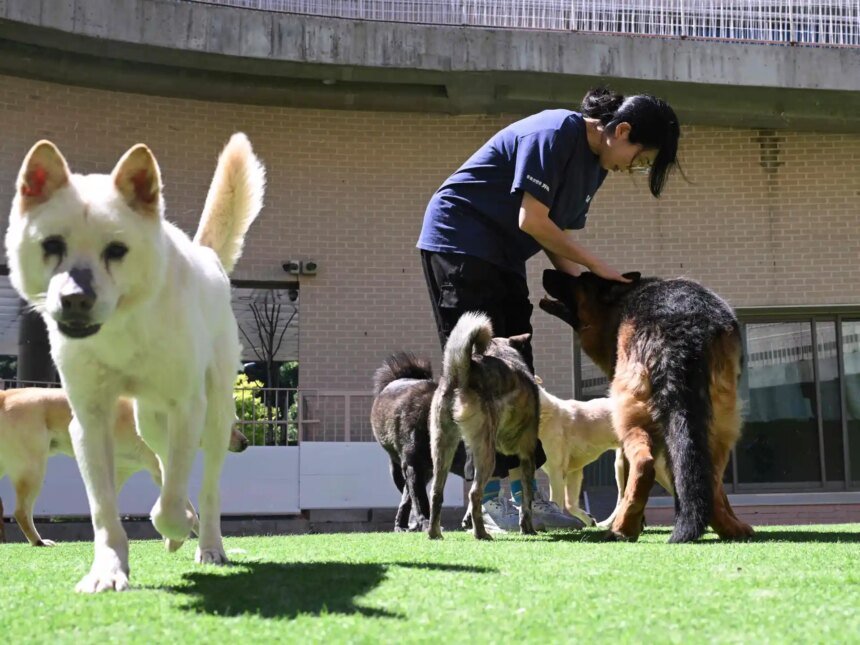
The dogs bred for food were often large breeds such as the “Norongi”, also known as the “Korean Yellow Spitz”.
“In South Korea, there has always been a distinction between dogs raised for food and those raised as pets,” Jo Young-bong, a former dog farmer, told AFP. When asked about the fate of thousands of missing dogs, he admitted that they had likely “already been eaten.”
Kim, of CARE, said the prospect was “infuriating.” He added that the reality is that animal welfare organizations in the country lack the resources to save more dogs.
Legal contradiction
According to the Ministry of Agriculture, 1,265 dog breeding farms – approximately 82% of the total farms – had submitted requests for closure as of last May.
Joe, a Christian pastor, started his dog farm in 1994 after finding he could not make a living from his church work alone.
“I feel that the dog meat ban is a betrayal,” he told AFP. “The law was imposed for political reasons, without serious dialogue or adequate measures to protect our livelihoods.”
Joe added that many former dog breeders are trying to transition into other livestock businesses, but lengthy state licensing procedures have made that transition difficult.
“Changing the law will not only end the consumption of dogs, but will also close an old legal loophole,” said Park Joo-yeon, a lawyer and president of an animal rights organization.
Out of classification
Unlike cows and pigs, dogs are not legally classified as livestock in South Korea, meaning the industry has continued for decades without any controls on compassionate care and slaughter.
Animal rights activists reported that dogs were killed by electrocution, hanging, or beaten to death. At the Pyeongtaek facility, journalists saw abandoned tools that were allegedly used to electrocute dogs.
As for human rights activist Shin Joo-won, he says, “The dogs often remained conscious while their internal organs burned, and other dogs witnessed this process.”
A human rights organization says it rescued 29 dogs from a Pyeongtaek farm last month, and has filed a lawsuit against their owner on charges of animal cruelty, which is a criminal offense.
The final judgment of success or failure on the South Korean experiment remains dependent on the practical application of the law and the limits of adhering to it or circumventing it, in order to verify the hope of victory for animals and to end the dog and cat meat trade once and for all.