Published on 6/28/2026
Several reports and investigative reports from Western newspapers and sources have unanimously agreed that Russia is facing at this stage the most serious pressure that the Crimean Peninsula has been exposed to since its annexation in 2014.
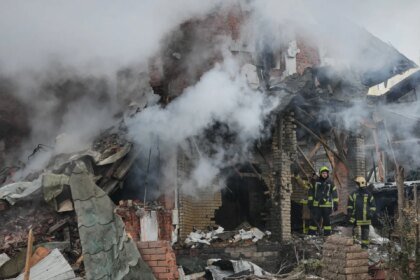
She pointed out that the continuing Ukrainian attacks with marches are no longer targeting only military sites, but are also striking the arteries of supply, energy, and transportation, in an attempt to isolate the island and exhaust Moscow militarily, economically, and politically.
Read also
list of 2 itemsend of list
While Kiev is betting that this pressure will turn into a card that imposes negotiations on its terms, the question that arises remains: Will the blockade push Russian President Vladimir Putin to negotiate or to greater escalation?
Initially, the British website iPaper reported that Russian authorities in Crimea declared a state of emergency after Ukrainian attacks caused power outages and severe fuel shortages.
The British newspaper The Times said that this announcement was not just an administrative measure, but rather an indication that Ukraine is close to achieving its declared goal of “isolating Crimea.”

She added that bridges, roads, railways, power stations and fuel depots became daily targets, while fuel sales to civilians stopped, summer camps were cancelled, and queues of cars began to extend on the Kerch Bridge in an attempt to leave the island.
As for the I-Paper newspaper, it adds that the images of queues and closed gas stations have become visual evidence of the war’s spread to most of the areas presented by the Kremlin as the “grand prize” of the war.
This is consistent with what was stated on the American website Axios that Kiev’s strategy is no longer limited to exhausting the Russian forces on the front, but rather aims to transfer the cost of the war to Russia.
The simultaneous attacks on oil refineries, gas stations, fuel depots, and supply lines made Moscow face challenges in securing fuel for its cities and supplies for its forces, while Ukrainian President Volodymyr Zelensky announced the start of a forty-day “influence operation” to pressure Russia to accept a political settlement.

However, the crisis does not stop at Crimea alone. Le Parisien newspaper believes that Kiev is today waging what can be described as an “economic war,” as it strikes the energy infrastructure that represents the main source of the Kremlin’s revenues.
The newspaper goes on to describe this stage as possibly representing “the beginning of the economic end,” especially with gas and oil facilities being subjected to repeated strikes, in conjunction with the decline in energy prices after the reopening of the Strait of Hormuz, which doubles the pressure on the Russian economy, which is highly dependent on energy exports.
But if economic pressures are mounting, Le Monde reveals that the home front within the Russian army does not look any better.
Based on about 7,000 leaked letters from Russian soldiers and their families, the newspaper reveals a picture completely different from the Kremlin’s official story. The letters do not talk about heroism and victories, but rather about fear, corruption, and violations within the army, according to the newspaper.
Le Monde attributed to one of the soldiers his plea to his commander, saying: “Don’t kill me,” before he watched a colleague of his being subjected to a field execution, while another explained how he had to pay bribes so that he would not be returned to the front.
The study on which the newspaper relied indicates that most of the complaints do not attack Ukrainians, but rather accuse Russian military leaders of corruption, mistreatment, and sending soldiers to what they call “the chopper,” in reference to suicide attacks.

Le Monde adds that these letters also reveal a parallel economy within the army, where leave or avoiding the front lines can be bought with bribes, while some commanders obtain soldiers’ bank cards before sending them into battle to seize their entitlements if they are killed or missing.
The newspaper concludes that the continuation of the war exacerbates the sense of impunity within the military institution, and increasingly undermines the morale of soldiers.
Amid these pressures, the question that the Times focused on arises: What will Putin do if he feels that Crimea is truly threatened?
In response to this question, the newspaper points out that there are two currents within the Russian elite, a pragmatic one that calls for freezing the war, preserving the current gains, and then negotiating, and a hard-line one who believes that the only solution is escalation, by mobilizing hundreds of thousands of reserve soldiers, sending conscripts to the front, and even expanding operations against countries supporting Ukraine.
The newspaper believes that Putin’s personality itself makes predictions difficult, as he is known for caution in normal circumstances, but when he senses existential danger, he may make hasty decisions, it said.
Therefore, the threat to Crimea, which for Putin represents his most popular political achievement and a symbol of Russian glory, may push him to accept negotiation, but it may equally push him to raise the ceiling of confrontation.
In this context, Axios quotes Putin as saying that the Ukrainian strikes aim to “destabilize Russian society and raise doubts about the armed forces,” while Zelensky responds that “all these difficulties are caused by Putin’s refusal to end the war and listen to our peace proposals.”
Between these two positions, Crimea today appears to be more than just a battlefield. It is a test of the will of both parties, and a point that may determine whether the war will head toward the negotiating table or toward a more dangerous stage of escalation.