Published On 1/7/2026
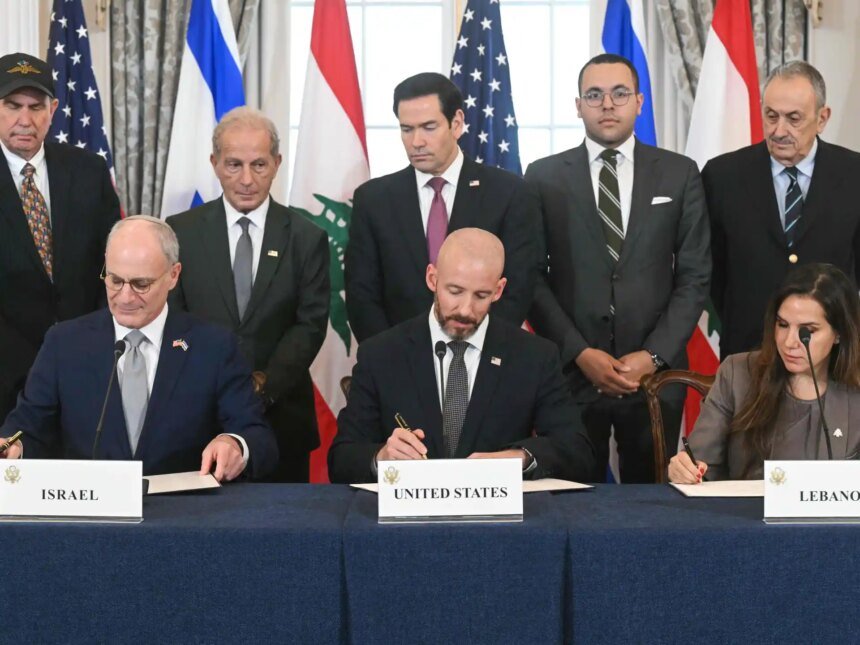
The political debate has escalated in Lebanon against the backdrop of the framework agreement signed with Israel in Washington, amid a sharp division between the political forces regarding its feasibility and its repercussions on the country’s future.
Attention is turning to southern Lebanon to follow up on the implementation of the terms of the agreement, especially with regard to the “experimental areas.”
The “Context of the Event” section on Al Jazeera screen reviewed the positions of the main Lebanese parties, indicating that the political scene is divided between opponents who see the agreement as a neglect of Lebanese rights and prefer to link any settlement to the Iranian-American negotiating path, and supporters who see it as a practical framework that opens the door to the restoration of Lebanese lands.
Other parties believe that the agreement suffers from shortcomings, but it reflects the existing balance of power at the current stage.
The paragraph dealt with a series of positions issued during the last hours by the most prominent Lebanese officials and political forces.
Lebanese President Joseph Aoun confirmed, during his meeting with Army Commander General Rudolf Heikal, that he discussed the expected tasks of the army in light of the results of the Lebanese-American-Israeli negotiations and the resulting framework agreement, praising the role of the military institution in extending state authority, preserving security and stability, controlling borders, and maintaining civil peace.
On the other hand, House Speaker Nabih Berri described the Washington agreement as “dictations,” considering it “worse than the May 17 agreement,” but at the same time he called for not being drawn into movements or reactions that might lead to chaos and internal fighting, considering that the American-Iranian negotiating path represents the only realistic opportunity to oblige Israel to withdraw completely from Lebanese territory.
For his part, the head of the Free Patriotic Movement, Gebran Bassil, announced, after his meeting with Berri, the agreement to reject any internal strife, and to emphasize the protection of the military institution as a symbol of national unity, stressing that protecting the state requires restricting decision-making and weapons to its own hands alone.
As for Hezbollah, it announced through Representative Hussein Al-Haj Hassan its categorical rejection of the framework agreement, describing it as “a shame and will not pass,” stressing that the party will not surrender its weapons, and that the disarmament condition contained in the agreement is not enforceable.
Historical background
During the interactive map displayed in the “Context of the Event” section on Al Jazeera’s screen, Abdul Qader Arada touched on the most prominent agreements that brought together Lebanon and Israel since the armistice agreement in 1949, through the May 17, 1983 agreement, the Madrid Conference, the April 1996 understanding, and the maritime border demarcation agreement in 2022, all the way to the arrangements for cessation of hostilities after the 2024 war, before signing the current framework agreement in June 2026.
He pointed out that the new agreement is based on enabling the Lebanese army to extend its control, in exchange for an Israeli withdrawal linked to the disappearance of threats, and includes the implementation of what is known as “experimental areas,” which sparked a wide debate about the extent of the need for its approval through Lebanese constitutional institutions.
“The division has changed and not ended.”
For his part, the writer and political analyst Amin Qammouriyeh believed that the internal differences were no longer limited to the issue of Hezbollah’s weapons, but rather extended to the nature of the negotiations with Israel, explaining that the current division includes forces that differ with Hezbollah regarding weapons, but they share with it in considering the current agreement as an infringement on Lebanese sovereignty.
He added that the majority of the executive authority may support the agreement, but the decisive factor remains in the field, where Hezbollah maintains, according to his estimation, the greatest influence in southern Lebanon, stressing that the party is so far committed to the ceasefire but does not recognize the framework agreement.
Qamouria pointed out that the most prominent obstacles to implementing the agreement are Israel’s insistence on linking its redeployment to the disarmament of Hezbollah, in exchange for the party’s refusal to hand over its weapons before the complete Israeli withdrawal from Lebanese territory.
The episode focused on the repeated warnings of the danger of internal strife, considering that they reflect fears that implementing some of the provisions of the agreement, especially those related to Hezbollah’s weapons, would lead to an internal conflict.
Qammouriyeh explained that the Lebanese Army and Hezbollah do not want, so far, to be drawn into an internal confrontation, but he warned that putting the two parties in direct confrontation could lead the country into a dangerous crisis, even though the situation is still, according to his assessment, under control.
The episode concluded by reviewing two main scenarios for the next stage, the first of which is the success of an internal Lebanese dialogue that leads to new understandings that maintain stability, and the second is the imposition of a regional and international settlement that outlines the features of the solution in Lebanon, amid doubts about the ability of the framework agreement to achieve success in light of the internal divisions and complexities of the regional scene.