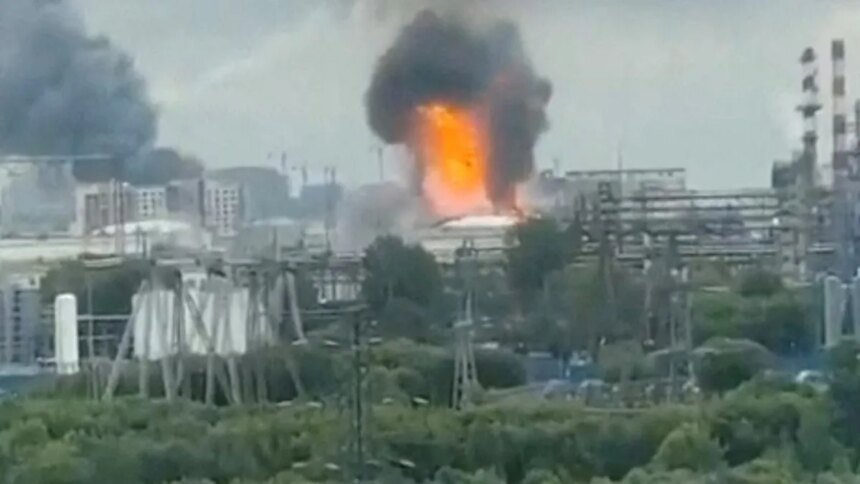
During the first half of 2026, the Russian-Ukrainian war entered a phase more closely tied to energy infrastructure, as long-range strikes turned into repeated pressure on oil refineries, pumping stations, and fuel stores that fuel the war economy and supply lines.
In this context, the Slavyansk Eco oil refinery in the Krasnodar region, southern Russia, emerged as a new link in a series of attacks on Russian energy facilities, after a massive drone attack that began last Saturday evening and extended until Sunday morning, according to Russian data.
Read also
list of 3 itemsend of list
Satellite images – analyzed by the Al Jazeera Network’s open source unit – reveal a thick black smoke cloud rising from the refinery on June 28, compared to a previous image taken on June 26 in which no signs of fire or smoke appeared at the same site.
Slavyansk is burning
A visual comparison between the two images shows expanding columns of smoke from inside the refinery, extending eastward over agricultural areas and surrounding residential areas, with red flame spots appearing near the emission center, indicating a widespread fire inside the facility.
The refinery is located in the city of Slavyansk-on-Kubani in the Krasnodar Territory, within an industrial scope connected to a network of roads, railways and oil storage facilities, making it part of the fuel refining and transportation system in southern Russia.
Moscow novel
The Governor of the Krasnodar Region, Veniamin Kondraev, announced that the region was subjected to a widespread attack by drones, noting that the fall of drone debris in Slavyansk-on-Kobani caused damage to a number of homes and the death of a person, in addition to the outbreak of a fire within the vicinity of an oil refinery, and damage to an electricity line and a gas pipeline.
The operations headquarters in the Krasnodar Territory also announced that drone debris caused a fire inside a refinery in Slavyansk-on-Kobani, and that the damage also included a power line and the windows of a private house, while emergency teams and special services worked at the site.
In a statement quoted from the Russian Ministry of Defense, Moscow said that its air defenses intercepted and destroyed 213 Ukrainian drones between 20:00 Moscow time on June 27 and 07:00 on June 28, over several Russian provinces, including the Krasnodar Territory, over the Crimean Peninsula, and the waters of the Sea of Azov and the Black Sea.
The importance of Slavyansk
Images of the fire gain additional significance given the refinery’s location within the refining sector in southern Russia. According to the annual report of Slavyansk Eco, the company is one of the active oil facilities in the Krasnodar Territory and the Southern Federal District, and its primary activities are the production of oil derivatives and their sale inside and outside Russia.
The report states that the volume of oil refining in the refinery amounted to about 3.99 million tons, and that the company’s share reached 9% of the refining volume of independent refineries in the Southern Federal District, and about 1.4% in Russia, while its products include fuel for cars and ships and derivatives used in industry, roads and subsequent refining operations.
War on energy pathways
The two Slavyansk fires do not come in isolation from a broader pattern of targeting. Since the beginning of the year until this June, the Al Jazeera Network’s Open Source Unit prepared a map to track strikes on energy facilities in Russia and Ukraine, which showed that Ukrainian targeting has increasingly focused on oil refineries, fuel tanks, pumping stations, and Russian export ports.

In previous monitoring by the unit, the Krasnodar Territory and the ports surrounding the Sea of Azov showed a recurring pressure on the Russian oil and logistical infrastructure, which included refineries and stations such as “Ilsky,” “Avibsky,” and “Tamaneftigaz,” and warehouses linked to Russian energy companies.
These targets coincide with increasing indications of pressure in the Russian fuel sector. The Associated Press reported that Russian President Vladimir Putin acknowledged the existence of difficulties in fuel supplies, pledging to strengthen the protection of oil facilities, accelerate the repair of damaged sites, and increase production to address the temporary deficit.
Thus, the Slavyansk refinery appears to be a new episode in a long battle of depletion of the energy infrastructure, as Kiev seeks to reduce Moscow’s ability to refine fuel and finance the war, while Russia is trying to contain the effects of the strikes on the supply networks in the south and the ports of the Black Sea and the Sea of Azov.