Stockholm
Christina Nordh
Published 09.25
Storms, floods and lack of drinking water.
Climate change is no longer a distant threat.
The generation that inherited the crisis is now heading towards its first election.

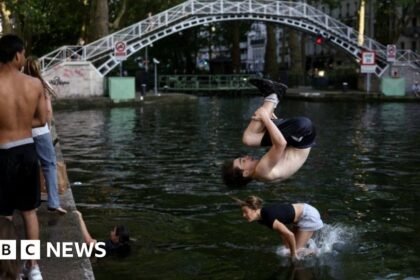
Last summer was Mälaren’s water several degrees warmer than normal.
And it may become increasingly common in the future.
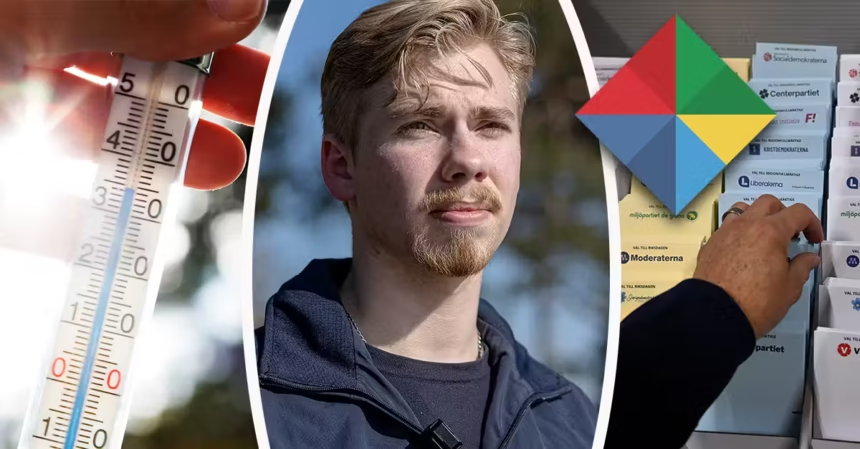
– All parties must work together on climate change. Now you’re getting nowhere, says Isac Äijä, 18.
Isac brakes the metallic green family car and turns into a parking pocket next to Drevviken out on Fornudden. He is beaming with pride, his driver’s license is fresh, but his.
Alarms about water shortages from Gotland and eastern Skåne have become commonplace. Erosion prompts municipalities to build shelters. Heavy rains cause severe flooding. But here, in the metropolitan area, no climate changes are noticeable, right?
Well, last August 15 passed Stockholm water out with a call to Stockholmers to save water. Mälaren’s surface water, which the entire region depends on for drinking water, was too warm.

In addition to the city of Stockholm, Lake Mälaren also supplies the municipalities of Tyresö, Haninge, Huddinge, Botkyrka, Salem and Nacka – a total of around two million people.
– Mother said we needed to save a little more on water. You were influenced, that is, in the attitude towards how much water you actually dispose of. It was a little lesson. But it wasn’t so direct – like a blow, for example.
By blow, he means something that feels like a real slap in the mouth, an abrupt awakening.
Are you worried that there will be a water shortage here in Stockholm?
– Yes, I have never heard that you really have to save water. It will probably be problematic to live like that for a long time, I think. You become limited. Then it also applies that everyone helps. You have to make some sacrifices.

This summer, Isac will go on holiday to Gotland, where at the beginning of the year there was an alarm about a water shortage.
– I am most worried that the drinking water will be worse when we get there.
But it’s not just a lack of water that worries Isac. Global warming is also worrying, he thinks.
– Last summer it was very hot in Stockholm. And I remember in 2018 when they talked about the forest fires on the news. I was ten years old then. It was probably the first time I really thought about climate change.
– We live near the forest in Tyresta National Park and have had to go out and put out fires from time to time. People have thought they put out the fire. But what they don’t understand is that the fire spreads underground, because the roots burn.

Do you think a lot about climate?the changes?
– Yes, absolutely. If you look at a longer period of time, you can see that the climate has become warmer. And also see that it is the carbon dioxide emissions that affect and make it warmer. It is clear that the worries are there, but you get used to it. We know that the climate is getting worse.
He believes that in the future we will have a warmer world – and that the quality of the drinking water will become worse.
– Everyone must help against climate change. We may need a strike, as I said before. Because it is not easy to detect when climate change is so slow.
– Mostly I’m worried about how my children, if I have any, will be. And how urgent the situation will be. How much they will have to sacrifice. You don’t want to give them a bad future.
Are you worried that the earth will become uninhabitable in the future?
– It will probably be. But it will take a while to get there. It might not happen to me, but maybe it will happen to my grandchildren. Maybe there will be places you can live. But how many people will die on the way there in floods, forest fires and extreme weather?
Do you have a message for the politicians?
– Yes, the climate is not just one party’s problem. It’s everyone’s.
This autumn he will vote for the first time and it is starting to feel difficult.
– It becomes smarter every day to know what to vote for, the more knowledge you absorb. You get to see different sides of the coin with the two blocks. And the world situation… it’s quite worried and then it’s more important what you prioritize. I am thinking both of the war in Ukraine, but also of the war in the Middle East.
As you know, the war in the Middle East has affected oil prices. The issue has suddenly become more important to Isac.
– Oil prices have gone up. Then you have to think about how to vote on that issue too – whether to lower the petrol price or raise it. It gets very clever.
This is how you differentiate between weather and climate
Climate is about the long-term average of weather conditions in a particular location, often over 30 years. Unlike the short-term and changeable weather, climate gives us an overall picture of temperature, wind, rain and snow over a longer period of time.
A changing climate leads to various effects, such as floods, torrential rains and heat waves – phenomena that affect both people, communities and ecosystems.
Negative effects of climate change and biodiversity loss are two parallel crises that are strongly interconnected and have a clear link to human activities.
Ongoing climate change is today a significant influencing factor for all types of ecosystems.
Source: SMHI
The expert: Mälaren two to three degrees warmer in some months

The temperature of the surface water rose to a maximum of 27 degrees in Lake Mälaren.
Then the water supply for 1.6 million Stockholmers was threatened.
– It was a strained water situation, says Christian Rockberger, CEO of Stockholm water and waste.
He says that something like this has not happened before in the capital. According to him, the alarm to Stockholmers to conserve water was due to several different factors.
The problem came at the same time as the need for water was high when vacationing Swedes came home from their summer houses, in the second half of August 2025, and schools started.
– It is quite common that you need to save water during the summer in other parts of the country. This was because it was warm surface water. And the warm surface water came deeper down, where we have our raw water intakes.

One of the intakes is located at a depth of approximately 15 meters in Norsborg, the other on Lovön – where the depth of the intake can be adjusted.
The water in Mälaren is getting warmer and warmer.
– It is a long-term trend and affects the water that we take in. We take measures in both the long and short term. It was above all our” in Norsborg, which was knocked out, says Christian Rockberger.
– Now we are introducing four more slow filters in Norsborg, to be more robust. They will be ready within two years.
They have also developed a plan for future water supply, which includes a new deep raw water intake in Norsborg.
– Looking at a ten-year perspective, we will also build a new waterworks at Lovön. We will use another purification technique that is not as sensitive to temperature changes.

A new raw water intake costs one to two billion kroner. The new treatment plant involves an investment of a couple of hundred million, according to Christian Rockberger.
Is the heat the biggest threat to the drinking water supply in Stockholm?
– It can be handled, but we have to adapt to it.
Measuring expert Stina Drakare, SLU, says:
– You can definitely see that the water has become warmer, especially in the spring. It can be 2–3 degrees in individual months. It is a sign that the water is heating up earlier. You can solve the problem for a while, until it is so hot with climate change that the lake is completely mixed up during the summer – and then it will be hot everywhere anyway.