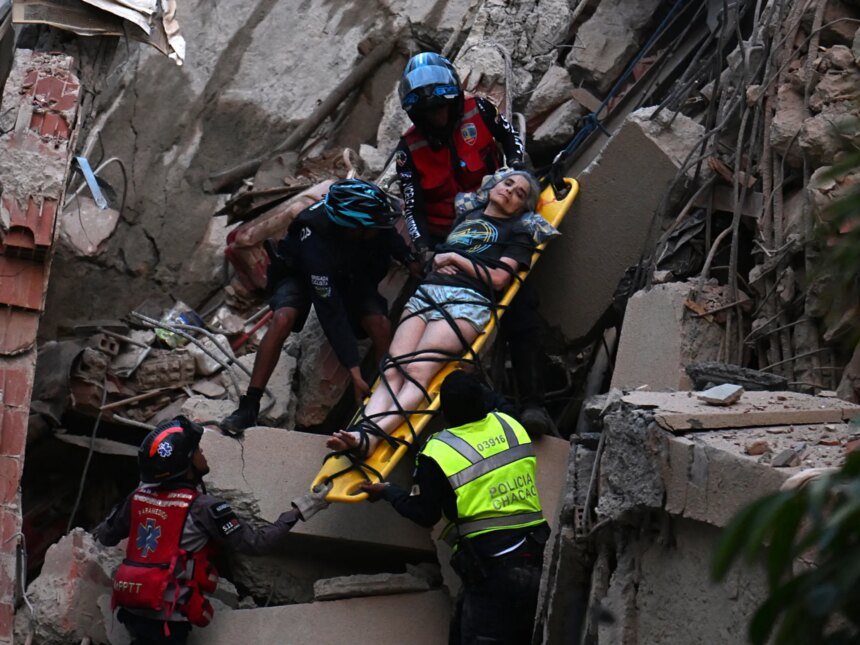
Venezuela declared a state of emergency after two strong earthquakes struck the country on Wednesday evening, killing at least 32 people and injuring more than 700 others, amid search and rescue operations in Caracas and other areas.
As the search continues under the rubble, the authorities are still verifying the extent of the damage, especially in the state of La Guaira, near the capital, while the US Geological Survey warns of the possibility of the toll rising due to the nature of the buildings in the affected areas.
So what happened in Venezuela? Where were the epicenters of the two earthquakes? Why do the authorities fear expanding losses?

What happened in Venezuela?
Two strong earthquakes struck Venezuela on Wednesday evening, around 6:04 pm (22:04 GMT), while the country was marking a national holiday to commemorate the Battle of Carabobo in 1821, which paved the way for Venezuelan independence from Spain.
The two earthquakes resulted in the collapse of a number of buildings and extensive damage, especially in the capital, Caracas, and prompted the authorities to declare a state of emergency and close the international airport serving the capital.
Acting President Delcy Rodriguez declared a state of emergency in a televised speech, describing the situation as an incident with serious repercussions, stressing that priority is currently being given to rescue operations. She called on doctors, nurses and other health workers to immediately go to hospitals and clinics to help treat the injured.
The most severe damage was recorded in Caracas, specifically in the Altamira neighborhood, where emergency teams recovered survivors from under the rubble of a 22-story building, while relatives were searching for their missing persons.

How many victims were killed in the two earthquakes in Venezuela?
Rodriguez announced that at least 32 people were killed and more than 700 others were injured in the two earthquakes, which were followed by about 20 aftershocks. She indicated in her speech that she did not yet have data on the state of La Guaira, which is close to the capital, and which she said was the most affected.
The authorities have not yet published a breakdown of the victims according to age, gender or location, and officials said that the numbers are expected to rise as search and rescue operations continue.
The US Geological Survey warned that the death toll could rise significantly, because many buildings in the affected area are made of unreinforced brick and mud brick, which are very fragile materials in strong earthquakes.
In a preliminary statistical model used to support emergency response plans, the authority estimated the probability of high death scenarios, but stressed that this is not a certain outcome: a 39% probability that deaths will range between 1,000 and 10,000, and a 37% probability that they will range between 10,000 and 100,000.

Where were the epicenters of the two earthquakes?
The epicenters of both earthquakes occurred in Yaracuy state, west of Caracas, according to the US Geological Survey. The first, with a magnitude of 7.2, was at a depth of 22 kilometers (14 miles), at 22:04 GMT, followed less than a minute later by a larger earthquake with a magnitude of 7.5 at a depth of about 10 kilometers (6 miles).
Although both centers were outside the capital, tremors were felt across Caracas and much of central and western Venezuela, including the states of Carabobo, Miranda, La Guaira, and Trujillo.
Tremors were also recorded in neighboring Colombia, and the Amazon region in Brazil reached more than 1,700 kilometers (1,050 miles) from Caracas.
How big are the damages?
The two earthquakes caused extensive damage in several regions, especially Caracas, La Guaira, and the central and western regions of the country, as buildings collapsed, infrastructure was damaged, and residents took to the streets in a state of panic. In the Altamira neighborhood, a 22-storey building was seen completely destroyed, while residents were calling out the names of their relatives, and volunteers climbed piles of rubble to help search for those trapped.
The government closed the capital’s international airport due to the damage, suspended classes for several days, and suspended railway services. Interior Minister Diosdado Cabello called on residents to leave their homes, and said that the authorities had cut off gas supplies to many buildings as a precautionary measure, confirming that there had been casualties without providing a specific number.
Power outages were also recorded inside the capital, as the remains of shattered glass covered a number of streets.
Search and rescue operations continued in the most affected areas while the authorities continued to assess the extent of the destruction, and experts warned of the possibility of strong aftershocks in the coming days.
Why did the earthquake hit Venezuela?
Venezuela is located along the border between the Caribbean and South American tectonic plates. The US Geological Survey said that the largest of Wednesday’s earthquakes was caused by a shallow strike-slip fault near the boundaries of the two plates, which is a type of earthquake that occurs when two blocks of the Earth’s crust slide horizontally, one side by side with the other, releasing energy that generates seismic waves.
The authority added that earthquakes of this magnitude involve movement across a wide section of the fault, not at one point. The country has witnessed devastating earthquakes throughout its history.
According to the US Geological Survey, about 30,000 people were killed in 1812 when a powerful earthquake destroyed the cities of Mérida and Caracas.
More recently, a major earthquake struck Caracas in 1967, causing several high-rise buildings to collapse and killing about 240 people, many of them in the capital’s central neighborhoods.

How did the world react?
Governments across the Americas and the world have expressed their solidarity with Venezuela, while other countries have declared their willingness to send humanitarian aid.
US: President Donald Trump said on Truth Social that the two earthquakes “caused a horrific number of deaths,” adding that the United States was “ready, willing and able to help,” and that he had instructed all government agencies to prepare to act quickly.
Secretary of State Marco Rubio announced that Washington would “immediately send” search and ambulance teams, medical resources, and humanitarian aid to Venezuela, saying on the X platform: “America stands with the Venezuelan people in this ordeal.”
China: Beijing announced its readiness to provide whatever assistance it can to Venezuela, according to the needs of the Venezuelan side. Chinese Foreign Ministry spokesman Gu Jiaqun said that there are, so far, no reports of casualties among Chinese citizens.
El Salvador: President Nayib Bukele said that his country is preparing to send 300 paramedics and other rescue personnel, in addition to 50 tons of medical supplies and emergency equipment.
Ecuador and Panama: The two governments announced the provision of humanitarian aid, and Ecuadorian President Daniel Noboa said that humanitarian considerations should advance despite political differences.
India and Chile: Indian Prime Minister Narendra Modi expressed his deep sorrow over the devastation, stressing that India “stands ready to provide all possible assistance.” Chilean President José Antonio Cast said that his country is placing itself at the disposal of the Venezuelan government to coordinate sending aid, adding that “Chile and Venezuela are united in facing this tragedy.”
Italy: It declared its full solidarity with Venezuela, and said that it would ask the European Union to activate the “civil protection mechanism” to coordinate and finance emergency intervention operations, stressing that the Crisis Unit in its Foreign Ministry and the staff of its embassy in Caracas are working to ensure the safety of its citizens.
Mexico and Brazil: The two countries expressed their solidarity and said they were closely monitoring the situation, adding that there were no immediate reports of any of their citizens being harmed.