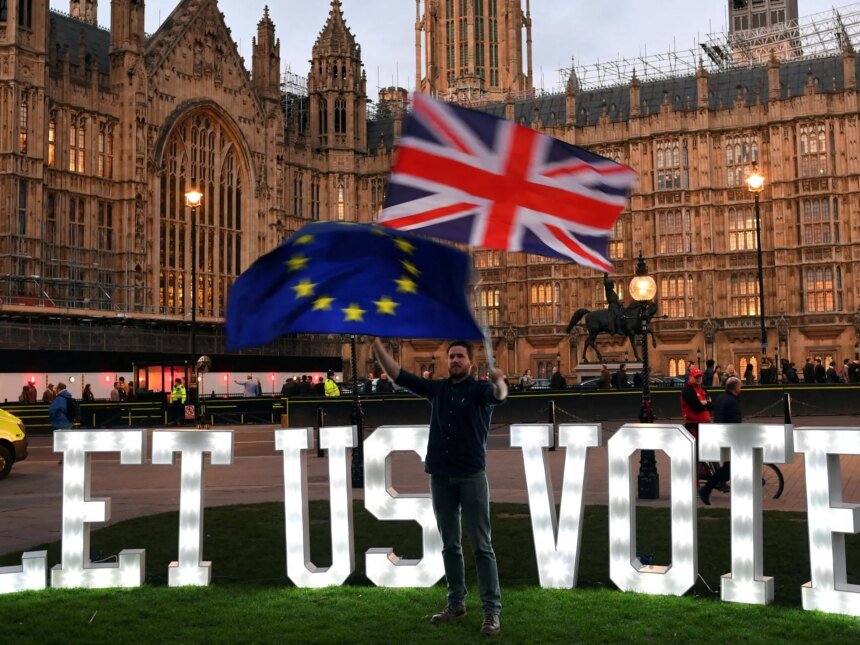
Keir Starmer’s resignation came on June 22, 2026, on the eve of the tenth anniversary of the referendum that took Britain out of the European Union, adding a new name to a long list of prime ministers who were consumed more by a chronic economic crisis than by political differences. Since the 2016 referendum, six prime ministers have succeeded in managing the British economy, but none of them has been able to return the economy to the path it was on before Brexit.
After a full decade has passed, the question is no longer whether leaving the European Union has caused damage to the British economy, but rather what is the extent of this damage and how did it move from markets and companies to public finances and living standards.
Today’s accumulated economic evidence indicates that the impact of Brexit has been a gradual and continuous erosion of investment, trade, productivity and output, which has made the British economy permanently smaller compared to the path it would have taken if it had remained within the European Union.
The size of the loss
A November 2025 paper from the US National Bureau of Economic Research (NBER), by Nicholas Bloom of Stanford University, Philipp Bunn of the Bank of England, Paul Mizen of King’s College London, Pavel Shmetanka of the German Bundesbank, and Gregory Thwaites of the University of Nottingham, is one of the most comprehensive studies to date of the impact of Brexit.

The study concluded that Britain’s exit from the European Union reduced British GDP by the end of 2025 by between 6% and 8%, and led to a decline in corporate investments between 12% and 18%, and reduced productivity and employment by about 3% to 4%.
These results are of particular importance because the researchers reached them through two independent approaches. The first compares Britain’s performance with 33 advanced economies that faced the same global shocks during the same period, and the second is based on data from more than 7,000 companies in the Bank of England’s “Decision Makers Panel” survey.
Although some official institutions adopt more conservative estimates, the difference between the various studies is not related to the presence or absence of the loss, but only to its size. The British Budget Responsibility Authority expects a long-term decline in productivity of about 4% and a decline in trade intensity of 15%, while some academic studies indicate greater damage. But the common result is that the British economy is substantially smaller than it could have been.
These numbers carry meanings that go beyond the statistical aspect. An economy shrinking in size by between 4% and 8% means losing tens of billions of pounds in annual output, and it also means a weaker tax base and less ability to finance public services and government investments in the future.
How did that happen?
The importance of these results is that they not only measure loss, but also explain the mechanism of its occurrence.
According to the study, uncertainty was the most influential factor. The continuing uncertainty about the future of the trade relationship with Britain’s largest market has prompted thousands of companies to postpone investment decisions or cancel them completely. Weaker demand forecasts also limited hiring and capital spending.

At the same time, productivity within companies declined as spending on technology, innovation and expansion declined, and part of administrative resources shifted to dealing with new regulatory procedures and customs and trade compliance requirements that did not exist before Brexit.
Brexit has also increased trade frictions even in the absence of direct tariffs. New customs declarations, rules of origin, and regulatory compliance requirements have raised the cost of doing business for a large number of companies, especially small and medium-sized ones.
At the level of the economy as a whole, the most productive companies and those most integrated in international trade were the most vulnerable to losses resulting from the new barriers, which led to a decline in the efficiency of resource allocation across the entire British economy. The study confirms that these costs did not appear in the form of a single severe crisis, but rather accumulated year after year, which made it easy to downplay their importance at the time despite the breadth of their cumulative impact.
Investment and trade…the two most affected channels
Official data show that investment was the biggest victim of Brexit. After moving in parallel with similar advanced economies before 2016, British investment began to lose momentum continuously after the referendum, until the gap widened to between 12% and 18%.
Declining investment is one of the most serious economic repercussions because it affects the future productive capacity of the economy. New factories, production lines, technology, and research and development all depend on long-term investment decisions that have become more cautious over the past decade.
As for trade, it was affected by the emergence of new regulatory and customs barriers that raised the cost of transporting goods and services between Britain and the European continent. The UK’s Budget Responsibility Authority assumes that trade intensity fell by about 15% as a result of these new frictions.
These developments are directly reflected in living standards. A smaller economy means slower real wage growth, less investment, weaker government revenues, and greater pressure on public services. Estimates by the Center for Economic Policy Research and the Britain in a Changing Europe Foundation indicate that the past decade was characterized by weak wage and productivity growth, phenomena that are difficult to separate from the impact of Brexit.
The City of London… loss and repositioning
The effects of Brexit appear more complex in the financial services sector, the largest export sector in the British economy.

New Financial documented the move of more than 440 financial companies to European Union countries after the referendum, with more than 900 billion pounds (about 1.2 trillion dollars) of banking assets and more than 100 billion pounds (about 132 billion dollars) of insurance and asset management assets being transferred to centers such as Dublin, Paris, Luxembourg, Frankfurt and Amsterdam.
Ernst & Young estimates the volume of transferred assets at about one trillion pounds sterling (about 1.32 trillion dollars), while estimates by the City of London Corporation indicate that about 40,000 financial jobs will move to the European continent.
But the picture is not one-sided. The City of London has maintained its position as a global financial center thanks to the depth of its financial markets, the flexibility of its legal system, and its network of professional services. According to Reuters, the number of employees in the city has increased by about 25% since 2019, reaching 676,000 employees.
Major global financial institutions have also expanded their operations in Britain, and London has continued to attract huge international investments, while financial technology companies have become one of the new growth engines within the sector.
These data indicate that Brexit did not lead to the collapse of the City of London as some feared, but it imposed a permanent redistribution of part of the activities related to the European market, which reduced some of the advantages that Britain enjoyed before exit.
A financial bill is piling up
The most direct impact is seen in public finances. According to calculations prepared by the Library of the British House of Commons for the Liberal Democrats, applying the tax-to-GDP ratio of 34.7% to the estimated output gap indicates a loss of tax revenues ranging between 65 and 90 billion pounds sterling annually (about 85.5 and 118.4 billion dollars).

This amount, according to the same calculations, is equivalent to about 250 million pounds per day (about 330 million dollars) in lost revenues compared to the economic path that could have been achieved in the absence of Brexit.
These numbers gain particular importance in light of the increasing pressure on public spending, whether in the health, infrastructure, defense, or family support sectors. Every decline in domestic product is directly reflected in the state’s ability to collect taxes and finance its obligations.
The British Institute for Government also describes the last decade as having included “more than a trillion pounds of missed opportunities,” referring to the accumulated gap between the actual performance and potential performance of the economy.
What do Brexit advocates say?
Some economists still reject this assessment. Patrick Minford, professor of applied economics at Cardiff University and one of the most prominent Brexit supporters, is one of the most prominent voices that believe that the gains have not yet been seen.
Minford, based on research he published with Yongding Zhu in 2024, argues that European deregulation and unilateral trade openness could raise British GDP in the long run by up to 6.8%.
Supporters of this proposal believe that the potential gains of Brexit need a longer period of time to fully appear, and that Britain is still in the stage of restructuring its commercial and regulatory relations with the world.
However, this opinion remains a minority within academic circles. The Center for Economic Performance at the London School of Economics believes that these models overestimate the gains of trade liberalization and underestimate the losses associated with the decline in services trade and the loss of regulatory privileges that British financial institutions enjoyed within the European single market.
Smaller economy and narrower options
Ten years after the referendum, the economic picture appears clearer than ever. The global financial crisis, austerity policies, the Corona pandemic, and the energy shock in 2022 all contributed to weakening the British economy. But evidence collected by academic studies and official institutions indicates that Brexit added an independent and continuing burden on top of those shocks.

Between the Authority for Budget Responsibility’s estimate of 4% of GDP and the National Bureau of Economic Research’s estimate of 8%, a picture emerges of an economy that has permanently lost part of its size. In a slowly growing economy, public resources become scarcer, improving living standards becomes more difficult, and the options available to successive governments diminish.
Over the past decade, these economic restrictions have gradually become a constant factor in the British political scene, with successive prime ministers continuing to manage an economy that no longer resembles the one that preceded the 2016 referendum, which explains why the repercussions of Brexit remained present at the heart of the British economic debate even ten years after the decision was taken.