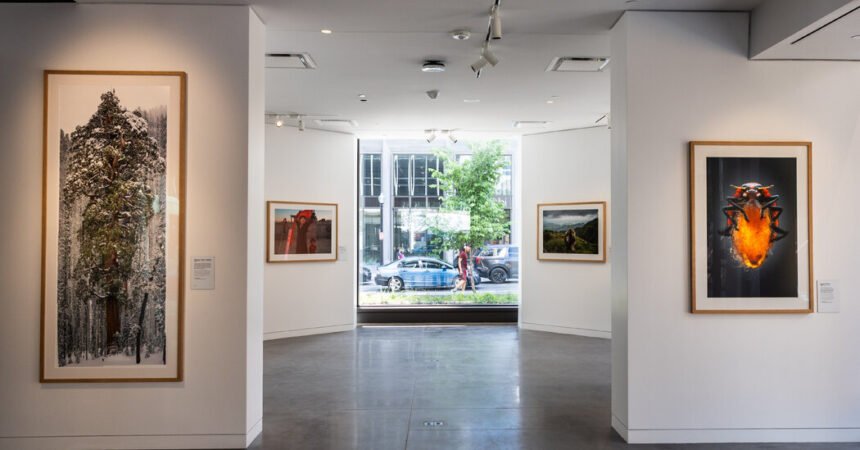
The National Geographic Museum of Exploration opens on Friday, offering more than 100,000 square feet of immersive exhibits and attractions in a $300 million complex occupying most of a city block in downtown Washington, D.C.
At the core of the new space will be the visual storytelling that has been synonymous with National Geographic magazine for more than a century. One exhibition, for instance, features the photographer Joel Sartore’s intimate portraits of wildlife. Another, called “Red, White and Blue,” explores American history and culture through photographs that emphasize the colors of the U.S. flag.
But many visitors are likely to be drawn to a large room just off the lobby that serves as a permanent showcase for some of the most notable photographs that the magazine has published over the decades. (The magazine was founded in 1888, though early issues did not have photography.)
“We all are just a vessel that brings information,” said John Stanmeyer, one of the photographers whose work is on display. “I do it writing with light,” he added, “which is what photography is — Greek for writing with light. I write with images.”
Here are some notable images on display at the museum, as seen through the eyes of the photographers behind them.
Jodi Cobb’s Geishas
Jodi Cobb was on assignment in Japan to photograph geishas — highly trained, reclusive women who entertain the elite — for “A Day in the Life of Japan,” a book that came out in 1985.
“I went to the geisha house, and I photographed her getting ready for her evening’s performances,” Cobb recalled. “And she stepped out from behind her makeup table, and a shaft of light came in through the window of the house and hit her face in just a very incredible way. And it just illuminated her in a way that just sort of stunned me. And then it was gone. I was able to make a few frames.”
The photograph led to a grant from Kodak, which allowed Cobb to spend three years documenting the lives of geishas for a project that was eventually acquired by National Geographic.
The Museums Special Section
Steve McCurry and ‘the Afghan Girl’
In June 1985, National Geographic’s cover was a haunting portrait of a young Afghan refugee with piercing green eyes. It would become one of the most famous photographs in the magazine’s history.
Sharbat Gula was thought to be 12 when the portrait was taken, but her name would not become widely known until 2002, when the photographer Steve McCurry found her in the mountains of Afghanistan. Until then, she was mostly known as “the Afghan Girl.” It was the first time she had her picture taken.
“People still respond to it — it’s still a powerful portrait, and it speaks to refugees,” McCurry said. “It speaks to women in Afghanistan, that struggle back in the 1980s when Afghans were fighting for virtually their very existence.”
But the photograph had its critics, some of whom accused McCurry and National Geographic of exploiting Gula, and of not learning her name in the first place.
In 2022, Gula told an Italian news outlet, Il Venerdì, “That photo created a lot of problems for me.”
Gula was evacuated to Italy after Afghanistan fell to the Taliban in 2021. In a 2023 documentary about McCurry, she said: “At the beginning, I hated the photo and the attention. Now I am very happy. The picture earned me respect and made me very popular. The income from the photo has helped widows and orphans and helpless people.”
McCurry said he had kept in touch with Gula and her family. He also said he and National Geographic had supported her financially and assisted with evacuating her and her family from Afghanistan.
Recalling the moment he took Gula’s photo, McCurry said, “I knew immediately that this was a powerful situation and that her look, her face, was something powerful.”
Ami Vitale and a Last-of-Its-Kind Rhinoceros
Ami Vitale captured the final moments of Sudan, the last male northern white rhinoceros, on March 19, 2018.
Vitale first met Sudan in 1999, when he was being moved to Kenya from a zoo in the Czech Republic. At the time, this species of rhino was close to extinct. The zoo and conservation groups were mounting a desperate bid to save Sudan’s species by giving him more room to roam and a favorable environment for breeding.
“You look at them, and you understand they’ve been on the planet way longer than us as a species,” Vitale said. “They’re just prehistoric. I felt like I was standing in front of a dinosaur who was just hulking and enormous, and then unexpectedly gentle.”
When Vitale learned that Sudan, then 45, was dying at the Ol Pejeta Conservancy in Kenya, she flew there to document him one last time. She captured Joseph Wachira, one of Sudan’s caregivers, crouching at his side, their foreheads touching.
“That image is so powerful because it represents the heartbreak of what humanity has done,” Vitale said. “But at the same time, I think it’s so important to shed some light on the people who are devoted to protecting these creatures.”
Vitale said what she remembered most about taking the photograph was the silence.
“It was almost like the whole world was mourning this moment,” she said.
John Stanmeyer’s Djibouti Signal Photo
Stanmeyer took this photograph as part of National Geographic’s Out of Eden Walk, a project that the journalist Paul Salopek started in 2013 with the goal of tracking global human migration by walking across multiple continents.
Early on, Stanmeyer and a translator were in the capital of Djibouti when they came across a group of migrants holding their cellphones aloft on a moonlit beach, trying to catch a signal from neighboring Somalia. The scene struck him as a perfect encapsulation of the project.
“I’m like, ‘Oh my god, this is the Out of Eden Walk,’” Stanmeyer recalled. “This is us. It’s just, we have technology now to communicate to those we know instead of meandering totally alone across the landscape that is collectively our home. The technology is allowing us in the act of migration no different than 50, 60, 70,000 years ago.”
Evgenia Arbugaeva’s Haulout
Evgenia Arbugaeva and her brother, Maxim Arbugaev, captured a phenomenon called haulout — the forced migration of walruses to land as a result of melting of ice floes — in the Russian Arctic, where she is from.
In 2019, while on a fellowship with National Geographic to document the Chukchi people, the duo came across a beach where the sand was dark and filled with the bones of walruses. Arbugaeva discovered that climate change had a profound effect on walrus migration. She returned to the beach later that summer to photograph hundreds of walruses that had come ashore. She snapped this image then.
“It’s probably one of the hardest things that I’ve ever experienced in my life,” Arbugaeva said. “Because when we were in this hut, I could only photograph from the door because we couldn’t come out, obviously. And not only do you see these beautiful animals up close, but you also see them suffering and dying.”
The Arbugaevs and Maxim Chakilev, a marine biologist, continued documenting the walruses and eventually made “Haulout” (2022), a short documentary that was nominated for an Oscar.