Published on 6/23/2026
|
Last update: 12:51 (Mecca time)
In the summer of 1776, the United States was not a unified nation but merely 13 British colonies scattered across the Atlantic Ocean, contesting local identities, currencies, and legislation, and united only by a growing sense of bitterness toward the British Crown, which treated them as “second-class subjects.”
Although the guns of the revolution had begun to burn 14 months ago in the battles of Lexington and Concord, the idea of complete separation from the motherland was not unanimous.
Read also
list of 2 itemsend of list
While the “patriots” were pushing for salvation, the “loyalists” (who constituted 20% of the population) were hoping for a possible peace, which made the declaration born from the womb of a fierce confrontation that was historically considered the “first civil war” waged by America, whose seeds sprouted in violence and division.

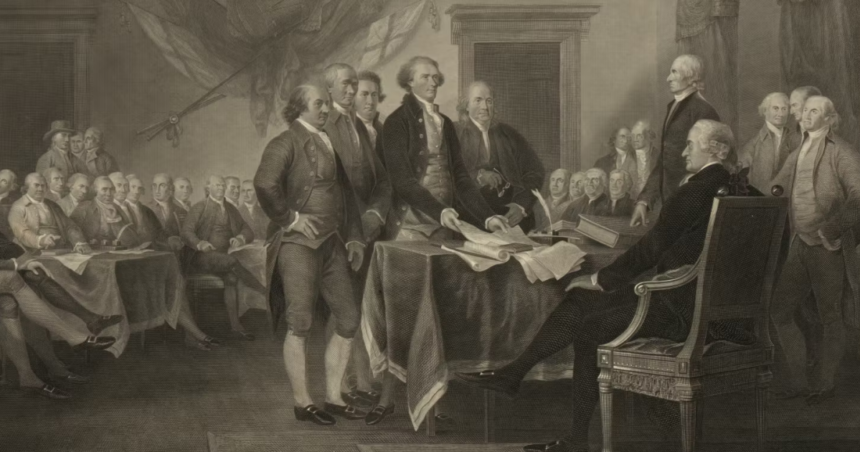
In the midst of this political and military controversy, the young Virginian lawyer Thomas Jefferson (33 years old) was tasked with drafting a text justifying separation from Britain and explaining its reasons to the world.
Jefferson wrote the draft quickly, drawing inspiration from the Enlightenment and the Declarations of Native Rights, emphasizing that he did not seek to invent new ideas so much as to express “the American mind” or “the American state of mind” as it was crystallizing at the time.
However, the text that would later become the founding document of the United States did not come to light in its first form, but rather was subjected to a storm of amendments from members of the drafting committee and within the corridors of Congress.
It was an unambiguous text, confirming the decision of the United Colonies to become “free and independent” nations, separate from “all allegiance to the British Crown,” in other words, to separate from the mother country.
Congress discussed this document clause by clause, and dozens of amendments were made to it, numbering 86, while about a quarter of its original content was deleted.

After political struggle and exciting parliamentary scenes that included a race against time to save the swinging votes, the amended document was approved and printed, later turning into a spark that changed global political thought.
Congress voted on independence on July 2, and the final version of the declaration was approved on July 4, 1776. Since then, this text has become a global symbol of the idea of freedom and the right of peoples to self-determination, and has contributed to inspiring political movements and revolutions around the world.
The following are the most prominent scenes and exciting circumstances that accompanied the writing and approval of this historical text:
First, the stark irony of slavery
While Thomas Jefferson sat behind his wooden desk writing the words that would become a universal icon of freedom: “We hold these truths to be self-evident, that all men are created equal,” he was served in the same room behind his back by his young slave, 19-year-old Robert Hemings.
It can be said that this text, which declared the freedom of a nation, was written in an environment in which slavery was legal in all 13 colonies.
Second, writer’s frustration
Drafting the document was not a literary picnic; Congress and the committee dealt with the text with sharp political pragmatism. They truncated and deleted a quarter of the original text (25%) and made 86 amendments to it.
This dissection caused Jefferson great frustration and bitterness that accompanied him until his death, as he saw throughout his life that his peers in Parliament had “distorted and torn” his eloquent text, so that the calligrapher who copied the document did not respect his own way of writing the terms.

Third, the lawyers’ trick
In the first draft, Jefferson wrote that individual rights were “sacred,” but Benjamin Franklin stepped in and crossed them out, replacing them with “self-evident.”
Historians believe that this change was an old lawyer’s trick to avoid debate. By declaring that equality was something “self-evident and indisputable,” the emerging states evaded the dilemma of the presence of half a million black slaves on their lands at the same moment of declaring freedom.
Fourth, the intense race for votes
The vote on independence was not unanimous at first, but was accompanied by parliamentary scenes that resembled thriller films. On July 1, indicators were pointing towards failure, but to save the situation:
One of the most prominent opponents, John Dickerson of Pennsylvania, was deliberately absent to allow his state to vote yes, and ailing Representative Cesar Rodney rode his horse on a crazy, rainy night trip from Delaware to be present at the last moments and overturn his state’s vote in favor of independence.
Fifth, the lack of consensus
New York’s position was not clear at first, so the word “unanimous” was missing from the initial preamble, but it joined on July 9 and the document is now titled: “Unanimous Declaration of the Thirteen United States of America.”
It can be said that this document, despite the tension that surrounded it, transcended the circumstances of its hasty writing and the disagreements of its makers, to become one of the most influential texts in modern history.