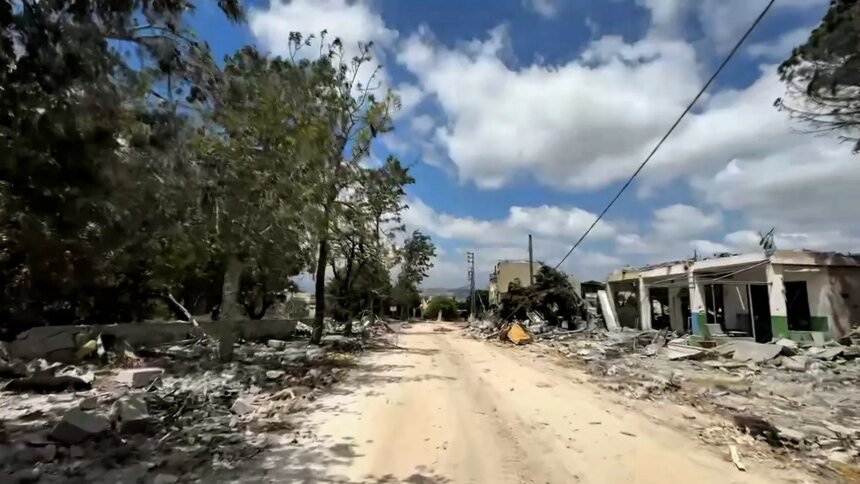
South Lebanon- Abu Saad stood at the entrance to the western town of Zawtar, leaning on his cane, which had become an extension of his exhausted body, as if he was using it to measure the distance between him and a memory that had never left him. A dark-skinned man, the sun etched layers of fatigue into his features, and wrinkles crept onto his face like a long map of successive wars and endless displacement. His face was calm, but in his eyes there was a trembling long wait, like someone returning to a place that he knew had changed but had not changed inside.
On the road leading to his town, there was nothing resembling the return he had imagined, no convoys of people, nor the noise of reassuring steps, but rather a heavy emptiness surrounding the place, and a danger rising in the sky, where the Israeli planes were never absent from the scene, like a shadow hanging over the ground and the people. The road seemed lonely, exposed as if it were a trap open to unsuspecting possibilities.
Abu Saad came from Sidon thinking that the moment to return had come, that the war might have eased, and that the road home had become less harsh, but before he took a single step towards his town, the air split with the sound of the march, sharp and sudden, as if it interrupted the intention before the step.

Painful return
Abu Saad said in a shaking voice to Al Jazeera Net: “I arrived at the entrance to Zawtar from the direction of Mifdoun, and the road was very dangerous. The drone came, diverted us from the road, and then threw a sound bomb.” Then he was silent for a moment, as if he were rearranging what remained of his certainty, before adding: “I did not come here from Sidon to go back. I am tired of displacement, and a person can only rest in his home.”
He continues, with his hand on his cane as if he were clinging to the last thing that connected him to the earth: “Whoever reaches seventy, what does he expect next? Life is over…but the earth and the house are still calling.”
Abu Saad had heard news of an Israeli withdrawal, so he decided to return immediately, as if he was seizing a last chance of survival. But he found a different path than he was told, the sky was not reassuring, and the town to which he belonged was still suspended between danger and waiting. However, he did not back down. The man, tired of small and great exiles, no longer saw returning as a risk, but rather a necessity similar to breathing, because he only rests – as he asserts – in his home.
In the far south of Lebanon, where the hills intersect with the course of the Litani River and geography maps are intertwined with lines of engagement, the eastern town of Zawtar stands out as one of the hottest spots since the start of the Israeli aggression on March 2.
A small town whose area does not exceed five square kilometers, but it found itself in the heart of a battle that extends beyond its narrow borders to a broader field landscape in southern Lebanon.

Strategic area
Since the first months of the escalation, Zawtar al-Sharqiya has been subjected to more than 90 air strikes, making it one of the most targeted towns. Despite its small area, its geographical location gave it double military weight, as it overlooks the line of villages adjacent to the Litani River and extends in the vicinity of Beaufort Castle, an area that has always constituted a strategic node in the history of confrontations in the south of the country.
Brigadier General Dr. Bahaa Hassan Halal told Al Jazeera Net that the importance of land in modern wars is not measured by its area, but rather by the ability to see, control, maneuver, and operational influence it gives.
He explained that the eastern region of Zawtar, and the related areas of western Zawtar, Yahmar Beaufort, Arnoun, Beaufort Castle, and Jebel Ali Al-Tahir, cannot be read as separate villages or hills, but rather as an interconnected terrain belt that forms an integrated field control system.

He added that the common mistake is to view these sites as independent points, while military thought deals with them as a geographic network that controls the axes of movement, positioning, and connectivity between sectors.
Zawtar al-Sharqiya derives its geo-strategic importance – according to Halal – from its location that connects the southern highlands to the basins of the Litani River and the internal road network, making it a transportation node between the highlands and open areas.
He pointed out that the region’s proximity to the Litani Basin gives it additional importance, not because the river constitutes an absolute barrier, but because it imposes relatively limited movement channels and crossing points, which is reflected in the distribution of force and options for deployment and maneuver.

“ruling land”
Regarding the field dimension, the Brigadier General explained that the region falls within the concept of “ruling territory,” that is, sites capable of monitoring the axes of movement, influencing the positioning, providing defensive depth, enhancing early warning, and reducing the opponent’s margin of maneuver.
He added that the interconnection between Zawtar al-Sharqiya, Zawtar al-Gharbiyya, Yahmar al-Shaqif, Arnoun, Qal’at al-Shaqif, and Jebel Ali al-Tahir makes the region closer to an overlapping geographical arc that controls the rhythm of movement in the sector, rather than to separate geographical points.
Halal stressed that controlling the “ruling land” does not necessarily mean resolving the war, explaining that modern armies do not always seek to occupy all of the land, but rather to dismantle the opponent’s geographical connectivity, open maneuvering corridors, disrupt areas of control, and reduce the effectiveness of defenses.
He linked the importance of the Al-Zawatir region to a number of military theories, most notably the theory of ruling territory, defense in depth, the theory of corridors and bottlenecks, and the concept of the “center of gravity” of the Prussian general and military researcher Carl von Clausewitz, in addition to the theory of maneuver versus attrition.
Despite talk of a relative decline in the number of Israeli vehicles deployed, the withdrawal is still incomplete, with the continued concentration of forces on the outskirts of these towns, keeping the lines of contact in a state of permanent and unresolved tension.
losses
Al Jazeera Net monitored – through private scenes – houses turned into rubble, and others that were severely damaged, while orchards bear witness to repeated waves of bombing. Inside the town, there are roads dug by raids, buildings that have lost their features, and residential areas that have turned into voids open to silence.
The United Nations Development Programme, in coordination with the National Council for Scientific Research in Lebanon, announced the results of a rapid assessment of damage to buildings in southern Lebanon, which includes the areas south of the Litani River, including the districts of Bint Jbeil, Marjayoun, Nabatieh, Tyre, and Sidon, in continuation of a previous assessment that included Beirut and Mount Lebanon.
The results showed the following:
- Total direct building damage is estimated at $1.38 billion.
- The resulting aggregate volume is estimated at 3.1 million cubic metres.
- The complete destruction of 11,095 buildings was recorded, affecting 17,000 housing units.
- 2,242 buildings were partially damaged (5,219 housing units).
- Slight damage was caused to 9,311 buildings (18,282 housing units).
The data shows that the villages and towns most affected in terms of the number of completely destroyed buildings are concentrated in:
- Bint Jbeil District: The towns of Ainatha with 1,658 buildings and Bint Jbeil with 1,076 buildings.
- Marjayoun District: The towns of Mays al-Jabal with 969 buildings and Taybeh with 824 buildings.
- Tire District: Borj Al-Shamali towns with 370 buildings and Naqoura with 216 buildings.