Published on 6/21/2026
Since the launch of the Space Age in the 1950s, scientists have been preoccupied with a problem known as “planetary protection,” that is, preventing the transfer of pollution between celestial bodies and Earth.
As humanity approaches carrying out more ambitious missions to return samples from the Moon, Mars, and perhaps from other worlds, new questions have begun to emerge that until recently belonged to science fiction literature: What if these samples carried an unknown form of life?

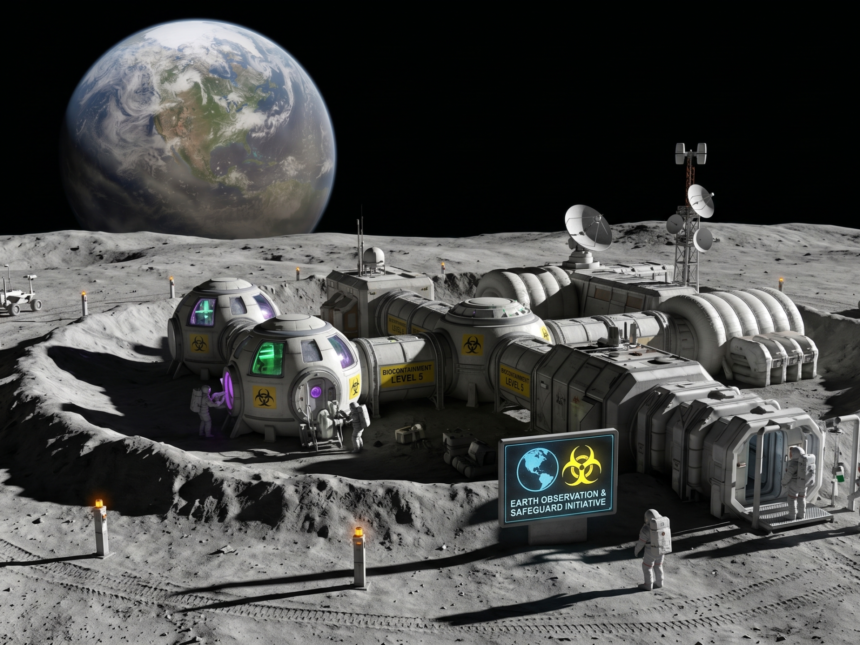
This question prompted researchers to put forward an unprecedented proposal in a study published in the journal Ambio, calling on the US space agency NASA to establish a biocontainment facility on the surface of the moon, whose mission would be to examine and isolate space samples before allowing them to be transported to Earth.
Read also
list of 2 itemsend of list
Researchers Frederick Moxley and Anthony Ricciardi confirm that the idea is not based on the existence of evidence of alien life, but rather on the principle of scientific caution and advance preparation for low-probability, high-impact risks.
An inspection station located 384 thousand kilometers from Earth
Scientists propose creating an advanced research and quarantine facility on the moon that would serve as an advanced inspection station for samples coming from deep space. Instead of transporting the samples directly to Earth, they are first sent to the lunar base, where they are subjected to a series of careful tests and analyses.
The facility will rely primarily on robotic systems to perform handling, inspection and containment operations, which will minimize human exposure to any materials or objects of unknown origin.

Researchers believe that the moon provides an ideal location for this purpose, as it forms a natural barrier that separates the Earth from any potential dangers, and if a pollution incident occurs within the facility, it will remain isolated away from terrestrial ecosystems, giving scientists enough time to understand the situation and take appropriate action.
“Humanity is entering a new era of space exploration, but our planetary protection strategies have not evolved as quickly as sample return missions to Earth,” Moxley says.
The moon is a “firewall” between Earth and space
The researchers liken the proposed facility to a firewall separating Earth from any microorganisms or biological materials that might accompany future missions.
“The facility will act as a firewall between Earth and any potentially dangerous organisms that may return with future space missions,” Moxley adds.
This idea is gaining increasing importance with the expansion of scientific programs aimed at searching for traces of ancient or current life on Mars and the moons of the giant planets. The greater the chances of finding biometric fingerprints, the greater the need for more sophisticated security systems.

The researchers point out that current ground facilities are capable of dealing with the most dangerous known pathogens, but they were designed to deal with life forms that belong to Earth’s biology, and potential organisms of alien origin may possess unknown characteristics that make risk assessment more complex.
Lessons from invasive species on Earth
The study was based on environmental science experiences to understand potential risks, as history is full of examples of living species that moved to new environments without predators or natural controls to limit their spread, which led to widespread changes in ecosystems.
Anthony Ricciardi, a specialist in biological invasions, confirms that these experiments provide an important lesson when thinking about the possibilities of space pollution.

“Decades of studies have shown that an organism that arrives in the wrong place at the wrong time can spread uncontrollably and leave long-term, perhaps irreversible, impacts on ecosystems,” he says.
Although the possibility of discovering tiny alien organisms is still uncertain, researchers believe that the scale of the potential consequences justifies taking advance precautionary measures instead of waiting for the problem to occur.
Between caution and exploration
Scientists do not call for fear of space exploration, but rather to develop tools that keep pace with humanity’s growing ambitions. Every new step towards Mars or distant worlds opens enormous doors of knowledge, but it also imposes the responsibility of protecting the Earth and other environments from any potential pollution.
Building a biocontainment facility on the moon may seem today an ambitious and perhaps far-fetched project, but it reflects an important shift in the way scientists think.
As the frontiers of human exploration expand, the question is no longer limited to what we will discover in the universe, but rather how we will protect our world as we seek to understand other worlds. Here the true value of science becomes clear. Not only in discovering the unknown, but in preparing for it wisely and responsibly.