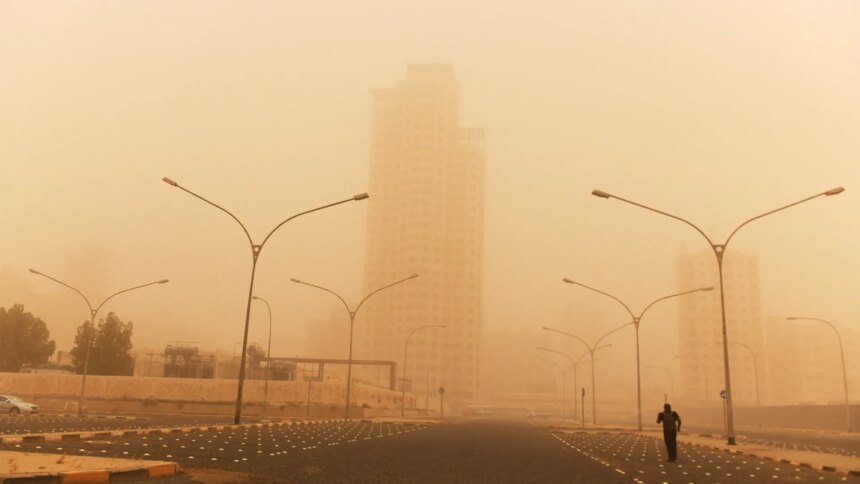
It seems that the repercussions of dust storms in the Middle East go beyond their local effects on the region’s weather, as a study published by the journal “Nature Communications” revealed that they have a stronger impact on the world’s weather than the “El Niño” phenomenon.
The world’s weather is controlled by what is called the “Indian Ocean Dipole”, which is the phenomenon that results from the fluctuation of sea surface temperatures between the western and eastern sides of the ocean. It was believed for a long time that the main driver of the fluctuations of this phenomenon was what is known as “El Niño and La Niña” in the Pacific Ocean, in addition to internal interactions between the atmosphere and the Indian Ocean itself.
El Niño is defined as “a period of abnormal warmth in the surface waters of the tropical (eastern and central) Pacific Ocean, which leads to a weakening of the trade winds, and usually causes drought in some areas.”
Conversely, La Niña is “an abnormal cooling of these waters, and occurs when trade winds intensify, pushing warm water westward, allowing cold water to rise to the surface, and often leads to the exact opposite effects of El Niño.”
Scientists used to see the Pacific Ocean and the Indian Ocean as two basins connected by an “air tube.” If the temperature rose in the Pacific Basin (El Niño), the atmospheric pressure would be disturbed and the clouds would tighten with it, which would automatically change the direction of the winds over the Indian Ocean and push it towards the warm westerly phase (the warmth is heading toward the coasts of Africa and the Middle East), and vice versa in the case of La Niña.
But the recent study prepared by a research team from Peking University in cooperation with the Scripps Institution of Oceanography at the University of California San Diego, and James Hansen, a prominent climate scientist at the Earth Institute at Columbia University, has created a scientific breakthrough by proving the limited effect of this “air bridge”, compared to what dust and suspended particles emanating from the Middle East region do, such as the Arabian Peninsula and the surrounding deserts, where they play a decisive and direct external role in directing and moving the “Indian Ocean Dipole” phenomenon that controls the world’s weather. This is a factor that was overlooked or not adequately estimated in previous climate models.

How did scientists prove the power of dust?
In their study, the researchers relied on an intelligent analysis mechanism, where they collected and audited satellite data and weather and ocean records extending over a period of 40 years (from 1980 to 2020), and then fed them into advanced computer climate models.
Through these simulations, digital analyzes showed that changes in dust activity in the Middle East from year to year are solely responsible for explaining 36% of the annual temperature fluctuations in the Indian Ocean. This huge number has proven to scientists that dust is not just a passing phenomenon, but rather is a major partner that controls a third of the ocean’s behavior.
To ensure that the dust was affecting itself and not driven by the famous “El Niño” phenomenon in the Pacific Ocean, the researchers used a complex mathematical mechanism to “separate and stabilize” the El Niño effect and completely remove it from weather equations.
The surprise was that, despite the absence of El Niño statistically, the link remained very strong, and it turned out that the lower the dust, the higher the temperature of the western Indian Ocean. They even discovered that by the fall, the time of peak climate activity, the effect of Middle Eastern dust completely overtakes the effect of El Niño, making dust the first and most powerful external driver of the weather system in the Indian Ocean during this season.

Climate protection shield
The study explained the precise physical mechanism that gives dust all this effect, as the researchers found that in a normal situation, when dust storms are intensely active over the Arabian Peninsula in the summer, the dust acts as an umbrella that reflects the sun’s rays and prevents them from reaching the surface of the water, which keeps the Arabian Sea (northwest Indian Ocean) cool.
The impact on the world’s weather begins when dust disappears. In years when the Middle East witnesses a decline in dust storms in the summer, the “umbrella” that was blocking the light disappears, and the sky becomes completely clear over the Arabian Sea (northwest Indian Ocean). The absence of this barrier allows strong sunlight to strike the surface of the water directly and intensely, leading to a rapid and sharp rise in water temperatures in the western Indian Ocean adjacent to Africa. This sudden temperature difference upsets the atmospheric balance, sending strong easterly trade winds across the equator. It pushes warm surface water away from the coasts of Indonesia and Australia and causes it to pile up in the west, while cold deep water rises in the east, a condition that causes terrifying autumn and winter, translating into massive floods in East Africa, severe drought and catastrophic forest fires in Australia and Indonesia.
These results lead to a global paradox. Dust storms, which are classified locally as a disturbing pollution factor, act as a “climate protection shield” that is extremely important for the stability of the planet. When Middle Eastern dust is active on its natural schedule and at its usual levels, it protects the world from extreme weather by acting as a “protective planetary umbrella” that prevents excessive warming of the ocean and curbs floods and droughts before they occur.
Dust… between influence and exaggeration
For her part, Rafaela Sotiropoulou, an assistant professor at the University of Western Macedonia and a specialist in atmospheric environmental management, praised the results of the study, as they shed light on a role that had not previously received sufficient attention for Middle Eastern dust in affecting the climate of the Indo-Pacific Oceans.
But she explained in statements to Al Jazeera Net that dust should be viewed as an “influencing external factor” or “modifying” the severity of the bipolar phenomenon in the Indian Ocean, and not as the only reason behind its emergence.
The researcher, who participated in previous studies on dust in the Middle East and North Africa, said, “Dust storms themselves are affected by large-scale climate systems, such as the El Niño phenomenon, monsoon winds, and atmospheric pressure patterns, which makes it difficult to fully separate the effect of dust from the effect of these other factors.”
She added that the study’s estimate that Middle East dust explains about 36% of the annual changes in the bipolar phenomenon is a strong indication of the importance of this factor, but it should not be considered a fixed number or an absolute truth, as it relies on climate models and monitoring data that inherently carry a degree of uncertainty.
She pointed out that current climate models still face challenges in representing the complex interactions between dust, clouds, solar radiation, and the atmosphere.
She stressed that the physical mechanism proposed by the study seems logical and compatible with the current understanding of climate science, as changes in dust concentration can affect the amount of solar energy reaching the ocean, and thus change wind patterns and water temperatures. However, she believes that confirming this effect definitively requires further experiments using independent climate models and broader comparisons with satellite data and long-term climate observations.
She concluded by saying that the real value of the study does not lie in replacing the role of the El Niño phenomenon or the natural interactions between the ocean and the atmosphere, but rather in showing that Middle Eastern dust represents an important additional factor that may contribute to improving scientists’ understanding of the dipole phenomenon in the Indian Ocean and enhancing the accuracy of future climate predictions.
A complex relationship
Dimitris Kaskaotis, a member of the atmospheric research team at the Institute for Environmental Research and Sustainable Development at the National Observatory of Athens, agrees with much of what Rafaela said in her comment on the study. He said in statements to Al Jazeera Net that “the relationship between dust and the dipole phenomenon in the Indian Ocean is complex and mutual. Changes in ocean water temperatures can affect the strength of the monsoon winds, while the monsoon winds in turn affect dust emission rates from the regions of southwest Asia and the Indian Thar Desert, so dust does not work in isolation.” It is distinct from the rest of the components of the climate system, but rather forms part of an interconnected network of interactions between the atmosphere and the oceans.”
Dimitris, who also participated in previous studies on the effects of dust, explained that it is scientifically plausible that Middle Eastern dust affects the dipole phenomenon and the strength of the summer monsoon by changing the radiative balance in the atmosphere and increasing heating over the Arabian Sea and the western Indian Ocean, which may later be reflected in rain patterns in India, but he expressed reservations about giving an accurate numerical estimate of the size of this effect, such as the percentage proposed by the study, which amounts to 36% of annual changes in the climate phenomenon.
He pointed out that the climate models and reanalysis databases used in such studies still involve a degree of uncertainty, and that the impact of other types of aerosols, such as smoke transported over long distances resulting from fires, may also participate in shaping the interactions between the atmosphere and the oceans, so he believes that understanding the true role of dust requires evaluating all of these factors together.