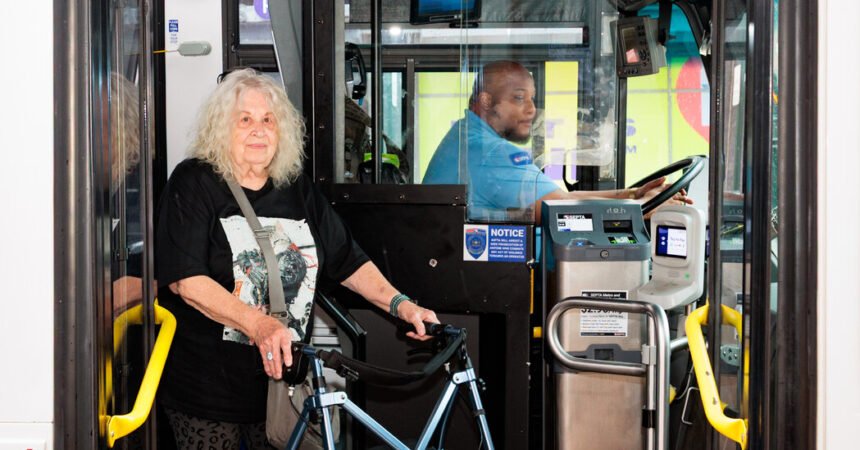
Judy Vassallo, an 89-year-old retired art teacher who lives on her own in a leafy neighborhood just north of Center City in Philadelphia, used to take her 2002 Honda CRV to the suburbs for a visit with friends, or downtown for doctor appointments and Pilates classes.
But since gasoline prices shot up after the United States and Israel attacked Iran in late February, she couldn’t stomach paying nearly twice as much to fill her tank. Instead, Ms. Vassallo started taking the city bus, which is free for seniors. She found that she liked it — saving on gas and parking tickets.
“Once it becomes a habit, it’s not an onerous thing, it’s built into the pattern of my behavior,” Ms. Vassallo said. “You’re going into the city, you’re going to take the bus. And I’m finding that it’s so much easier.”
Americans are powerfully attached to their cars, and their spending at gasoline stations jumped 21 percent from February to May. But that ability to spend has limits. According to Dow Jones Energy, consumption was 6.1 percent lower in May from a year earlier. Some of that is a long-running trend owing to the increasing efficiency of passenger vehicles, said Denton Cinquegrana, the company’s chief oil analyst, and about half is probably a consumer response to higher prices.
Much of that response comes from people forgoing discretionary driving, like road trips and grandchildren’s traveling sports games, particularly those with lower incomes. But in recent years, Americans have also gained greater ability to adapt, as more employers have allowed for telecommuting and more electric vehicles have arrived on the market.
“There’s more flexibility within working situations,” Mr. Cinquegrana said.
Despite the car-dependent nature of most American cities, sticker shock does make a difference: After the 1970s oil embargo, oil consumption per person in the United States fell, and didn’t return to the same level for another 20 years.
Some of those changes can last. The energy crisis gave rise to federal fuel-economy standards that spurred gas-saving innovations in vehicle design, keeping consumption lower than it might have otherwise been even as driving recovered.
Over the past decade, studies have shown that gasoline prices affect consumption both when they are going up and when they are going down. According to one 2021 paper, drivers have become more responsive to high prices over time, potentially because of energy price shocks that have prompted them to try different forms of transportation.
One option that has become more available lately is battery power. Some popular models, like Toyota’s RAV4 and Camry, are now available only with hybrid engines.
According to Cox Automotive, hybrids have been flying off dealer lots since the war started. And even though Congress truncated Biden-era incentives for fully electric vehicles, enough of them are coming off subsidized leases to supply a healthy used market.
“We’ve seen a change in consideration,” said Stephanie Valdez Streaty, director of industry insights at Cox. “People who need to buy a car, they’re looking online at these options that are more fuel efficient.”
One of those motivated buyers was Karin Ranta-Curran, a university administrator in Denver, who had decided to buy a third car because her youngest son started needing to drive himself around more. The family had considered getting an electric vehicle, but held off because of the expense of installing a home charger.
The war in the Middle East changed that.
“We woke up that morning and Israel started bombing Iran, and we thought, ‘OK, this might be the time,’” said Ms. Ranta Curran, who found a good deal on a used electric Lexus and now drives it to work.
She’s happy with the car and not having to pay for gas, even if geopolitical circumstances made it necessary. “We’re certainly not early adopters, so this was a bit of a forced decision in some ways.”
That is not an option for most people. Vehicle prices have climbed steeply since the pandemic, interest rates remain high, and low-income workers are under pressure as wage growth slows. That’s leading consumers to hold off on big-ticket purchases, counteracting what might otherwise be a faster replacement cycle toward cleaner cars.
Even bicycle sales have declined substantially from last year, according to the National Bicycle Dealers Association. It attributes the slowdown to an unsteady economy and tariffs that drove prices higher, although e-bike sales continue to grow.
Baylii Adams-Yates is among those who feel stuck. She attends college in Morgantown, W.Va., and works as a dental assistant. She owns a 2016 Jeep that gets about 13 miles to the gallon, and doesn’t think she could sell it for enough to buy a more efficient car. But having a car that’s so expensive to drive also means she can’t take jobs that are a little farther out of town, or make extra income by doing deliveries.
“I tried doing DoorDash for the week, and I drained my gas tank within a day, every day,” said Ms. Adams-Yates, 25. “I would love to be able to do that, but it’s not realistic.”
Other countries, particularly in Europe and Asia, are more affected by petroleum shortages than the United States has been. They also have access to affordable electric vehicles imported from China, and have taken more policy measures to reduce energy demand. The U.S. Energy Information Administration forecast last week that global oil consumption would decrease this year, rather than increase, as it originally had expected.
For many U.S. consumers, there’s no way to cut back on gas, and they just have to reduce spending in other ways.
Take Kjersten Oudman, who runs a farm with her husband outside Sioux Falls, S.D. They have no choice but to fill their tractors with diesel to plant in the spring, and no choice but to deliver boxes of vegetables to 130 farm share members once they’ve started harvesting, filling the pickup truck with gas about three times a week. Unlike big logistics companies, they can’t tack on a fuel surcharge; the subscriptions are paid at a fixed price.
“We’re going to have to eat it for the foreseeable future,” Ms. Oudman said. Shelling out an extra few hundred dollars a month means tightly budgeting on groceries, which she tries to keep to $80 a week for her family of five, and postponing investments in the business. They were hoping to insulate their wash-and-pack building to store vegetables for longer, but the extra fuel costs pushed the project off.
“We got about halfway done and were like, ‘Well, I guess we’ll have to wait now,’” Ms. Oudman said.
It’s not just gasoline. Oil heating is still common in some parts of the United States, and the cost has jumped far more than natural gas or electricity since the war started.
Jennifer Kewley moved in 2020 into the house her great-grandfather built in Milwaukee, and replaced the roof and the siding. But it still has an oil heater, and filling it up costs about double what it did before the war.
In March and April, she set the heat at 55 degrees and bundled up while working from home doing medical billing for a hospital system. She filled up the tank only halfway, for $600, and is hoping the price will drop by the time she needs the heat again in October. Over the long term, she’s thinking about how she might cobble together the money to replace the old boiler.
“I think that this is a situation that could happen again,” Ms. Kewley said. “I don’t think this is a one-off, where I could just go another 20 years like this.”
Whether oil and gas demand recovers also depends on the price of everything else, since consumers have to balance rising costs for food, utilities, insurance and other necessities.
Judith Awkerman already made one compromise, giving up the dream of moving into a nicer house once her children were through college because home prices have jumped around where she lives near Newport, R.I. She has also given up frequent visits to her two sisters, who live in other parts of the state. She’s not sure she’ll return to those longer drives, even if gas prices recede.
“I don’t think it’ll be like, ‘Yay, we can do whatever we want,’ because it’s cumulative with everything,” she said. “Car repairs, medical expenses, medications — it would take a whole system downgrade, where inflation is way down, which of course we won’t have for a while, I don’t think.”