After its soaring debut as a public company, SpaceX has been on a turbulent ride in recent days, as pent-up demand for the stock has waned, alongside broader questions about the exuberance underpinning the artificial intelligence industry.
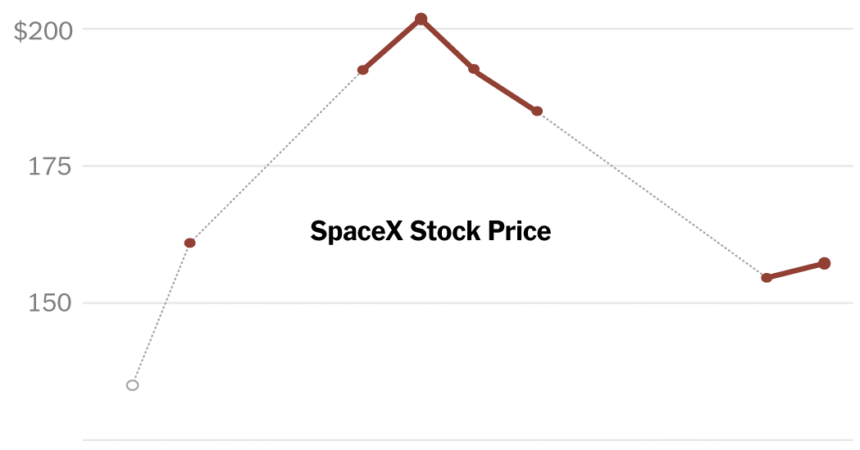
On Tuesday, SpaceX’s share price briefly fell below $150, which is where the stock first began trading when the company listed just over a week ago. The pressure on its stock price in early trading added to a sharp 16.4 percent drop on Monday after the company began pitching a bond sale to investors this week, borrowing more money just over a week after its blockbuster initial public offering.
The debt deal helped reignite concerns about the massive corporate spending spree taking place in both debt and equity markets to fund the build-out of artificial intelligence infrastructure, and whether such lofty expectations are realistic.
The stock closed on its first day of trading at $161 a share and rose to a high of $202 last Wednesday. But it has fallen each day since. The stock was up 2 percent to about $157 in midmorning trading on Tuesday.
Such volatility is not uncommon for newly listed companies. Ahead of the I.P.O., investors and analysts cautioned that SpaceX’s stock price would likely swing higher and lower in the days and weeks after its public listing. The company was met with such demand for a relatively small number of shares that were available to buy that the company’s value soared in its initial days of trading.
“What you have seen in the last couple of days is a bit of an unwind of some of these extreme positions,” said Philip Straehl, chief investment officer at Morningstar Wealth.
According to analysts at JPMorgan, the average newly listed stock rose 32 percent on its first day of trading, but over 12 months then fell to more than 20 percent below its initial offering price. When Meta went public in 2012, it fell roughly 30 percent in its first two weeks, but has risen almost every year since, recording astronomical gains for investors.
Investors who bought into the SpaceX I.P.O. at a price of $135 a share are still up on their investments. But others who piled into the stock in the days that followed its market debut have seen their gains evaporate.
SpaceX’s slump comes as other technology stocks are under intense pressure globally.
The South Korean Kospi index, which contains many of the country’s chipmakers, fell 10 percent overnight into Tuesday, though the index remains almost 100 percent higher this year. The Philadelphia Exchange Semiconductors Index, a benchmark for investors tracking the industry, fell roughly 6 percent but also remains almost twice its value from the beginning of the year.
“It’s hard to ignore some of the speculative elements that have driven market performance over the past two or three months,” said Mr. Straehl, adding that such volatility was “not necessarily surprising.”
Investors will also be paying close attention to Micron’s earnings tomorrow. The company manufacturers memory chips used in A.I. computing, with strong earnings likely to help soothe nervousness in the market.
“The investment boom is likely to extend, and near-term expectations of its scope may still need to rise,” said analysts at Goldman Sachs on Monday. “But with a lot of value already built in, markets are more vulnerable to news that challenges an optimistic view.”