On Sunday, June 21, the world will witness an annual astronomical phenomenon known as the summer solstice, when the sun reaches its northernmost altitude above what is known as the Tropic of Cancer before beginning its apparent journey south. This year, the solstice occurs at 11:24 a.m. Mecca time, that is, a full hour before the noon call to prayer in Mecca.
The importance of this date is not limited to being the beginning of summer astronomically and the longest day of the year for the inhabitants of the northern half of the Earth, but it is also linked to one of the greatest scientific stories in history.
Read also
list of 2 itemsend of list
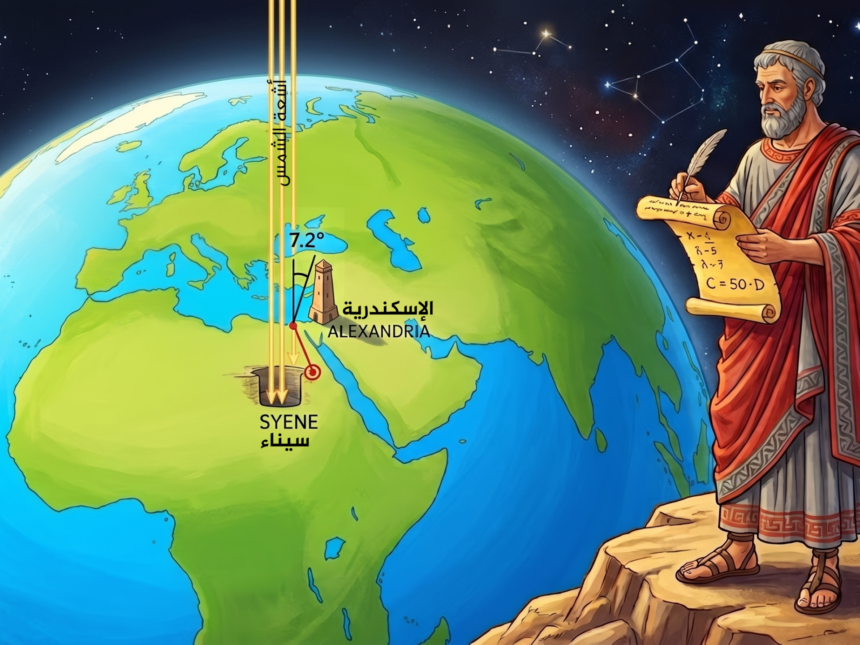
On this day more than two thousand years ago, Eratosthenes, a scientist, geographer and director of the ancient Library of Alexandria, took advantage of this phenomenon to achieve an achievement that seemed impossible in his time, which was to measure the Earth’s circumference with amazing accuracy using only the sun’s shadows.

Dr. Omar Fikry, former head of the Planetarium Department at the Library of Alexandria and Vice President of the Arab Planetarium Society, says that Eratosthenes caught his attention with what was mentioned in some papyri about the almost disappearance of shadows in Aswan on the day of the summer solstice, compared to their appearance in Alexandria.
After years of monitoring and measuring, he verified the sight of sunlight at the bottom of a well in Aswan at a time when the obelisks of Alexandria were casting clear shadows, and by comparing the angle of this shadow with the distance between the two cities, he was able to calculate the circumference of the Earth with amazing accuracy.
Fikri confirms that the genius of the experiment was not in its simple tools, but in the idea that turned an everyday observation into one of the greatest scientific achievements in history.
Astronomical geometry… How did the ancients embody the Earth’s tilt in their stones?
The scientific reason behind these amazing historical phenomena is due to the Earth’s axis being tilted from the plane of its orbit around the sun by about 23.5 degrees. If it were not for this precise tilt, the four seasons would not have existed on our planet, and the sun would not have risen in the summer to the north or set to the south in the winter.
This apparent movement of the sun across the seasons was not just a passing observation, but rather turned into a fundamental pillar for the emergence of archaeological astronomy among ancient civilizations that adapted architecture to match the movement of the universe.

In Britain, the famous Stonehenge building was lined up precisely with the sunrise on the summer solstice, while the Pharaohs in ancient Egypt built unique temples that interacted with this solar cycle. The most notable are the Karnak Temple, whose main axis is perpendicular to the sunrise of the winter solstice, and the Great Temple of Abu Simbel, which is penetrated by sunlight twice a year to illuminate the faces of statues deep in the mountain through the famous sun perpendicular phenomenon.
This computational creativity was not limited to the banks of the Nile, but extended to the Maya civilization in Mexico, which designed the Chichen Itza pyramid to reflect light shadows resembling a snake descending on the steps of the pyramid during the spring and autumn equinoxes.
Together, these buildings demonstrate historical genius. The ancients turned their temples into giant stone calendars to determine the planting seasons and organize their lives with extreme precision in harmony with the heart of the universe.
“In the footsteps of Eratosthenes”… an experience repeated every year
Eratosthenes’ experience did not remain confined to history books. Since the opening of the New Library of Alexandria in 2002, the Library Planetarium has begun organizing an annual event called “In the Footsteps of Eratosthenes,” which has been carried out regularly since 2003 until today.
Omar Fikri explains that the students are divided into small groups, and each group is provided with simple tools that include papers, pens, a protractor, a calculator, a water scale, and tools to install a measuring pole. Students then measure the length of the shadow and calculate its angle themselves, before comparing the results with the known distance between Alexandria and Aswan to arrive at an estimate of the Earth’s circumference.

At the same time, communication is being made with teams located in Aswan to ensure that the shadow has almost disappeared there, and the results are being exchanged with participants from Arab and foreign countries, turning the experiment into a global scientific celebration.
From the Library of Alexandria to schools in Qatar and Algeria
The experiment is no longer limited to Egypt. Many Arab scientific institutions and astronomy clubs have participated in repeating it over the past years, including events in Algeria, the Sultanate of Oman, Tunisia, and Libya.
In 2016, Qatar also witnessed a distinguished experience within the Qatar School Astronomy Olympiad, where hundreds of students participated in measuring the Earth’s circumference in conjunction with the sun’s perpendicularity over the city of Dar es Salaam in Tanzania, after calculating the distance between the two cities and comparing the results of the measurements, in a modern simulation of Eratosthenes’ idea using modern-day tools.
Omar Fikri says that the results are often surprisingly close to the true value of the Earth’s circumference, especially when averaging the results of all participating groups. Even when differences appear, they remain within the scientifically acceptable margin of error.

Omar Fikri believes that the true value of the experiment goes beyond simply calculating the Earth’s circumference. The most important goal is to teach students to think outside the box and realize that sciences are not separate subjects as they appear in textbooks.
Eratosthenes was not only an astronomer, but he was a geographer, poet, mathematician, and thinker with many interests. Indeed, many scholars of antiquity combined medicine, philosophy, mathematics, geography, and literature.
This is why Fikri calls on students to invest in what modern tools provide them with, such as the Internet, artificial intelligence, and free sources of knowledge, and not be satisfied with what the school curricula alone provides.
A small shadow and a big question
Perhaps the beauty of the story of Eratosthenes is that it reminds us that the greatest discoveries do not always begin with huge laboratories or complex satellites, but rather they may begin with the shadow of an obelisk and a well in a distant city and a question that its owner refuses to ignore.
More than two thousand years ago, a man looked at a small difference in shadows and was able to measure an entire planet. Today, thousands of students are still repeating the same experience in the era of satellites and GPS, only to discover that the essence of science has not changed, which is curiosity, observation, and the courage to question.
As Omar Fikri repeats, there are two overlapping circles: the circle of knowledge and the circle of ignorance. As the circle of knowledge expands, the boundaries of the unknown expand before us. Therefore, the passion for knowledge, research and exploration remains the greatest thing that a person can learn from the immortal experience of Eratosthenes.