Published On 3/6/2026
The US Space Agency (NASA) is moving toward a new phase of lunar exploration, not limited to sending astronauts on temporary visits, but rather aiming to establish a permanent human habitat on its surface by 2036.
The Artemis program is the cornerstone of this ambitious vision, as the coming years are expected to witness a series of successive missions, including testing lunar landers during the “Artemis-3” mission in 2027, then sending a human crew to the moon within the framework of “Artemis-4” in early 2028, before the “Artemis-5” mission arrives at the end of the same year to establish the nucleus of a permanent settlement near the south pole of the moon.

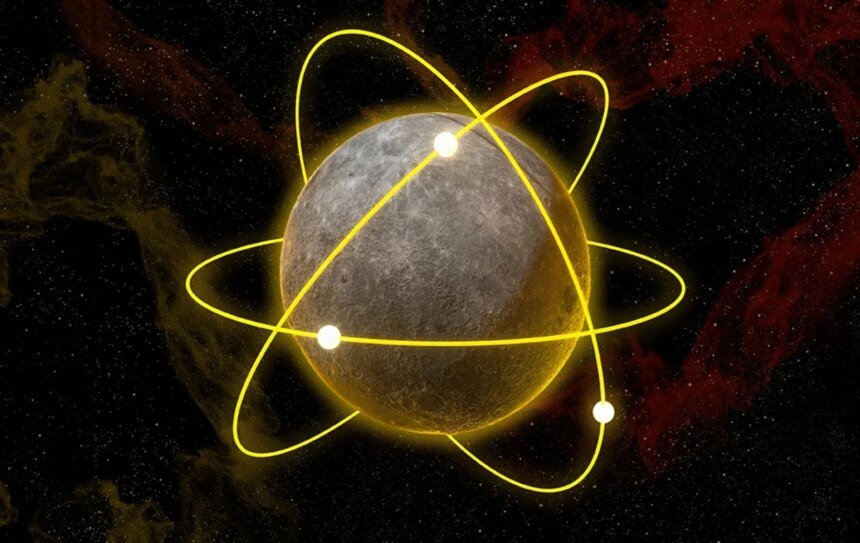
According to current plans, this base will not be just a scientific station, but rather a center for research and exploitation of natural resources, in addition to a future platform for launching manned missions to Mars. But achieving these goals requires a reliable source of energy that operates day and night, which makes nuclear energy the most realistic option.
Read also
list of 2 itemsend of list
Why is solar energy alone not enough?
Although most current spacecraft rely on solar panels, the harsh conditions on the Moon make this solution insufficient to operate a manned base in the long term. The Moon almost lacks an atmosphere to protect its surface or mitigate its temperature fluctuations, which leads to sharp changes in temperature between day and night.
During the lunar day, the temperature may rise to about 121 degrees Celsius, while at night it drops to about 133 degrees Celsius below zero. The base will need a continuous source of power to provide heating during the long lunar night, and help get rid of excess heat during the day.

The need for electricity increases if the base wants to extract water from the lunar soil, as this water will not only be used for drinking and irrigating crops, but will also be electrically broken down into hydrogen and oxygen gases to produce rocket fuel.
Current projections indicate that a typical lunar nuclear reactor would be roughly the size of a large car, but capable of generating enough energy to power an entire office building.
Unprecedented engineering challenges
Despite the attractiveness of the idea, its implementation faces complex technical obstacles. The nuclear reactor will be required to withstand extreme temperature fluctuations, abrasive lunar dust, micrometeorite impacts, in addition to lunar tremors and constant exposure to cosmic radiation.
The project also requires the development of special landing systems, advanced protection and radiation means, and electrical distribution networks capable of integrating the reactor into a permanent base. The issue of transporting nuclear fuel to the moon also arises, as it must be launched on board rockets, which raises safety concerns if an accident occurs during the launch or flight.
Engineers face the additional challenge of cooling the reactor in a vacuum environment. On Earth, reactors rely on air or water to help remove heat, while on the Moon, entirely new systems will have to be developed to radiate heat directly into space.
An international race toward lunar nuclear energy
Maintenance also represents an important challenge, as the lunar base is expected to include a limited number of astronauts, which means that the reactor must be highly reliable and able to operate for long periods with minimal human intervention and with limited availability of spare parts.

Some experts believe that designing, testing, certifying, launching, and operating an entirely new class of lunar reactors before 2030 represents a very ambitious timeline. However, Simon Middleburg, co-director of the Institute for the Future of Nuclear Energy at Bangor University, stresses that nuclear power is “the only way that can sustainably support a lunar base over the long term.”
These ambitions are not limited to the United States alone; China and Russia are also working on a joint project that aims to deploy a nuclear reactor on the moon by 2035.
Middleburg believes that the arrival of nuclear energy to the moon is only a matter of time, saying that the establishment of a nuclear reactor on the moon’s surface will be achieved sooner or later, whether by one country or through international cooperation, because it is a seemingly inevitable step in the future of space settlement.